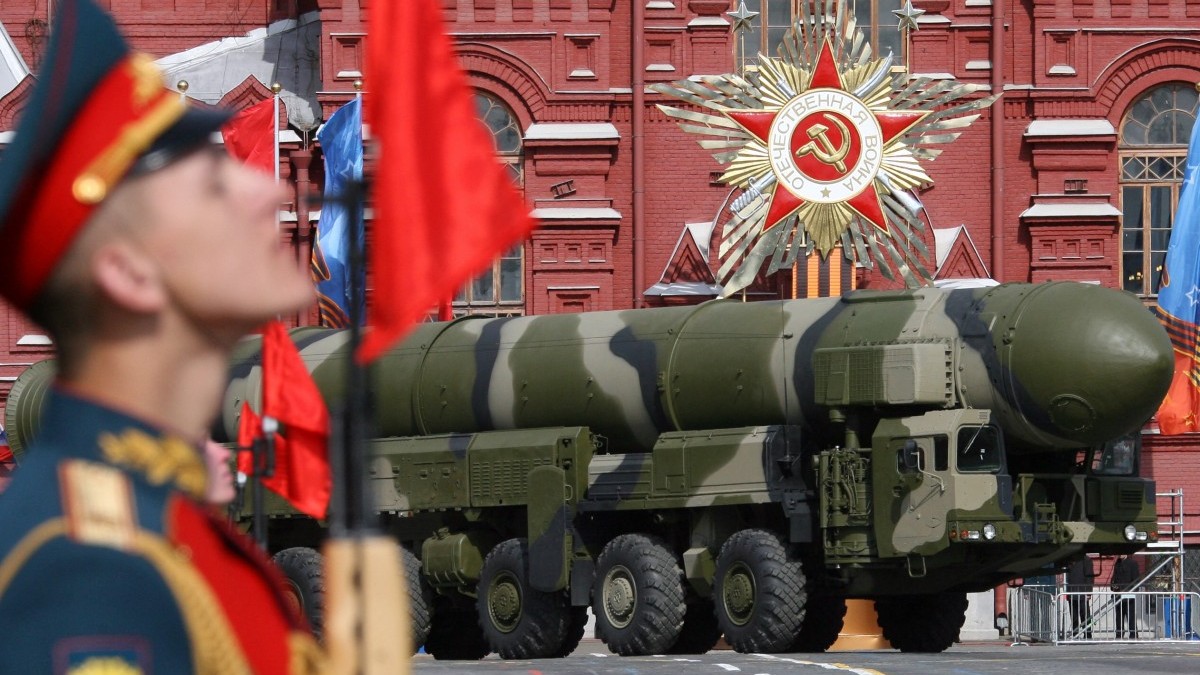
A Russian Topol-M ICBM drives across Red Square in a Victory Day Parade in Moscow on May 9, 2008.
YURI KADOBNOV / AFP
Just hours after the expiration of the New START Treaty, the Pentagon announced that the United States and Russia have agreed to re-establish high-level military-to-military dialogue, AFP reported on Thursday, February 5th.
“Maintaining dialogue between militaries is an important factor in global stability and peace, which can only be achieved through strength, and provides a means for increased transparency and de-escalation,” the U.S. military’s European Command said in a statement.
The agreement came after “productive and constructive progress” at Ukraine peace talks in Abu Dhabi attended by Trump’s special envoy Steve Witkoff and son-in-law Jared Kushner, European Command said.
The expiration of the New START treaty between the United States and Russia has raised global concerns over a potential new nuclear arms race, also because military dialogue between the two powers was suspended in 2021.
The treaty, signed in Prague in 2010, formally limited each side to 1,550 deployed strategic nuclear warheads, and also established transparency measures, including data transfers, notifications, and on-site inspections. Its end—effective Thursday, February 5th—releases Washington and Moscow from these binding restrictions.
UN Secretary-General António Guterres warned that the expiration marks a “grave moment for international peace and security.” He highlighted that New START and other arms control agreements had “drastically improved the security of all peoples” and urged the two nations to negotiate a successor framework without delay. According to Guterres, the risk of nuclear weapons use is now the highest it has been in decades.
The treaty, a successor to the original START agreement of 1991, played a crucial role in preventing uncontrolled nuclear buildup while ensuring transparency between the two largest nuclear powers.
Its lapse follows a broader pattern of declining arms control measures, including the Intermediate-Range Nuclear Forces Treaty, the Open Skies Treaty, and the Conventional Armed Forces in Europe Treaty. Experts—including Britain’s former Chief of the Defence Staff Admiral Sir Tony Radakin—have warned that the collapse of these frameworks threatens global stability and increases the prominence of nuclear weapons in international security.
NATO also expressed concern, urging “restraint and responsibility” in the nuclear domain. An official from the alliance noted that both Russia and China are rapidly expanding their arsenals, and NATO will continue to take necessary steps to maintain its own defenses.
Russia’s Dmitry Medvedev, who signed the New START treaty in 2010 during his presidency, warned that its expiration should “alarm everyone.”
The Russian Foreign Ministry on Wednesday, February 4th stated it intends to act “responsibly and in a balanced manner” despite the treaty’s end, remaining prepared to take military-technical measures to counter potential threats. Washington, meanwhile, has indicated that any future arms control agreements should include China, which has been steadily increasing its nuclear capabilities.
The Chinese foreign ministry said on Thursday that the expiration of the U.S.-Russia arms treaty was regrettable, and urged the U.S. to resume dialogue with Russia on “strategic stability.”
Germany’s foreign minister Johann Wadephul echoed this sentiment, emphasizing that China must be involved in any future negotiations. Russia has similarly suggested that European nuclear powers France and the UK should be included in subsequent agreements.
Both the United States and Russia are modernizing their nuclear forces, including new weapons systems such as Russia’s Poseidon and Burevestnik missiles, as well as U.S. plans for enhanced missile defenses. According to Darya Dolzikova, senior research fellow at RUSI, these developments complicate the prospects for a new arms control treaty.
Pope Leo XIV also cautioned against the risk of a “new arms race,” adding that the “current situation requires us to do everything possible to avert a new arms race, which further threatens peace between nations.”