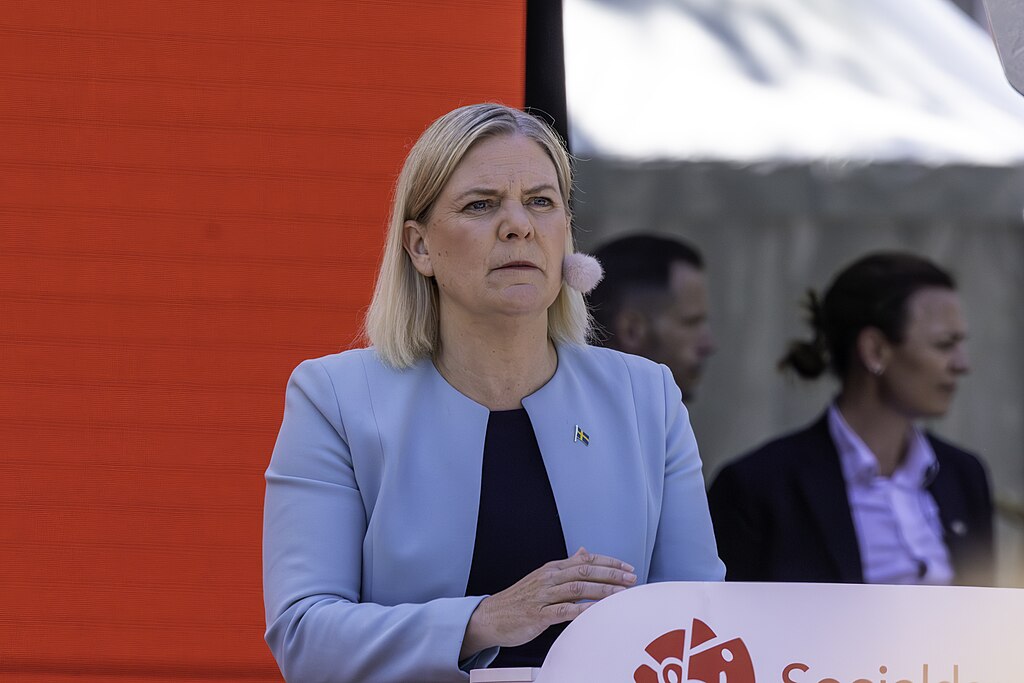
Magdalena Andersson
Bene Riobó, CC BY-SA 4.0, via Wikimedia Commons
The debate over migration has opened a deep rift within Sweden’s political Left. During the Party of European Socialists (PES) congress held in Amsterdam last weekend, former Prime Minister Magdalena Andersson and the new PES President Stefan Löfvén—also a former Swedish PM from the same party—presented contrasting visions of Nordic socialism and, behind that, of Sweden’s political future.
Andersson acknowledged that her country once had “one of the most generous asylum systems in Europe” and admitted that such a policy “was a mistake.” She stressed that the Social Democrats are now “much stricter on migration and crime,” reflecting the pragmatic shift that dominates her strategy.
Andersson, along with voices close to her, have begun speaking of “moving beyond the old bloc system” that has long divided Swedish politics between Left and Right. On a morning show on Swedish TV4, Andersson was described as “flirting” with Moderate Prime Minister Ulf Kristersson, explicitly mentioning she could imagine cooperation across block lines. This has fueled online buzz, with some users interpreting it as Andersson positioning for a grand coalition or issue-based deals post-election.
Löfvén, by contrast, avoided addressing migration altogether. In his speech before more than a thousand delegates, he argued that “progress does not stop at national or European borders” and that shared challenges “must be faced collectively.” His idealistic and pan-European tone contrasted sharply with Andersson’s emphasis on security, order, and welfare.
The contrast between the two leaders reflects the deeper transformation taking place in Swedish society. The country that welcomed nearly 150,000 asylum seekers in 2015 alone—and, including those, close to a million immigrants since—now faces an unprecedented lack of public safety, with shootings and bombings linked to criminal gangs having become frequent occurrences. The Kristersson government has tied this wave of violence to past migration and integration failures—a view increasingly shared by the Swedish electorate.
Aware of this shift, Andersson has called for a renewed focus on “jobs, welfare, and family safety.” Her position echoes that of Danish Prime Minister Mette Frederiksen, who has also hardened her party’s migration stance. In both cases, political pragmatism has overtaken ideological idealism: the Nordic social democrats are trying to regain the trust of working-class voters without surrendering the migration debate entirely to the Right.
Sweden’s division mirrors a broader tension within Europe’s social democracy, trapped between moral conscience and political survival in a changing reality. At the Amsterdam congress, none of the fourteen resolutions adopted by the Socialist International directly addressed migration, despite—or because of—it being the issue most likely to split the movement.
If Andersson succeeds in forging a new political axis beyond the traditional left-right divide, the country would become the latest example of a continental trend: hybrid ‘Frankenstein’ coalitions, like the ones in France and Germany, designed to shut out growing populist and identity-based parties under the auspices of preserving institutional stability and ‘defending democracy.’
Löfvén maintains that Europe needs immigrants to sustain its welfare systems and that closing its doors would be a historic mistake. Andersson, meanwhile, argues that without control and order, there can be no social cohesion or public trust. Both perspectives coexist uneasily within the same party—one torn between moral conviction and electoral calculation.