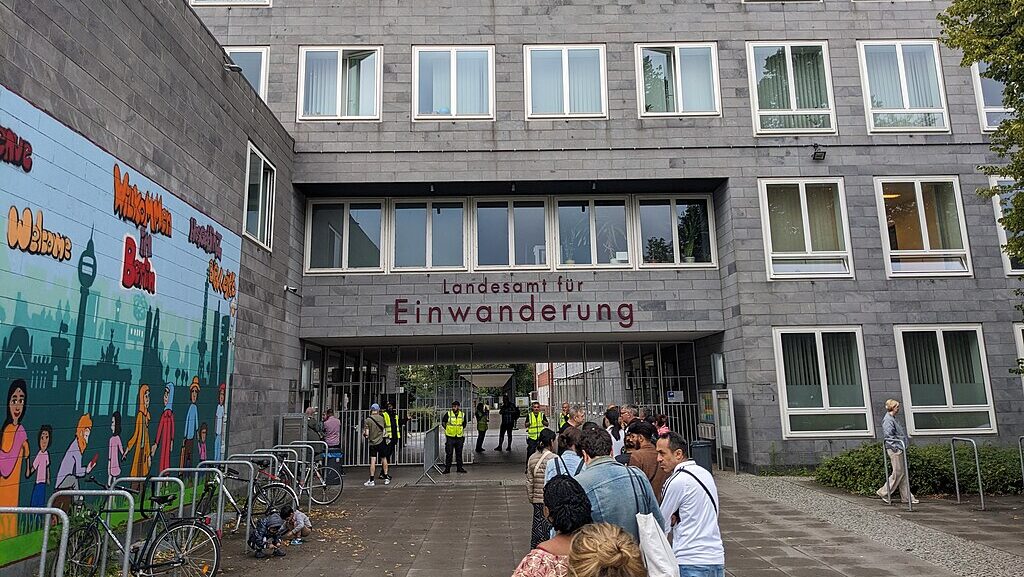
People queuing in front of the Berlin immigration office (Landesamt für Einwanderung)
Nicbou, CC0, via Wikimedia Commons
If you are looking for a business to enter, now may be a good time to supply immigrant housing in Germany since millions of euros are awaiting those who do. The rich are getting richer, the taxpayers are being asked for more and more, and immigrants not willing to integrate into German society are the laughing third, getting all the benefits.
Three recent reports have put Germany’s refugee spending into the spotlight, raising questions about how much taxpayers are being asked to shoulder and whether the sums involved have grown beyond comprehension.
Germany’s largest refugee shelter, located in Berlin-Tegel, costs nearly 300 million euros each year. The security service on the site alone amounts to 250,000 euros per day. Between 2022 and 2023, operators received 100 million euros, with the Berlin Audit Office now alleging that the payments were barely reviewed. Whether this intervention will lead to changes remains uncertain. For critics, the case illustrates a broader pattern: housing immigrants is its own separate industry—and it is booming. There is a lot of money to be made, and many people are profiting from immigration in the background, silently pushing the immigration agenda in Germany—and all over Europe. Some question how the government can afford these projects but not renovate schools and hospitals—projects that benefit the German population.
The issue, commentators argue, stems from the state’s ability to spend without the limits faced by private businesses. For companies, shareholders demand a return on their investments, but state funding lacks the requirement of profitability, so millions can be sent for these endeavors. Debt is financing these subsidies for supporting immigrants, while the local population sees the government slowly cracking under the weight of loans.
Hamburg offers another stark example: Afghan immigrants alone have cost the city one billion euros since 2020. “One billion. Only Afghans. Only in Hamburg,” writes Die Weltwoche. The article warns that Germans have “lost touch with these sums,” no longer grasping the scale of the expenditures. The amounts spent on hotels sheltering illegals would be more than enough to offer tax relief to the German middle class or offer programs in schools for young students.
Critics argue that Germany can no longer keep up with this model and that the government should put an end to this system. In that context, it’s no surprise Alternative für Deutschland (AfD) is seeing record popularity among voters disillusioned with the current establishment and turning to new alternatives.