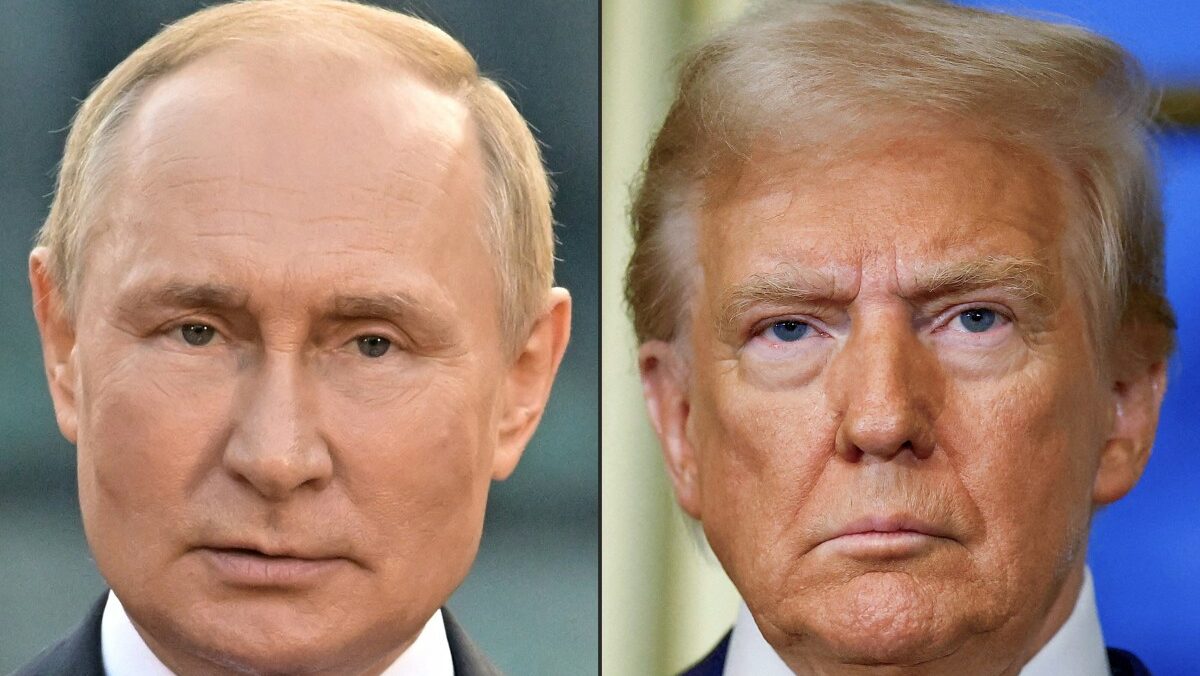
Russian President Vladimir Putin and U.S. President Donald will meet Putin in Alaska on August 15.
Ilya Pitalev and Sarah Meyssonnier / various sources / AFP
U.S. President Donald Trump will meet with Russian President Vladimir Putin on Friday, August 15th, in Alaska to talk about a potential ceasefire—if not peace—plan. The Alaska summit would mark the first meeting between a sitting U.S. and Russian president since Joe Biden met with Putin in Geneva in June 2021.
“The highly anticipated meeting between myself, as President of the United States of America, and President Vladimir Putin, of Russia, will take place next Friday, August 15, 2025, in the Great State of Alaska,” Trump said on his Truth Social site.
The Kremlin confirmed the plan, saying the location was “quite logical.”
“Alaska and the Arctic are also where our countries’ economic interests intersect, and there are prospects for large-scale, mutually beneficial projects,” Kremlin aide Yuri Ushakov said in a statement on Telegram.
Alaska became the 49th state of the United States in 1867, after Russia agreed to sell it for $7.2 million (equivalent to roughly $150–$160 million in today’s dollars). At the time, many Americans considered the initiative insane, and it was referred to as “Seward’s Folly” after Secretary of State William H. Seward, the key negotiator behind the deal.
“The presidents themselves will undoubtedly focus on discussing options for achieving a long-term peaceful settlement of the Ukrainian crisis,” Kremlin aide Yuri Ushakov said on Telegram.
Putin held talks on Friday with the leaders of China and India ahead of his summit with Trump, while Trump envoy Steve Witkoff has quietly consulted with European leaders as well as Ukraine about a Russian proposal for a ceasefire.
Ukrainian President Volodymyr Zelensky issued a strong warning on Saturday, declaring that “decisions without Ukraine” would not lead to peace and firmly rejecting any notion of surrendering territory to Russia.
“Ukrainians will not give their land to the occupier,” Zelensky wrote on social media. “Any decisions against us, any decisions without Ukraine, are also decisions against peace.” Zelensky affirmed that Ukraine is “ready for real decisions that can bring peace,” but stressed that any resolution must be a “dignified peace,” offering no further specifics.