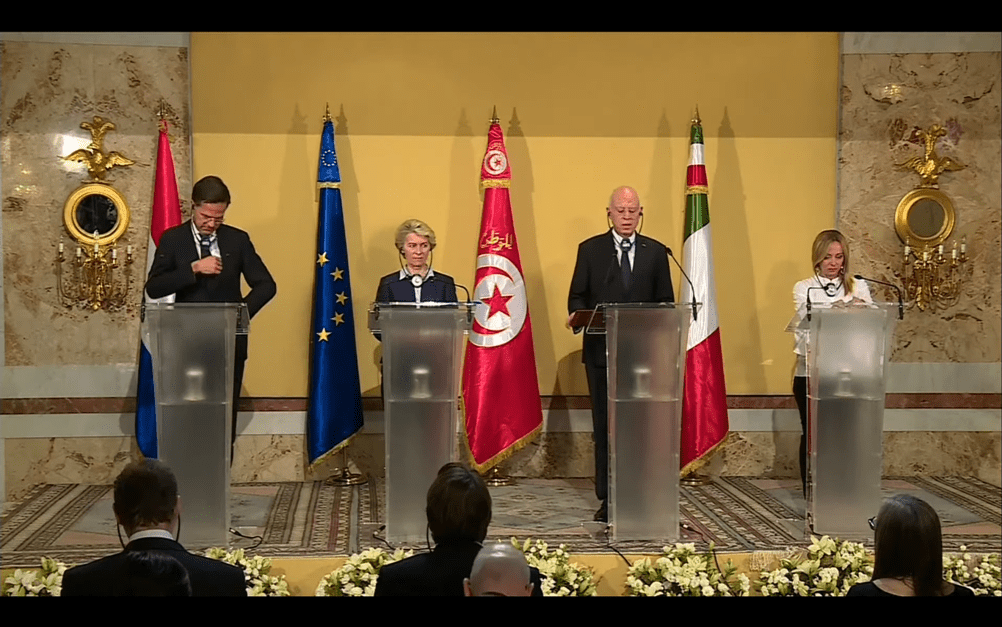
Italian Prime Minister Giorgia Meloni, Dutch Prime Minister Mark Rutte, and President of the European Commission Ursula von der Leyen were back in Tunisia over the weekend.
After a previous recent visit on June 11th, they have now concluded a partnership agreement with Europe’s southern neighbour in the form of a Memorandum of Understanding.
This partnership is structured in terms of five pillars:
- People-to-people connections: This includes Tunisian access to the Erasmus+ program and the creation of “Talent Partnerships” for young people to study and work in the EU. It also includes provisions for modernising schools within Tunisia.
- Economic development: Growth of the Tunisian economy will be stimulated, including through macro-financial assistance and short-term budgetary support from the EU.
- Investment and trade: Presently, the EU is Tunisia’s main foreign investor and trade partner, but the agreement sets the intention of attracting more private-sector investment, including in the digital, water management, and agricultural sectors. This will be done by setting up an “investment forum” in autumn, as well as finalising a Comprehensive Air Transport Agreement. Emphasis will be placed on investing in the digital sector, water management, and sustainable agriculture.
- Renewable energy: Tunisia’s potential for renewables will be harnessed, and the EU will provide the necessary technology. Projects such as the undersea cable ELMED, linking Tunisia to Italy, will be pursued, with an investment of over €300 million. A strategic partnership on energy will be formed to accelerate the energy transition and create local jobs.
- Migration: Tunisia will increase its collaboration with the EU in this area, policing the border, taking action against networks of people smugglers and human traffickers, as well as participating in rescue operations of illegal migrants in the Mediterranean. In particular, an Anti-Smuggling Operational Partnership is to be agreed on. These measures will cost the EU €100 million. Von der Leyen did, however, also mention facilitating legal migration, which is problematic, given that mass migration’s negative social impact is not contingent on the legal status of persons, but we may assume a net reduction is intended.
Politically, and in the short-term, the presence of a mainstream figure like von der Leyen serves to normalise Tunisian President Kaïs Saïed internationally, given recent negative media coverage of his constitutional reforms. It also solidifies Meloni’s priorities at the European level and generally highlights Italian strategic importance for Europe’s diplomatic architecture.
In line with Meloni’s Mattei Plan, if this partnership yields positive fruit and serves as a model for other African countries in their relations with the EU, African development may serve to absorb migration through local employment and, in some cases, may also secure alternative energy flows into Europe.