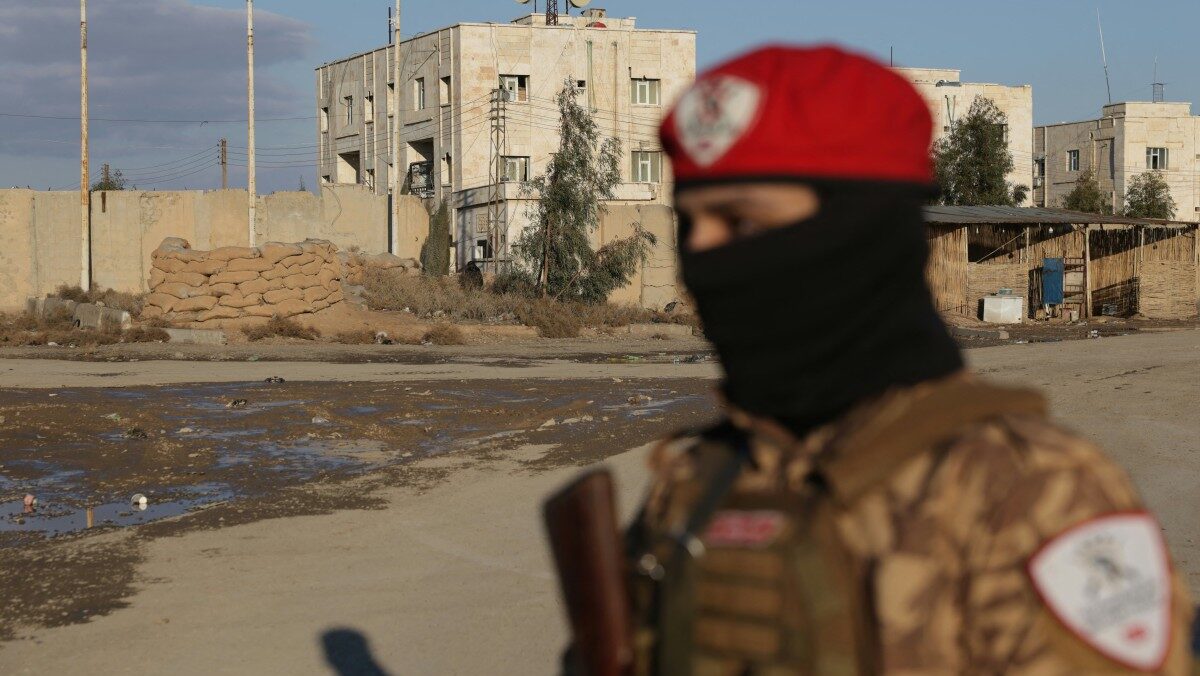
A Syrian government soldier stands outside SDF controlled Al Aktan prison which holds ISIS detainees
Bakr ALkasem / AFP
The army of Syria’s new government has released thousands of former members of the self-proclaimed Islamic State (ISIS) who were being held in prisons in the country’s northeast. Many of those freed previously fought alongside Islamist militias that are now part of the power structure in Damascus.
The development, confirmed by multiple local and regional sources, marks a turning point after months of reassuring messages to the international community about the supposed “moderation” of the new authorities.
“ISIS militants who murdered women and children and spread terror in Europe were captured by the Kurds and jailed for years. Today, Ahmed al-Shar’ is freeing them. A global danger. #ISIS #Syria #Europe #GlobalSecurity” pic.twitter.com/mRnlm7Za7W
— arif qurbany (@qurbany_arif) January 19, 2026
The releases took place during a chaotic handover of prison control, as armed clashes broke out and security collapsed at facilities that housed experienced militants, including commanders and foreign jihadists. While the exact figures remain disputed, this was one of the largest releases of jihadist prisoners since ISIS lost its territory.
In recent months, governments and international bodies have sought to normalise relations with the new Syrian government, portraying it as a lesser evil and a force capable of bringing stability after years of war. However, the release of thousands of prisoners linked to jihadism reveals a clear continuity of ideology that cuts through the official rhetoric: wolves in sheep’s clothing.
For a substantial share of the forces now in power, these men were not enemies but temporary allies in a constantly shifting conflict. Far from being an isolated gesture, the freeing of former militants fits into a broader pattern of rebuilding armed networks.
🚨🇸🇾 Jolani’s army has opened U.S./Kurdish prisons releasing HUNDREDS of convicted ISIS terrorists.
— Ethan Levins 🇺🇸 (@ethanlevinsz) January 18, 2026
They offer them weapons and a monthly soldier salary.
Syria is ran by ISIS. pic.twitter.com/Xlx4dl1M2Y
The consequences were immediate. Active cells have re-emerged, and attacks on vulnerable communities have resumed, particularly against religious and ethnic minorities that already suffered systematic persecution during the height of jihadist expansion.
For years, prisons in northeastern Syria—guarded by Kurdish forces with international backing—held between 9,000 and 12,000 suspected ISIS members. How to deal with them was long regarded as a ticking time bomb. The recent transfer of responsibility to the new government, without clear guarantees or effective oversight, has finally triggered that explosion.
Damascus claims the incidents amounted to limited escapes and says some of those who fled have been recaptured. Kurdish authorities, by contrast, accuse the government of deliberately releasing thousands of prisoners. Amid conflicting accounts, one fact is clear: effective control was lost, and the jihadist threat has increased substantially.
The impact of these events extends well beyond Syria. Among those released are foreign jihadists whose full identities have yet to be established. Some may try to make their way back into migration routes toward Europe, repeating a pattern seen after previous episodes of regional chaos. For European citizens, this translates into heightened risk at a time when political elites continue to rely on soothing rhetoric and an almost dogmatic faith in failed ‘normalisation’ processes.
The release of thousands of former ISIS members by the army of Syria’s new government shatters the idea that jihadism has been defeated or that political Islam has been reinvented as a reliable partner. Rather than closing a chapter, it reopens a threat that never truly disappeared. Ignoring this reality—out of diplomatic convenience or political calculation—will only push the problem beyond Syria’s borders, with direct consequences for regional and European security.