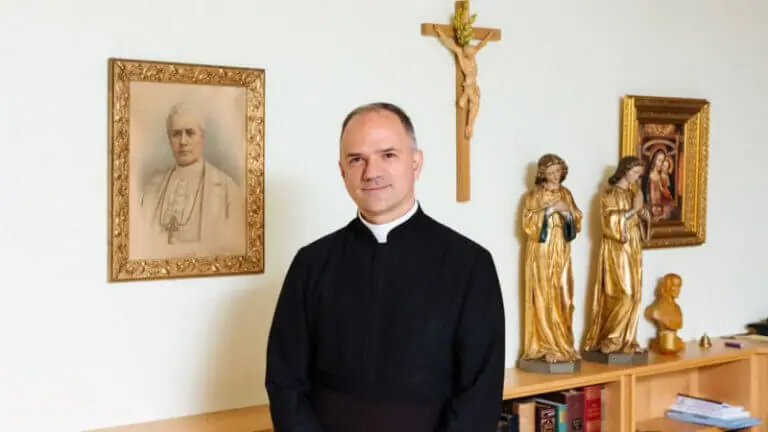
Courtesy of La Porte Latine
On February 2nd—the feast of the Presentation of Jesus in the Temple and the Purification of the Virgin—the Society of Saint Pius X (SSPX) sent shockwaves through the Catholic world when its Superior General, Father Davide Pagliarani, announced the decision to proceed with the ordination of new bishops on July 1st, 2026, entrusting the Society’s existing bishops with carrying out the consecrations.
The Society of Saint Pius X, founded by Archbishop Marcel Lefebvre in 1970, has been in canonical conflict with the Vatican since Lefebvre’s decision in 1988 to ordain four bishops without Rome’s consent in order to be able to ordain priests for the celebration of the pre-Vatican II liturgy. This decision, taken during the pontificate of Pope John Paul II, led to the de facto excommunication of the bishops thus consecrated. The excommunication was lifted by Pope Benedict XVI in 2009. Under Pope Francis, persistent rumours suggested that the Society might be granted a specific canonical status, while the pope extended Rome’s recognition of confessions and marriages celebrated by priests of the Society.
Of the four bishops ordained in 1988, two have died: Bishop Richard Williamson, who was expelled from the Society in 2012 and died in January 2025, and Bishop Bernard Tissier de Mallerais, who died in October 2024.
The decision taken by the Society risks reigniting tensions and making it more difficult to reach an agreement with Rome, following new exchanges which the Society, without disclosing their content for the moment, considers unsatisfactory.
“After much prayerful reflection, and having received a letter from the Holy See in recent days that in no way responds to our requests, Fr. Pagliarani, supported by the unanimous opinion of his Council, believes that the objective state of grave necessity in which souls find themselves requires such a decision,” the Society said in a statement.
Although relations with Rome have never been truly broken, as the Society of Saint Pius X recognises the authority of the popes and defends itself against any ‘schism’ in its approach, it nevertheless considers that the serious crisis in the Church makes its specific mission, outlined forty years ago in the years following the Second Vatican Council, still relevant today: to guarantee the formation of priests in accordance with the traditional magisterium of the Church.
In Catholic media around the world, debate has raged since the Society’s announcement. Prelates hostile to traditional liturgical sensibilities condemn a choice that they believe will lead to a new schismatic situation, while conservative voices justify the Society’s decision by pointing to the degree of degradation of the post-conciliar Church—the schismatic path taken by the German Church being one of the most glaring examples.
For the moment, the Vatican has responded to the announcement in these terms: “Contacts between the Society of Saint Pius X and the Holy See are ongoing, with the aim of avoiding ruptures or unilateral approaches to the issues that have arisen.” It is unclear what line Pope Leo XIV, whose temperament inclines him towards conciliation, will take.
Further explanations are expected from the Society in the coming days.