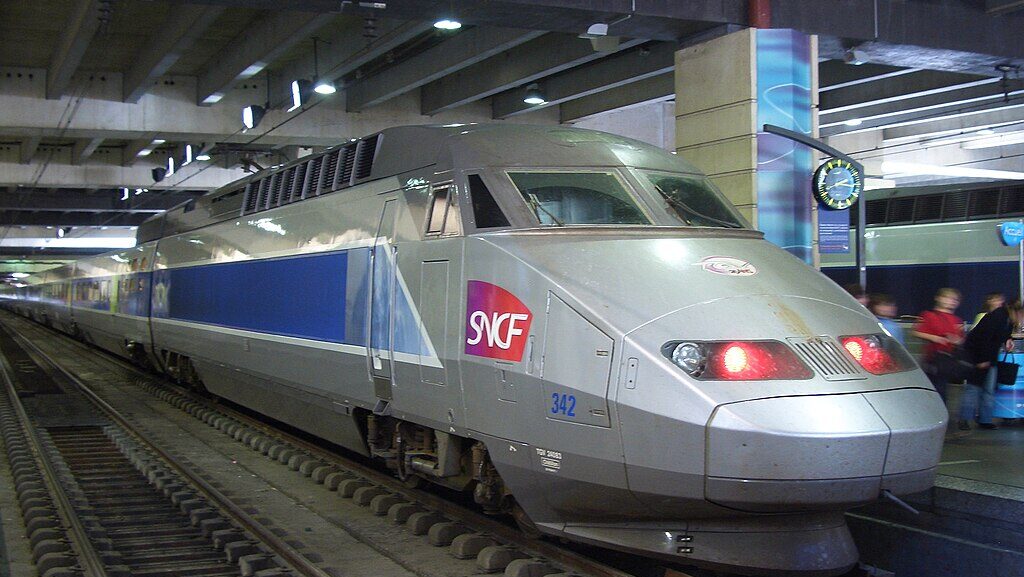
TGV Atlantique train at the Montparnasse train station, Paris.
SeeSchloss, CC BY-SA 2.5, via Wikimedia Commons
“The European Commission will present a plan in the autumn to significantly boost European high-speed rail transport,” said Transport Commissioner Apostolos Tzitzikostas, promising a long-term vision for a “more connected, efficient and competitive European network.”
The commissioner said the project involves the “coordinated planning, financing and implementation” of high-speed rail infrastructure and rolling stock operating across national borders.
“Ultimately, people will choose the train not only because it is more sustainable, but also because it is a more comfortable, faster and more affordable solution for long-distance travel in Europe,” said Tzitzikostas. “We need a coordinated funding approach that combines the best use of EU funding, national support and private investment,” he added.
However, many national railway companies face tight budgets, leading them to prioritise domestic routes where passenger numbers are higher and infrastructure demands are easier to manage. Building new high-speed infrastructure and acquiring trains capable of cross-border operation requires enormous investments, often stretching beyond what operators can justify without significant subsidies. As a result, air travel remains the fastest—and often more cost-effective—option for most Europeans for long-distance trips.
But connections and infrastructure aren’t the only issues. In addition to being faster, air travel is often cheaper and easier to book. A 2023 Greenpeace report that examined 112 European routes found that trips by train are, on average, twice as expensive as by plane.
Moreover, when travelling by train across borders, travellers want hassle-free, direct tickets with no transfers. However, European railway companies share little ticket information with each other or with the intermediary platforms through which tickets can be booked. This often forces passengers to buy multiple separate tickets.
Without smoother rail connections, lower prices and one-stop ticketing, air travel still has the edge. But if rail can deliver a “comfortable, affordable, easy-to-book service,” passengers will respond, Tzitzikostas insisted. “More are choosing high-speed rail already—not just because it’s more sustainable, but because it’s better.”
A survey conducted by the European Railway and Infrastructure Companies (CER) found that 77% of EU citizens would prefer to travel by high-speed train over airplane if the connection between capitals and major cities was fast and reliable. Another survey of 11,000 people, commissioned by rail manufacturer Hitachi Rail, found that almost half of respondents plan to travel more by train and less by airplane in the next five years. The Hitachi Rail poll also found that 62% of respondents support banning short-haul flights where high-speed rail alternatives exist.
However, questions remain over the objectivity of these studies, given that the research was conducted by a group of European railway companies and a rail manufacturer whose primary interest is to increase rail use. Further doubt may arise from the fact that, according to the European Commission’s 2021 report, rail accounted for less than 10% of cross-border travel in the EU, which is well below the figures mentioned in the studies.
At present, national priorities “do not always align with European ambitions,” due in part to domestic pressure on resources, Tzitzikostas said.
European governments are currently balancing competing demands on their budgets, including the costs of defence in light of the ongoing war in Ukraine, border security, migration management, and urgent domestic infrastructure projects. In this climate, large-scale investments in high-speed rail can be deprioritised in favour of immediate national needs, diverting funds away from cross-border transport initiatives and slowing the EU’s vision for a fully integrated network.
Lukács Fux is currently a law student at Pázmány Péter Catholic University in Budapest. He served as an intern during the Hungarian Council Presidency and completed a separate internship in the European Parliament.