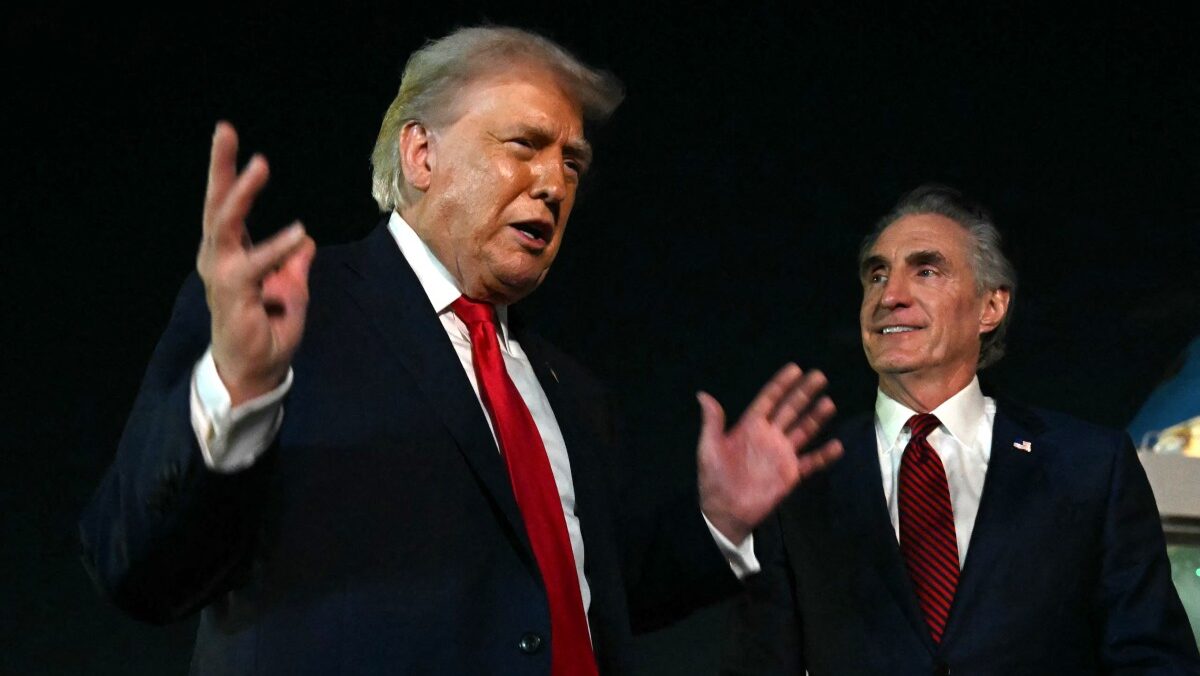
U.S. President Donald Trump speaks to reporters as Interior Secretary Doug Burgum looks on in Florida.
ANDREW CABALLERO-REYNOLDS / AFP
French President Emmanuel Macron has proposed hosting high-level talks in Paris this week as tensions rise between the United States and Europe over Greenland, trade tariffs, and Arctic security. According to Macron’s entourage, he sent a private message to U.S. President Donald Trump suggesting a G7-format meeting in Paris on Thursday, with Russia and several other actors potentially invited on the sidelines.
Trump later confirmed receiving the outreach on his Truth Social platform, publishing excerpts of Macron’s message to underline that Paris—not Washington—was pushing for another round of elite diplomacy. In the message, Macron wrote: “I can set up a G7 meeting after Davos in Paris on Thursday afternoon,” adding that he could invite “the Ukrainians, the Danish, the Syrians and the Russians in the margins.”
Macron also addressed broader geopolitical issues, telling Trump: “My friend, we are totally in line on Syria. We can do great things on Iran. I do not understand what you are doing on Greenland.” The comment reflected unease in some European capitals over Washington’s increasingly assertive posture in the Arctic.
The proposal follows Trump’s threats to impose steep tariffs on several European countries over what he views as EU obstruction and long-standing dependence on U.S. security guarantees, including in relation to Greenland. Trump has repeatedly described the island as strategically vital to U.S. national security. While EU officials frame the dispute primarily as a question of sovereignty, Washington argues that control of key Arctic routes and resources cannot be left to chance amid growing Russian and Chinese activity in the region.
Relations between Trump and Macron deteriorated further on Monday after the U.S. president threatened 200% tariffs on French wine and champagne, following indications that Paris would not participate in a proposed “Board of Peace” initiative on Gaza. Speaking to reporters in Florida, Trump suggested European leaders were in a weak negotiating position. “I don’t think they’re gonna push back too much. We have to have it. They have to have this done,” he said, referring to Greenland and broader security demands. He later said discussions would continue in Davos.
As Brussels discussed possible counter-measures, U.S. Treasury Secretary Scott Bessent warned against another tariff dispute with Washington, calling EU retaliation “very unwise.” He described Greenland as a strategic asset and said the United States “is not going to outsource our hemispheric security to anyone else.”
European Commission President Ursula von der Leyen responded by reiterating EU positions on international law and the need to respect the sovereignty of Greenland and Denmark, calling this “of utmost importance” to transatlantic relations. Some U.S. officials argue the EU relies heavily on American security guarantees while resisting U.S. strategic priorities.
Meanwhile, Danish Defence Minister Troels Lund Poulsen confirmed that Copenhagen has proposed a NATO surveillance mission in Greenland, effectively expanding the alliance’s role as Washington presses for a stronger U.S. presence. NATO Secretary General Mark Rutte said he had discussed “how important the Arctic—including Greenland—is to our collective security,” highlighting how European governments are increasingly turning to NATO—and U.S. power—to secure the region.