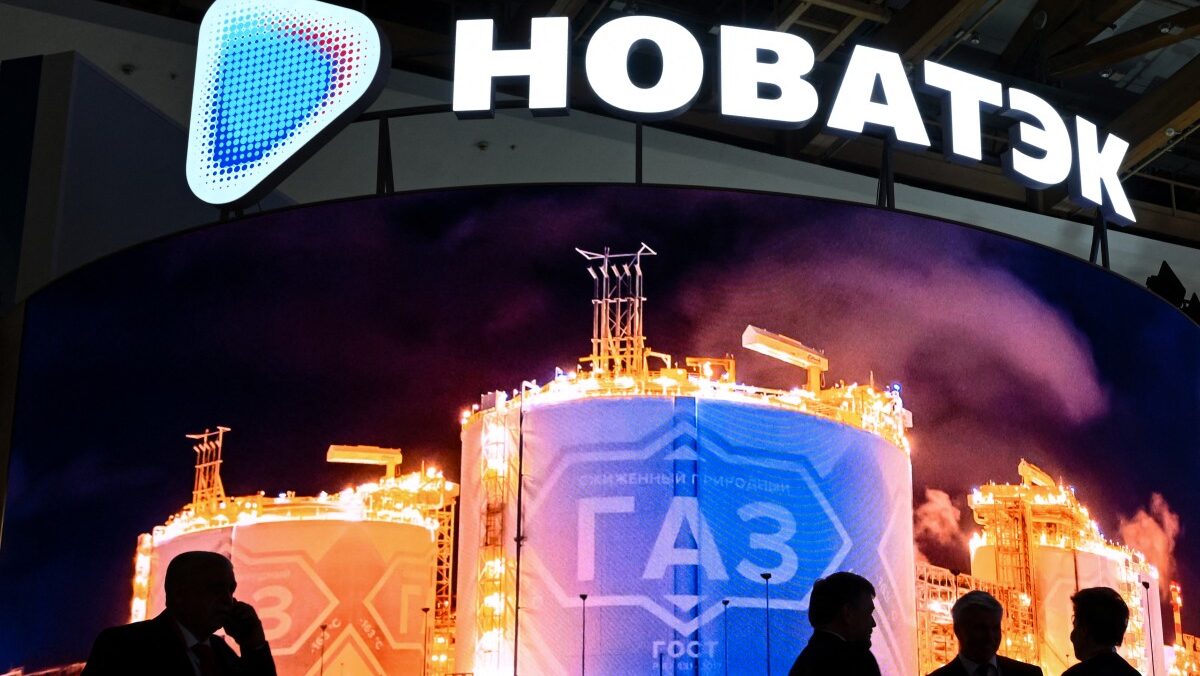
Participants gather in front of the stand of Russia’s liquefied natural gas producer Novatek at the Russian Energy Week forum in Moscow on October 16, 2025.
Olesya Kurpyayeva / AFP
The war in Ukraine has entered a new phase of economic pressure following the near-simultaneous announcement of new sanctions on Russia by the European Union and the United States. On Wednesday, Brussels approved its 19th package of sanctions, which includes a ban on imports of Russian liquefied natural gas (LNG). Meanwhile, the Trump administration launched a parallel offensive against Russia’s oil sector by sanctioning Rosneft and Lukoil, the country’s two largest energy companies.
The European package was unblocked after Slovakia lifted its veto in exchange for guarantees on energy prices and climate targets—a move reflecting the discomfort among countries most dependent on Russian gas. Denmark, which currently holds the rotating EU presidency, hailed the agreement as “a decisive step toward ending Europe’s energy dependence on Russia before 2027.”
We just adopted our 19th sanctions package.
— Kaja Kallas (@kajakallas) October 23, 2025
It targets Russian banks, crypto exchanges, entities in India and China, among others.
The EU is curbing Russian diplomats’ movements to counter the attempts of destabilisation.
It is increasingly harder for Putin to fund this war.
U.S. Treasury Secretary Scott Bessent stated, “The time has come to stop the slaughter,” justifying Washington’s sanctions as an effort to cut the Kremlin’s main sources of funding. “Since Putin refuses to end this senseless war, we are targeting the two largest oil companies that fuel his war machine,” he said.
For the first time since the beginning of the conflict, Brussels and Washington are acting with relative coordination in implementing strategic sanctions. Trump’s decision to directly target Russia’s oil sector—after weeks of bipartisan pressure in Congress—has escalated tensions with Moscow.
The measures will affect dozens of international subsidiaries and could force a reduction in Russian exports to Asia. India, currently Russia’s top crude buyer, has already announced it will review its imports to avoid breaching U.S. sanctions.
Sources indicate that Washington is divided between those who favor completely blocking Russia and those who see an opportunity to exploit its energy needs by purchasing oil via third parties like India and reselling it to the EU. Trump’s latest move suggests the former approach has prevailed—for now.
In the EU’s case, the new sanctions package goes beyond energy. The list of sanctioned vessels—Russia’s so-called shadow fleet—has grown to 558 ships. Restrictions on Russian diplomats have been expanded, and financial entities in Kazakhstan, Belarus, and even China have been added. According to High Representative Kaja Kallas, the goal is to “make it harder for Putin to fund his war” and curb trade evasion through third countries.
The immediate impact of these measures has already been felt: oil prices surged by 5% on international markets, while the ruble suffered another drop. However, analysts warn that the sanctions may have limited short-term effects, as much of Russia’s revenue comes from production rather than exports, and it still has alternative channels in Asia—particularly China.Despite the newly announced package, the EU remains divided over its sanctions policy. Eastern countries, led by Poland and the Baltic states, welcome the tougher stance. Others, such as Hungary and Slovakia, warn of the toll on European industry and energy competitiveness—a trend seen in recent years that will now hit both countries hard. The debate centers on whether the increasingly symbolic sanctions are truly effective or merely exacerbate the internal economic crisis.