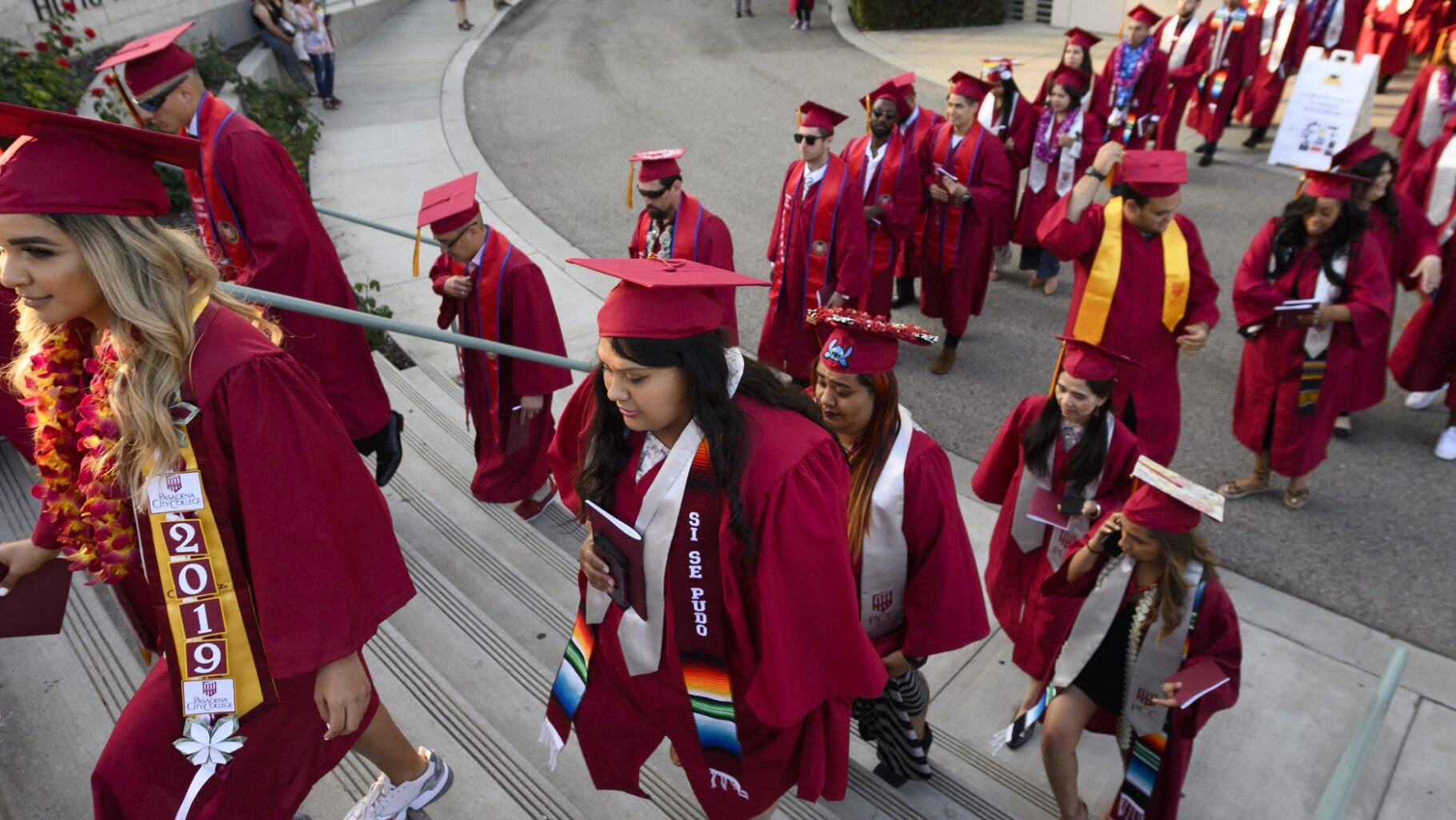
Students earning degrees at Pasadena City College participate in the graduation ceremony, June 14, 2019, in Pasadena, California.
Robyn Beck / AFP
The Trump administration on Wednesday, August 27th, unveiled a hardline proposal to replace the indefinite stays granted to foreign students, exchange workers, and journalists with strict, short-term visas. While this move will introduce new hurdles for all nationals, including Europeans, the administration positions it as a necessary step to prevent abuse of the immigration system and assert greater control over who remains in the United States.
The proposed rule from the Department of Homeland Security (DHS) would fundamentally alter the immigration status for hundreds of thousands of nonimmigrants. Under the new framework, F visas for academic students and J visas for cultural exchange workers, which currently allow holders to stay for the duration of their academic program plus any authorized training, would be capped at a standard four-year term.
Foreign media representatives on I visas would see a more drastic change, with visas limited to an initial 240 days. Citizens of the People’s Republic of China would be subject to an even stricter limit of just 90 days for media visas. In all cases, individuals could apply for extensions if their program or assignment continues.
For European students and professionals on these visas, who currently enjoy the simplicity of staying for their entire program’s length, this means new layers of bureaucracy, uncertainty, and the constant pressure of preparing extension applications. However, the DHS argues this inconvenience is a small price to pay for national security.
“For too long, past administrations have allowed foreign students and other visa holders to remain in the U.S. virtually indefinitely, posing safety risks, costing untold amounts of taxpayer dollars, and disadvantaging U.S. citizens,” a DHS spokesman stated. “This new proposed rule would end that abuse once and for all.”
DHS officials argue the change is necessary to enhance the government’s ability to “monitor and oversee” visa holders during their stay. The move would subject these populations to more frequent government vetting.
This is not the first time such a measure has been proposed. A similar plan was introduced in the final months of the Trump administration in 2020 but was swiftly withdrawn by the incoming Biden administration in 2021 following strong opposition from higher education and international exchange groups.
The new visa proposal aligns with a recent pattern of increased scrutiny on legal immigration. The administration has recently moved to revoke student visas and green cards based on ideological views. Furthermore, U.S. Citizenship and Immigration Services (USCIS) announced last week it would resume in-person neighborhood visits to verify information on citizenship applications, checking on an applicant’s residency, moral character, and “commitment to American ideals.”
The administration’s approach offers a contrast to the more permeable systems in place across the European Union. As the EU continues to struggle with challenges of illegal immigration and border control, the U.S. is presenting a tough but fair solution to their own problems. Immigration has taken a toll on the U.S. in recent years with crime and drug use skyrocketing overseas. Now a tougher system is being implemented, and Europe could take a page from the American book to heighten their security measures as well.