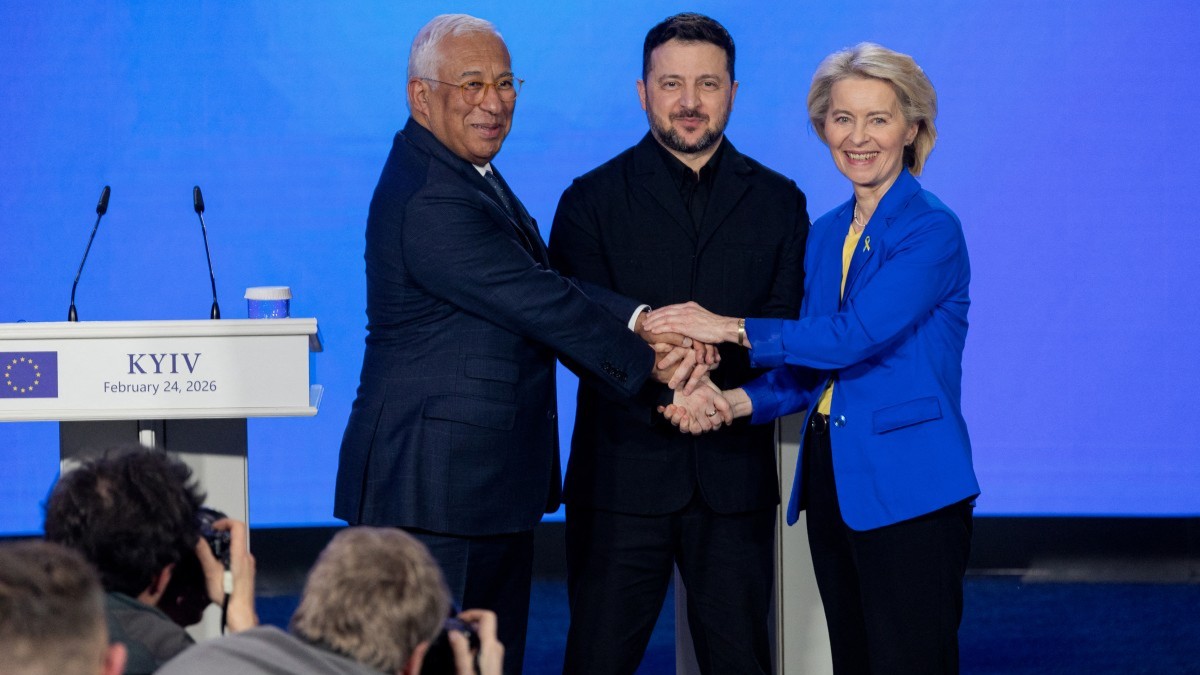
European Council President António Costa (L), Ukraine’s President Volodymyr Zelensky (C) and the President of the European Commission Ursula von der Leyen (R) pose for a photo during a press conference in Kyiv on February 24, 2026.
TETIANA DZHAFAROVA / AFP
On the surface, European Commission President Ursula von der Leyen is working to keep EU states happy. On Tuesday, she asked that Ukrainian repairs on the Soviet-era Druzhba pipeline, which Kyiv says was damaged in a Russian drone attack, are “accelerated.” The resumed flow of oil through this line is Budapest’s condition for lifting its block on a €90 billion EU loan package for Ukraine.
Yet behind closed doors, Brussels appears confident that it will get the cash over to Volodymyr Zelensky’s administration whether this dispute is resolved or not.
Economy Commissioner Valdis Dombrovskis told reporters in Paris that “often we’ve had to deal with Hungary’s opposition to certain decisions, but,” crucially, “at the end of the day we always found a way forward.”
Two diplomats quoted in Politico also highlighted that “on sanctions,” for example, “we’ve always found a way.”
Hungarian Foreign Minister Péter Szijjártó suggested in a post on Tuesday that the issue in Brussels’ approach lies in the fact that it approaches energy security—as, indeed, it does other matters—“ideologically” rather than “practically.”
Meetings with @SecretaryWright and @SecretaryBurgum confirmed that a new golden era has begun in Hungarian-American relations.
— Péter Szijjártó (@FM_Szijjarto) February 24, 2026
Nuclear cooperation is a key pillar of our partnership. Hungary will expand its nuclear capacity and US companies are ready to take part in this… pic.twitter.com/ClEEcv3m8x
Prime Minister Viktor Orbán also on Tuesday wrote to European Council President António Costa, who has criticised Budapest for defending its own interests, saying:
I am one of the most disciplined and consistent members of the European Council. [A statement even Brussels-friendly Politico couldn’t pick a hole in.] I fully understand your concerns. But you also certainly see the absurdity of the situation: we take a decision financially favourable to Ukraine that I personally disapprove, then Ukraine creates an energy emergency situation in Hungary, and you ask me to pretend that nothing happened. This is not possible.
Still, the Brussels establishment has consistently shown itself to be more interested in backing Ukraine’s interests, and even on Tuesday said it was looking at “non-standard” tactics for speeding up the country’s accession to the EU, despite remaining concerns among existing member states.