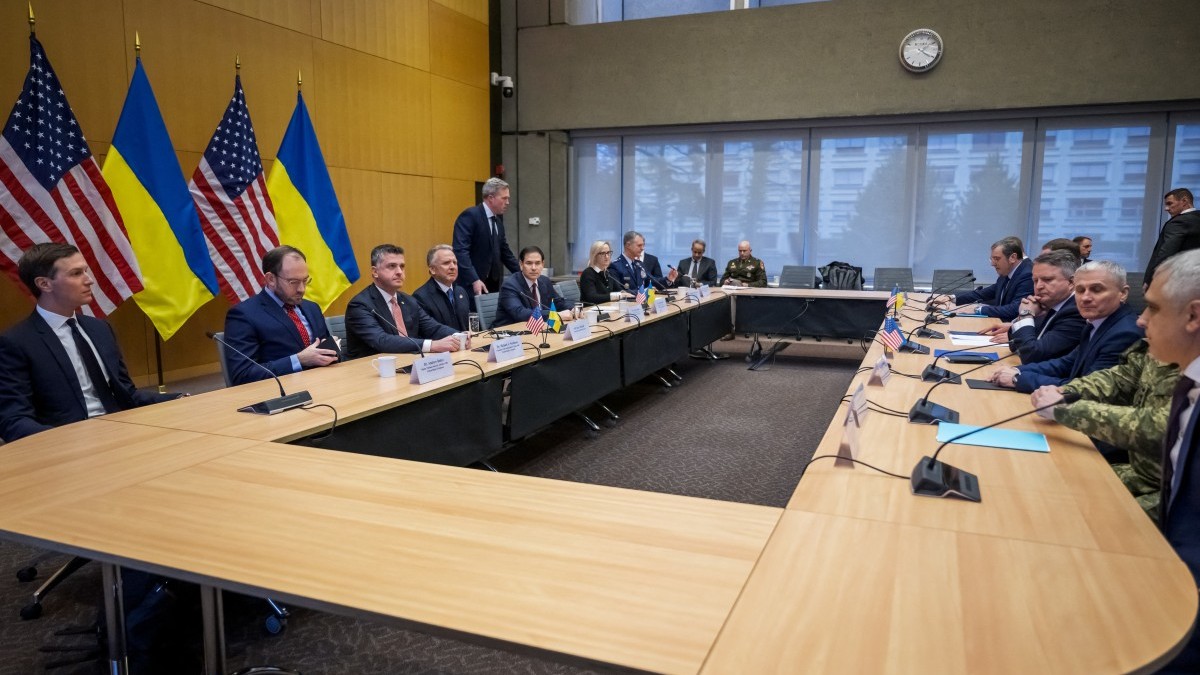
U.S. Secretary of State Marco Rubio (5th L), U.S. special envoy Steve Witkoff (4th L), U.S. Secretary of the Army Daniel Driscoll (taking his seat) and U.S. President Donald Trump’s son-in-law Jared Kushner (L) face the Ukrainian delegation during discussions on the U.S. peace plan at the U.S. embassy in Geneva, on November 23, 2025.
Fabrice Coffrini / AFP
The United States and Ukraine have moved significantly closer to a joint path toward peace after negotiations in Geneva. U.S. Secretary of State Marco Rubio described the discussions as yielding “enormous progress,” adding that the remaining issues were “not insurmountable.” The White House said that Kyiv was satisfied with the jointly revised version of the peace plan, noting that Ukrainian representatives believe the draft offers “short- and long-term, credible and enforceable mechanisms to protect Ukrainian security.”
On November 21st, after the U.S. peace plan emerged, President Volodymyr Zelensky said that he would not “betray” his country’s interests and promised to present “arguments” and “alternatives.”
During the Geneva talks, Ukrainian negotiator Rustem Umerov stated that the revised version of the U.S. plan “although still in the final stages of approval, already reflects most of Ukraine’s key priorities.”
The White House stressed that the draft includes enhanced security guarantees: protection for infrastructure, a framework for economic recovery, commitments ensuring political sovereignty and freedom of navigation. The U.S. delegation in Geneva included Rubio, President Donald Trump’s Special Envoy Steve Witkoff, Jared Kushner, and Daniel Driscoll, U.S. Secretary of the Army.
While the U.S. was focused on making an effective settlement, the EU—long absent from serious peace efforts—suddenly rushed to produce its own counter-proposal. For years, Brussels chose to prioritize funding the conflict rather than pursuing a negotiated outcome. Even now, EU leaders appear more preoccupied with trying to plug Ukraine’s projected €135 billion funding gap for 2026–2027 than with addressing the increasingly alarming money-laundering reports emerging from Kyiv.
Only as Washington’s plan gained traction did the so-called E3 group (Britain, France, Germany) begin drafting a document.
The European version raises Ukraine’s permitted military size from the U.S. plan’s 600,000 to 800,000 in peacetime. According to the document, the government in Kyiv would not have to relinquish any territories it currently controls, and the plan includes no provisions that would amount to de facto recognition of areas controlled by Russia. It also demands that frozen Russian assets remain blocked until full compensation is provided. The plan also includes a security guarantee for Ukraine from the United States, modeled on NATO’s Article 5 mutual defense clause.
Rubio has also indicated that the deadline for Ukraine to agree to the U.S. peace plan is now flexible, moving away from the original Trump ‘ultimatum’ of Thursday, November 27th. While he would like it finalized by Thursday, he emphasized that “whether it’s Thursday, Friday, Wednesday, or Monday of next week” is secondary given the death toll in Ukraine. “We want it to happen soon,’ he added.”
Finnish President Alexander Stubb noted on social media this morning that he has spoken with Zelensky, stressing that he welcomes the progress made at the Geneva talks but adding that any decision “falling in the remit of EU or NATO will be discussed and decided by EU and NATO members in a separate track.”