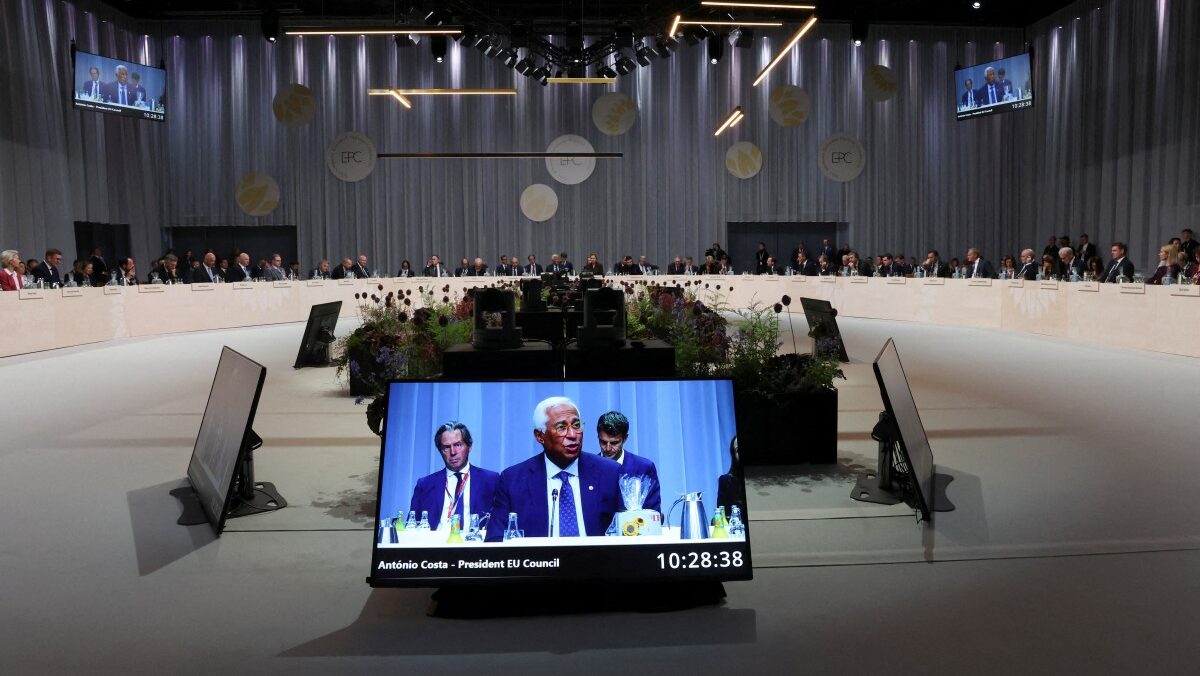
European Council President António Costa appears on a screen at the start of the plenary session of the 7th European Political Community (EPC) Summit at the Bella Center in Copenhagen, Denmark, on October 2, 2025.
Suzanne Plunkett / POOL / AFP
António Costa’s speech at the EU summit in Copenhagen on Wednesday revealed—to no one’s surprise—Brussels’ wide-ranging plans for yet further centralisation, especially when it comes to defence. Not for the first time, the war in Ukraine was touted as the main reason for handing more member state powers to the European Commission.
The European Council president was, of course, not as blunt as this, although what he did say was indicative of the same sentiment:
To build the Europe of defence we need efficient political oversight and coordination to keep track on how we are advancing.
Costa also said “we are committed to face together common threats, on all fronts … with a common purpose,” insisting that this purpose “has been clear since the start of Russia’s war in Ukraine.”
Through all his comments, the official appeared to overlook the growing divisions over Brussels’ approach to defence—especially when praising the possible accession of Ukraine to the EU because “enlargement will make Europe stronger.”
Hungary’s Viktor Orbán has made his opposition to increasing war rhetoric clear, insisting that “Europe must negotiate for peace” instead. His political director, Balázs Orbán, also said on Thursday that Budapest is arguing against “Brussels’ dangerous and harmful plans” at the summit in Copenhagen.
‼️At the summit of the European Political Community in 🇩🇰#Copenhagen, it once again became clear: Brussels has set itself on a path of war. More & more proposals are being put on the table, all serving to escalate the war in Ukraine: more money, more weapons, and a fast-tracked… pic.twitter.com/NnJKzb7rdB
— Balázs Orbán (@BalazsOrban_HU) October 2, 2025
But rather than listen to these concerns—especially regarding Ukraine’s accession to the EU, which Viktor Orbán says would bring the war to the bloc—Brussels appears to be trying to punish its critics into submission.
Indeed, the Commission has this week partly rejected a Hungarian plan to unblock €545 million in frozen EU funds. Some leftist MEPs expressed frustration over the fact Budapest was still able to access €163.5 million of this.
Orbán has also pointed to the implementation of “all kinds of legal tricks” to override his government’s position.
The Commission will present a ‘roadmap’ on “2030 defence readiness” in a fortnight. Costa also said on Wednesday that the Council will meet again before the end of this month—“and that will be decision time.”