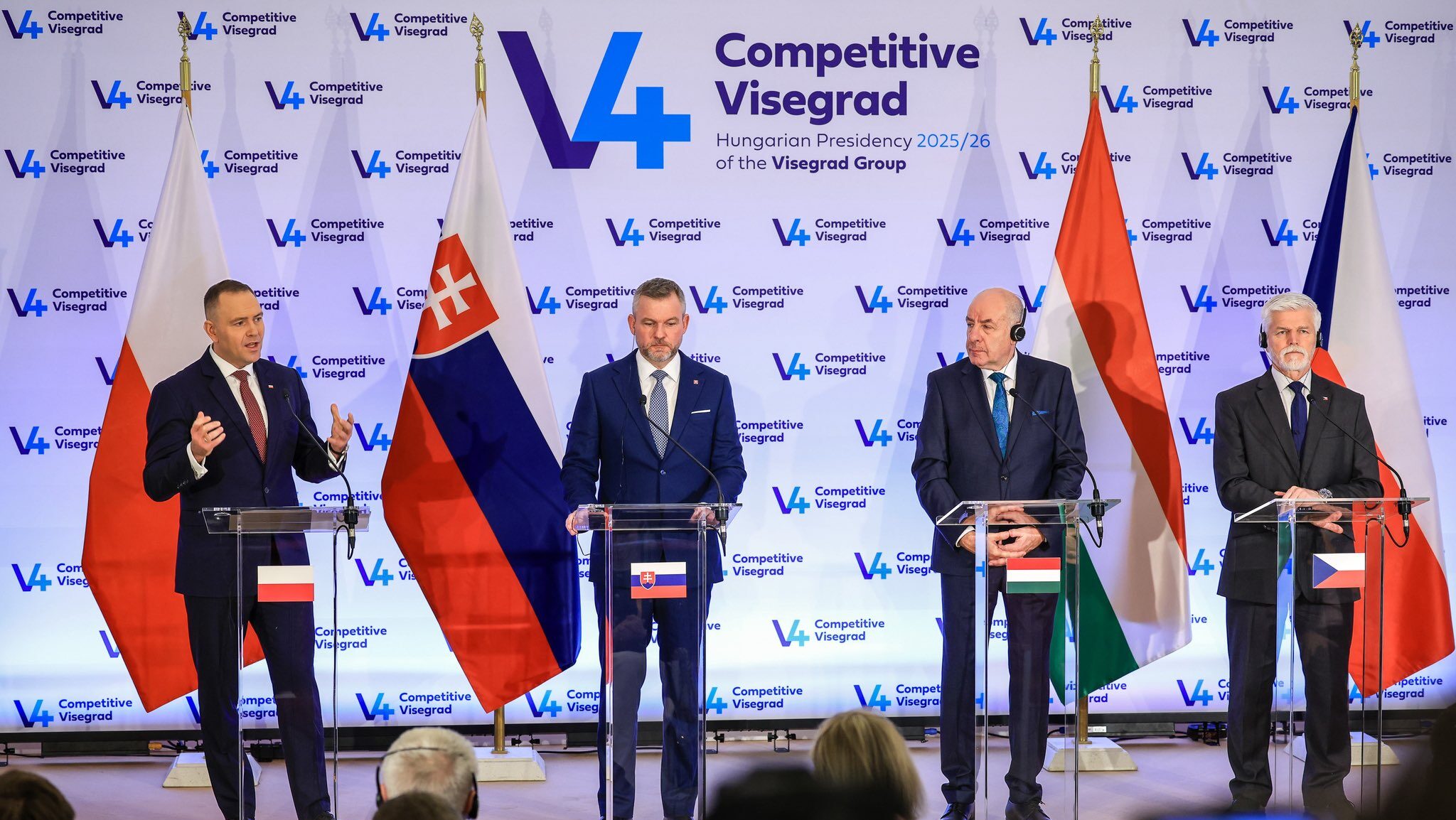
Central Europe’s presidents met in Hungary on Wednesday, warning that soaring energy costs, EU climate rules and migration pressures are forcing the Visegrád Group to close ranks and speak with one voice. Attending the meeting were the presidents of Poland, the Czech Republic, Slovakia, and Hungary—Karol Nawrocki, Petr Pavel, Peter Pellegrini, and Tamás Sulyok. Nawrocki had held earlier talks with Pavel in Prague on 24 November on security, economic ties and infrastructure.
From the outset, President Karol Nawrocki said that Poles, Czechs, Slovaks, and Hungarians “can essentially speak with one voice.” He underscored shared priorities such as strengthening regional energy infrastructure, enhancing gas and electricity connections, and building greater autonomy from external pressure.“Energy independence is an expression of the sovereignty of each of our countries,” he emphasized.
Nawrocki reiterated Poland’s intention to serve as a regional energy hub, supported by preliminary arrangements with U.S. president Donald Trump for expanded gas supplies to Central Europe. “Poland can be a hub for our region,” he said, adding that the plan is meant to secure competitive energy supplies and curb Russian influence in Europe.
During the Esztergom summit, Nawrocki highlighted the importance of the V4 as a unified regional voice on EU matters. While affirming that all participating countries support being part of the European Union, he insisted that membership does not preclude critique. “Democracy means being able to benefit from dialogue and discussion,” he said. He stressed that the V4 must be able to tell Western European partners when “migration or climate policies are not to our liking,” or when EU centralization contradicts Central Europe’s vision for the future.
“This is not an anti-European narrative,” he emphasized.
Slovak president Peter Pellegrini pointed out the economic and industrial aspects of V4 collaboration, noting that soaring energy costs across Europe pose a significant threat to the region’s industrial competitiveness. “Together with our European partners, we must find a quick and effective solution to reduce these costs, otherwise we risk companies moving their production to other parts of the world, such as the United States, Asia or outside the EU,” he said.
Pellegrini also pointed out that the V4 countries together can “assert demands that better reflect the social and economic conditions” of the region, including concerns about ETS2 emission quotas and the planned phase-out of internal combustion engines by 2035.