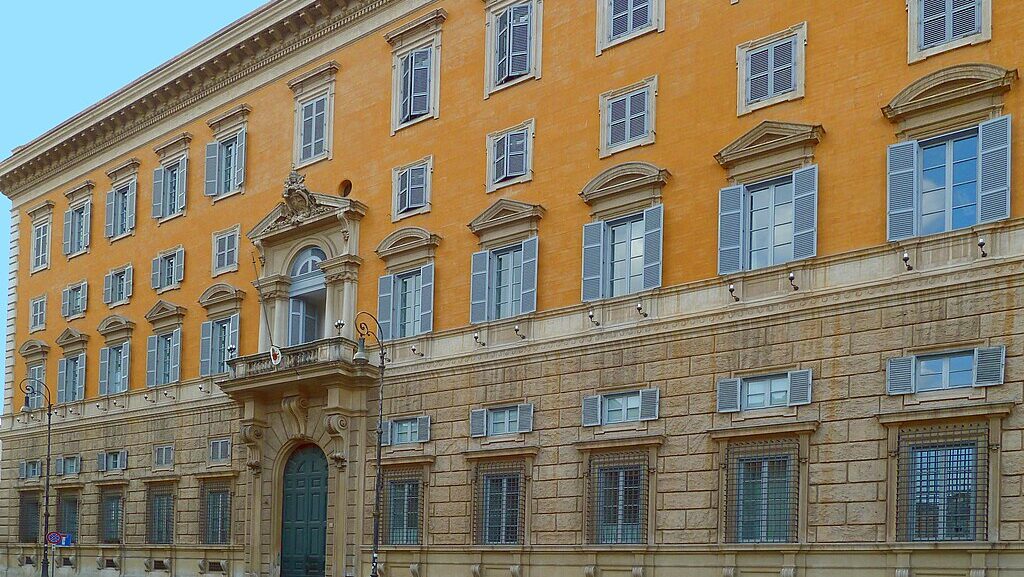
Palazzo del Sant’Uffizio (seat of the Congregation for the Doctrine of the Faith). Extraterritorial property of the Holy See.
Jim McIntosh, CC BY 2.0, via Wikimedia Commons
After the bombshell announcement by the Priestly Fraternity of Saint Pius X (SSPX) of its intention to proceed with new episcopal consecrations with or without Rome’s consent in the summer of 2026, a meeting was organised in Rome between the superior of the Fraternity, Fr. Davide Pagliarani, and Cardinal Victor Manuel Fernández, head of the Congregation for the Doctrine of the Faith. While it did not provide any solutions, the rather cordial meeting was intended to place future relations under the sign of dialogue in an attempt to overcome the tensions between tradition and progressivism within the Church.
The announcement made on February 2nd, the Feast of the Presentation of Jesus in the Temple and the Purification of the Virgin, of the intention of the Priestly Fraternity of St. Pius X to renew the sacraments of bishops, as Msgr. Marcel Lefebvre had done in 1988 against the authority of the Vatican, caused much ink to flow in the Catholic world.
The SSPX has always expressed its willingness to obey Rome despite the liturgical and doctrinal differences that persist. This is why, in its statement, it emphasises the ongoing dialogue with Rome, though this has so far been unsuccessful. Following the February 2nd statement, an invitation was sent to the superior of SSPX by Cardinal Fernández.
The two men met on Thursday, February 12th, at the Vatican in Rome.
This meeting, described as “cordial and frank” by the Society, did not exactly meet their wishes since the superior wanted to obtain an audience with the Pope himself. It nevertheless marks a first step in this tense context. Cardinal Fernández made known his disagreement with the Society’s decision to consecrate new bishops, which is planned for July. He indicated that if these consecrations took place without Rome’s consent, the Society would be placing itself in a situation of schism. But the door is not closed.
The meeting focused on the question of doctrinal dialogue. The Cardinal called for an in-depth discussion with the Society in order to clarify the doctrinal differences that have accumulated over decades and which currently prevent full communion with Rome. The doctrinal dialogue would focus on several sticking points identified by the Society and reported to the Pope on several occasions in the past. The question of the existence of religious plurality and the approval of this plurality by divine will is at the heart of these questions. Another problem is the varying degrees of adherence required by the different texts of the Second Vatican Council and their interpretation.
It is therefore a matter of drawing up a roadmap, or rather a working paper, to determine whether these disagreements can be resolved as misunderstandings or are insurmountable and beyond hope of being overcome. If a minimum common ground could be reached, the definition of a specific canonical status for the fraternity within the Catholic Church could be discussed.
Cardinal Fernández was very clear in stating from the outset that the ordination of bishops without a papal mandate was a schismatic situation. He therefore requested that, in order for this dialogue to take place under favourable conditions, the decision on episcopal ordinations be suspended.
The ball is now in the court of the Society of Saint Pius X. The Superior General must present this proposal to his council and then return to the Prefect of the Congregation for the Doctrine of the Faith to give him a formal response. If the protocol is agreed upon, further steps will be taken to move forward by mutual agreement, first on the doctrinal discussion and then on its practical consequences.
Observers of the Catholic world emphasise the generally courteous and calm tone of the exchanges, which still gives no indication of the outcome of the continued discussions. Archbishop Vigano, former apostolic nuncio to the United States, who distanced himself from Rome and was eventually excommunicated in 2024, was highly critical after the meeting and believes that the Society should not have to ask Rome for permission to do anything. Within the Society of Saint Pius X, caution remains the order of the day, while emphasising that the discussion remains open, particularly regarding the status of the Second Vatican Council—a council that presented itself as ‘pastoral,’ which raises the question of the ‘doctrinal’ status of its conclusions. Cardinal Fernandez pointed out that the texts of Vatican II could certainly be “discussed” but in no way “corrected.”