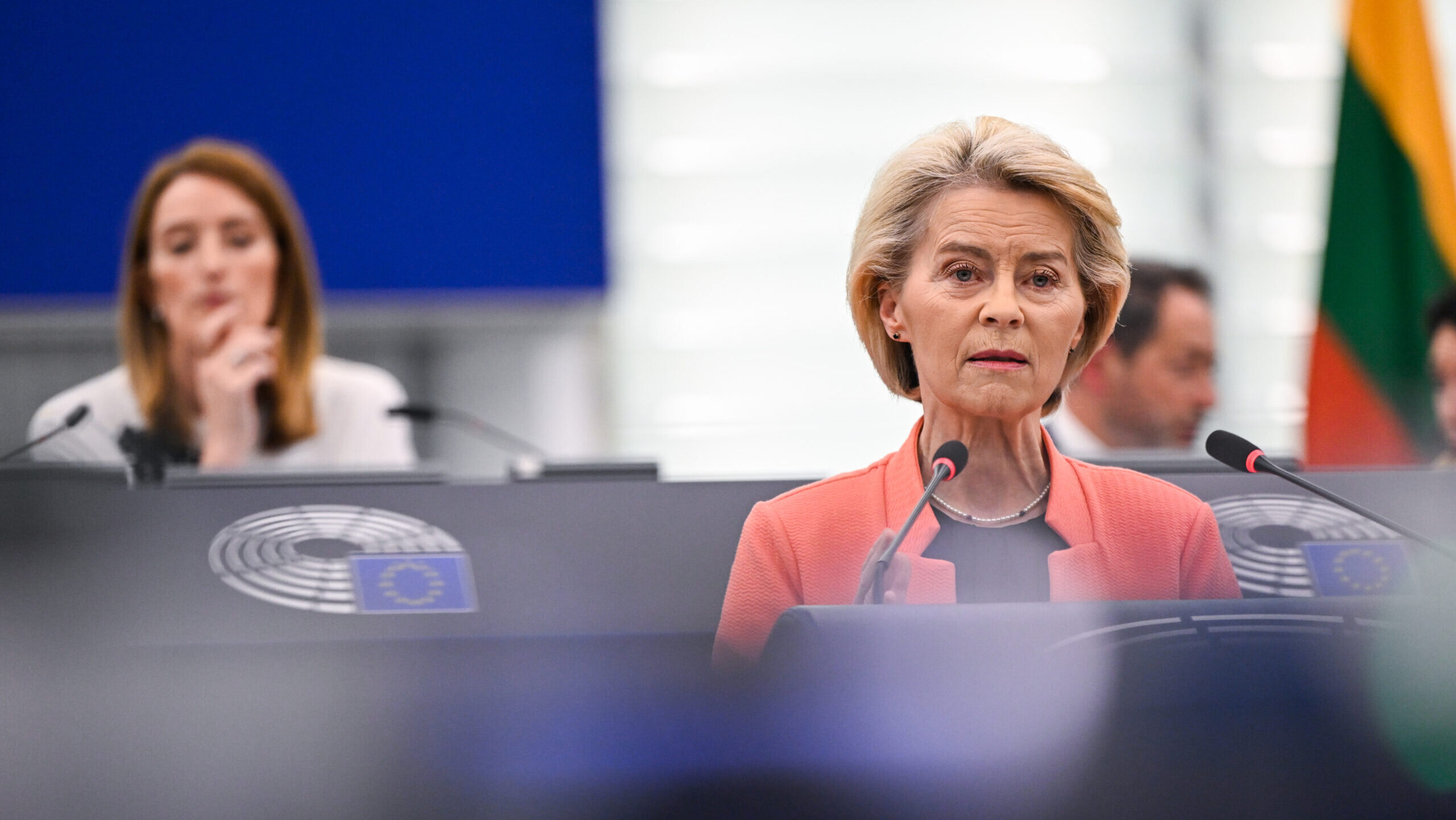
EU Commission President Ursula von der Leyen
Laurie Dieffembacq / © European Union 2025 – Source: EP
After promising concessions to the social democrats, EU Commission President Ursula von der Leyen survived the historic no confidence vote in the European Parliament on Thursday, July 10th, successfully evading accountability in the Pfizergate case once more, despite still refusing to address the EU Court of Justice (ECJ) ruling against her.
The censure was supported by 175 MEPs, mainly from the national conservative PfE, ECR, and ESN, as well as over a dozen far-left lawmakers. This number signals that there are a lot more MEPs who are fed up with the Commission chief than just the 75 “extremist conspiracy theorists” who initially signed the motion, as von der Leyen said when trying to delegitimize the effort during Monday’s debate while not even mentioning the ECJ ruling a single time.
On the other hand, only 360 MEPs voted against it, all of whom (except just five) came from the left-leaning ‘Ursula coalition’ that reelected von der Leyen last summer—the ‘center-right’ EPP, the socialist S&D, the liberal Renew, and the Greens. In contrast, she was confirmed last July with 401 votes, meaning she lost over 40 supporters in just a year, and she may not have gotten another term if the confirmation vote was held today.
At the same time, only 18 MEPs had the courage to officially abstain. The remaining 167 abstained in practice by boycotting the vote entirely—they did not push any button at all. As a result, their name didn’t appear on the voting record, allowing them to avoid highlighting internal party divisions.
Among them were, for instance, the members of Italian PM Giorgia Meloni’s Fratelli d’Italia party, ECR’s largest delegation. The party previously called the motion a “mistake,” even though it was triggered by one of its colleagues and supported by half the group, including the second and third largest delegations, the Polish PiS and the Romanian AUR.
Von der Leyen herself was so sure the vote would fail that she didn’t even stay to see it, but instead left Strasbourg the night before to travel to Rome ahead of the Ukraine Recovery Conference.
Fair enough. There was virtually no chance the censure would gather the two-thirds support it needed to succeed without a fully unified Right and half the left-wing MEPs. Despite their grievances, the ‘Ursula coalition’ would never vote for the collapse of the Commission, which remains the only stable source of their power as their alliance in the parliament has begun to break down.
Still, the social democrat S&D did not let this opportunity go to waste, and leveraged its support to get something in return. In exchange for not abstaining—which would have had no real consequence, other than making the final results look somewhat worse for von der Leyen—S&D successfully negotiated guarantees that the European Social Fund (ESF+), an instrument that funds social inclusion schemes to the tune of €150 billion, will remain untouched in the next EU budget as the Commission struggles to reallocate funding for defense or debt servicing.
Meanwhile, the liberal Renew (also mad at von der Leyen for withdrawing an anti-greenwashing legislation under pressure from the EPP) announced only at the last minute that it would not abstain , but said von der Leyen must change her leadership style if she wants to have the group’s long-term support, “from unilateralism to partnership.”