Ina FASSBENDER / AFP
Voters in Germany’s most populous state head to the polls on Sunday, September 14th, in a contest widely viewed as a litmus test for the national government of Chancellor Friedrich Merz.
The local elections in North Rhine-Westphalia, a region of 18 million people, could expose the extent of voter frustration with establishment parties that many see as unable or unwilling to address their concerns on migration, security, and the economy.
Around 20,000 positions are up for election, including mayors, district administrators, and city and municipal councils.
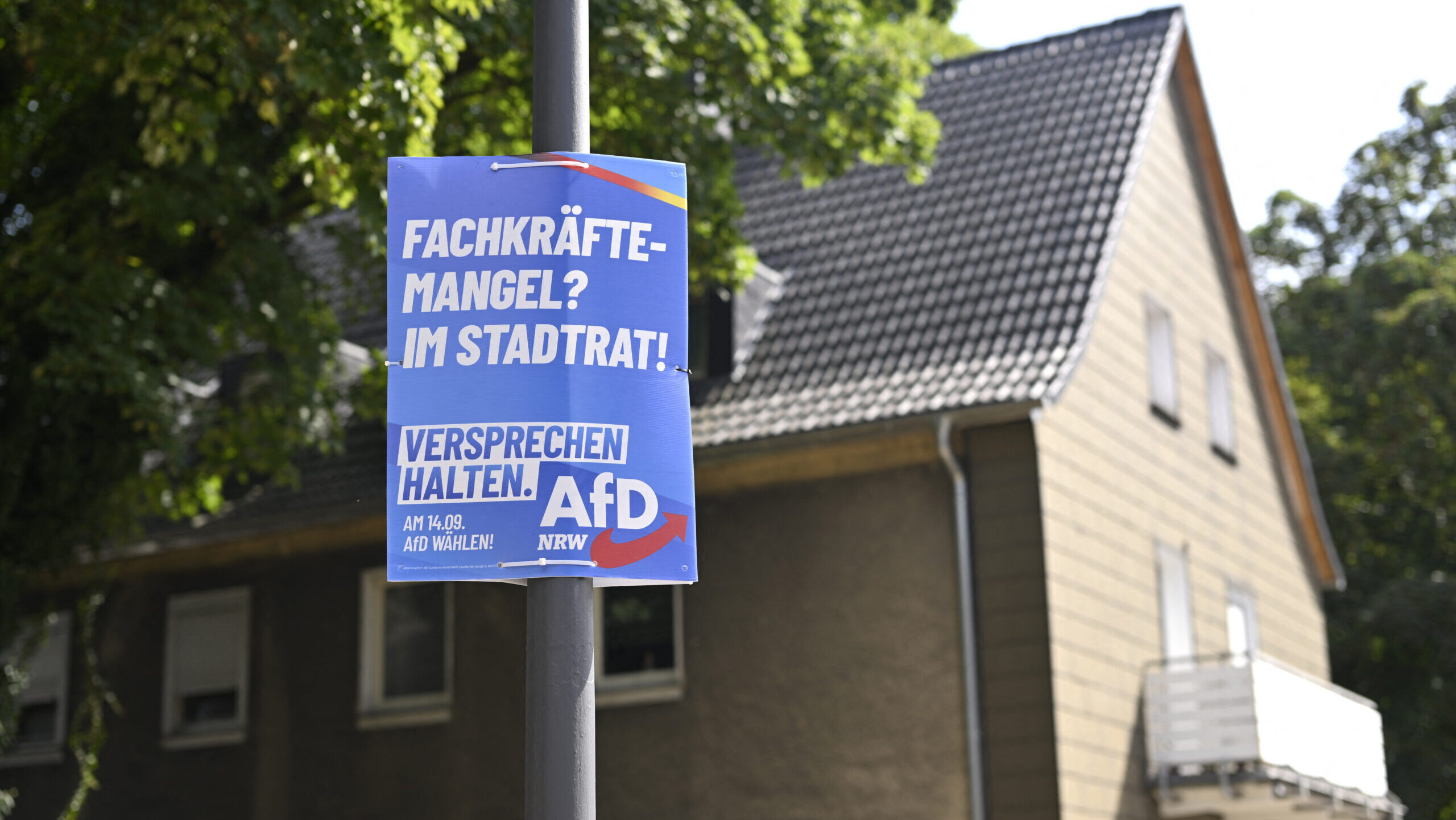
Yet the real drama lies in whether the right-wing Alternative für Deutschland (AfD) can build on its strong showing in February’s general election and achieve breakthroughs in North Rhine-Westphalia.
According to an INSA survey, the chancellor’s centre-right CDU is set to remain the strongest party with 36%, followed by the Social Democrats (SPD) at 23%. The AfD is forecast to capture 15%—tripling its result from 2020 and becoming the third-strongest force in the state.
NORDRHEIN-WESTFALEN | Sonntagsfrage Kommunalwahl INSA/NIUS
— Deutschland Wählt (@Wahlen_DE) August 22, 2025
CDU: 36% (+1,7)
SPD: 23% (-1,3)
AfD: 15% (+9,9)
GRÜNE: 10% (-10,0)
LINKE: 6% (+2,2)
FDP: 4% (-1,6)
BSW: 3% (NEU)
Sonstige: 3% (-4,1)
Änderungen zum Wahlergebnis von 2020 (landesweites Ergebnis)#Kommunalwahl pic.twitter.com/Mj6EvAwAem
The rise of the AfD reflects deeper discontent. Many voters feel that mainstream politicians ignore their concerns, particularly on immigration.
In North Rhine-Westphalia, one in four residents has an immigration background, mirroring Germany as a whole. Yet attempts to restrict public debate have backfired.
In Cologne, for example, all major parties signed a “fairness agreement” pledging not to talk about the disadvantages of immigration. The AfD, excluded from the pact, is now the only party openly addressing migration-related problems. It is likely that such silencing strategies merely feed polarisation and strengthen the AfD’s hand.
This frustration has also been sharpened by economic stagnation and rising unemployment. Merz, who promised a summer recovery, has instead presided over the first increase in joblessness above three million in a decade.
The SPD, meanwhile, faces a collapse on its home turf, the industrial heartlands of the Ruhr, where its once-solid base of steel, chemical, and automotive workers now fear for their livelihoods.
It is also Merz’s home state, and his CDU governs locally in coalition with the Greens under Minister-President Hendrik Wüst. Yet polls show half of residents are dissatisfied with Wüst’s government.
Few expect the AfD to win mayoralties outright, since other parties are likely to unite to block it in run-offs. But breakthroughs into second rounds and a surge in council representation would be unprecedented in North Rhine-Westphalia and a symbolic victory in territory where the party has historically struggled.
Merz has tried to downplay expectations, insisting that “local elections are local elections.” But with national polls showing only 22% satisfied with his government, and many Germans now rating the AfD as most competent on asylum policy, the results in North Rhine-Westphalia will reverberate far beyond the state’s borders.