Manfred Weber
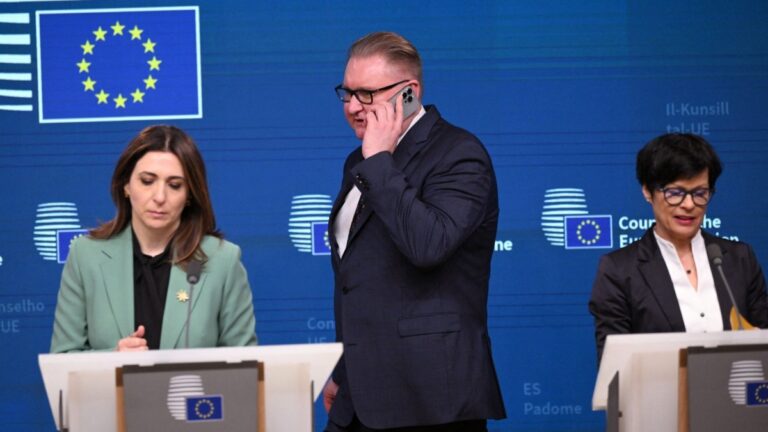
Fred MARVAUX © European Union 2025 – Source: EP
Manfred Weber’s speech during Monday’s censure debate against European Commission president Ursula von der Leyen will be remembered not for its brilliance but for its clumsiness. At a moment of high political tension, the leader of the European People’s Party (EPP) chose mockery and self-congratulation to defend a president increasingly under fire. The result was an image of detachment and complacency that reinforced, rather than dispelled, doubts about Europe’s political establishment.
While the Patriots for Europe and The Left both demanded accountability from the Commission—for entirely different reasons—Weber treated the debate as a farce. “This is becoming ridiculous,” he began, forcing a laugh. “A motion of censure is a serious tool, not a video for your French campaign.” From there, the speech descended into improvisation. He went on to suggest they form a new group called We Are Against—a line that drew awkward reactions across the chamber.
Weber dodged every substantive criticism directed at Von der Leyen—the collapse of Europe’s farming sector, the regulatory chaos stifling business, the erosion of national sovereignty—and instead filled his time with jokes about selfies, “French campaign videos” and “Salvini’s pool floats.”
Weber said the problem is not the direction of the European Union but those who dare to question it. “We build, you destroy,” he declared, as if propping up the Commission were enough to claim moral authority. But the scene had the opposite effect: it left the centrist European People’s Party looking like a party trapped in its own nostalgia—defensive, insular, and deaf to a base increasingly skeptical of Brussels’ federalist drift.
It is a striking transformation. The EPP, once the guarantor of moderation and stability, has under Weber’s leadership become a defensive machine—void of vision, stripped of identity. Its blind alliance with Von der Leyen, a president who no longer commands full support even within her own group, has turned inertia into a political strategy.
As Weber thanked the Commission president “for her service” in a paternalistic tone, the Patriots denounced the destruction of Europe’s productive fabric and the suffocation of small businesses under endless regulation. While the EPP applauded the usual speeches about “unity and resilience,” millions of Europeans watched the gap between Brussels and the nations widen further.