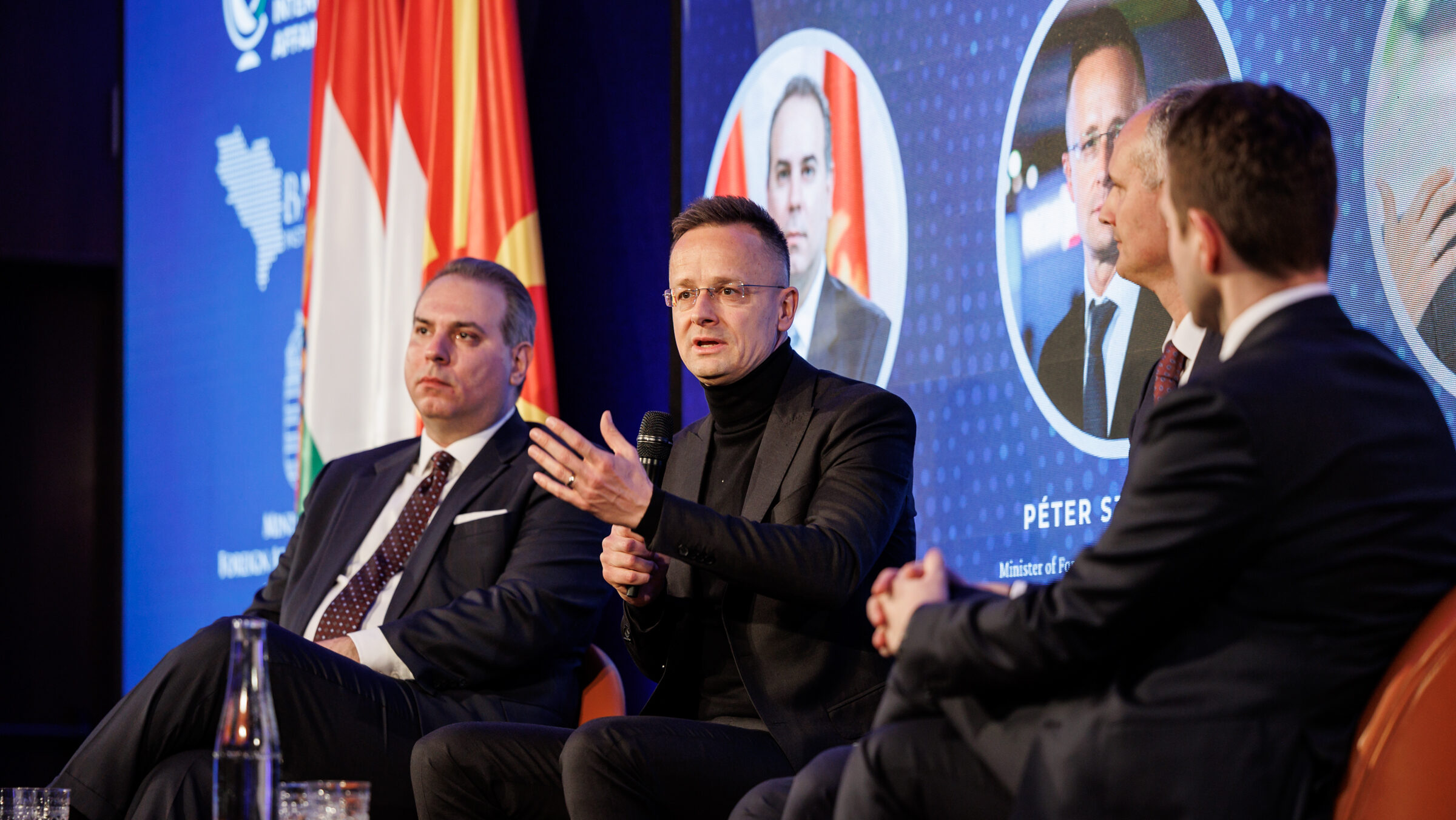
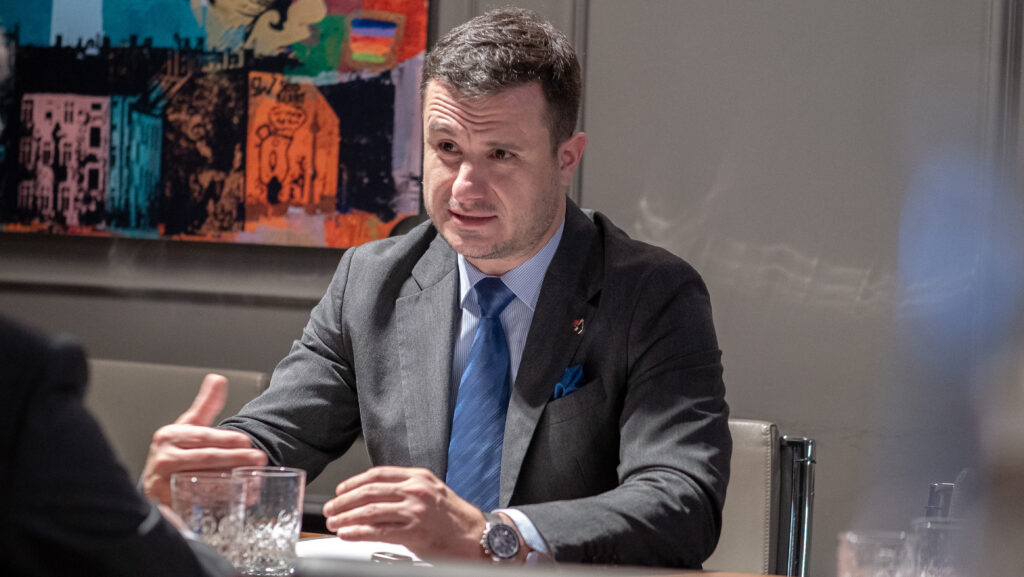
Minister of Foreign Affairs and Trade Péter Szijjártó of Hungary speaking at the Budapest Balkans Forum (C); Deputy Prime Minister for Foreign and European Affairs of Montenegro Filip Ivanović (L) listening.
@hiia_budapest on X, 9 March 2026
The challenges facing Western Balkan countries on their path toward European Union membership took centre stage on Monday evening, March 9, at the Budapest Balkans Forum 2026, organised by the Hungarian Institute of International Affairs (HIIA) in the Hungarian capital.
Speakers from across the region argued that while their countries remain committed to European integration, the EU’s enlargement process has increasingly suffered from a lack of clarity, shifting criteria, and political obstacles imposed by existing member states.
Opening the event, HIIA president Gladden Pappin highlighted Hungary’s role as a consistent advocate of enlargement toward the Western Balkans.
“Hungary has insisted on a merit-based enlargement process,” Pappin said, adding that the Western Balkans are central to building a Europe rooted in strong national identities.
Hungarian foreign minister Péter Szijjártó delivered a sharply critical assessment of the EU’s current policies, arguing that the bloc has become “over-ideologised” and increasingly marginal in global politics.
“The EU has entirely lost its common sense,” Szijjártó said, adding that Brussels has isolated the bloc from key global actors. He cited tensions with the United States, sanctions against Russia, strained relations with China, and trade disputes with countries in the Global South as evidence of strategic missteps.
According to the minister, the EU urgently needs new energy and dynamism—something he believes Western Balkan countries could provide. He criticised discussions about fast-tracking the membership of Ukraine while countries in the region have been waiting for years or decades.
He also criticised Ukraine for halting the transit of Russian oil to Hungary and Slovakia via the Druzhba pipeline—at a time when global supplies have become more uncertain due to the war in the Middle East—but praised gas transit cooperation with three Balkan countries, Turkey, Bulgaria, and Serbia.
Representatives from Western Balkan countries described the prolonged accession process as increasingly frustrating.
Filip Ivanović, deputy prime minister for foreign and European affairs of Montenegro, emphasised his country’s commitment to joining the EU. Montenegro opened accession negotiations in 2012 and has since opened all 33 negotiating chapters, closing thirteen.
“We should join the EU because we are Europe—by history, civilisation, by all standards,” Ivanović said, noting that between 70 and 80% of Montenegrins support membership. However, he warned that the constantly evolving EU reforms have made the process to adapt to EU laws more complex.
He added that new requirements and reforms have turned membership into “an ever-moving target, a dream that keeps escaping us.”
Timčo Mucunski, minister of foreign affairs and foreign trade of North Macedonia, described his country’s accession journey as particularly difficult.
North Macedonia became an EU candidate in 2005 but has yet to begin negotiations. For years, accession talks were blocked by Greece over disputes related to the country’s name and national symbols. The impasse was resolved when the country agreed to rename itself North Macedonia.
However, negotiations remain stalled due to disagreements with Bulgaria, which is demanding constitutional amendments recognising Bulgarians and other minorities.
“We have been asked to change our country name, our flag, our constitution for the sake of starting negotiations. We want full membership; we are extremely pro-European. But the values we want to implement are the true core European values. We do not want to join an EU that wants us to give up our national identity,” Mucunski said.
Despite these obstacles, Mucunski said North Macedonian society remains strongly pro-European, though public confidence that the EU genuinely wants the country to join has begun to decline.
Other Western Balkan countries striving to join the EU are Albania (which started accession negotiations in 2022), Serbia (2014), Bosnia and Herzegovina (a candidate since 2022), and Kosovo (which applied for EU membership in 2022).
Speaking exclusively to europeanconservative.com, Predrag Zenović, Montenegro’s chief negotiator with the EU, said that communication between Podgorica and Brussels has intensified significantly in recent years.
Montenegro aims to close all chapters by the end of 2026 and become a full EU member by 2028, he added.
Zenović acknowledged that keeping pace with the constantly evolving EU acquis has been one of the biggest challenges. Areas such as environmental policy, climate legislation, transport, and energy have undergone major legal changes, requiring Montenegro to continually update its domestic legislation.
Nevertheless, he stressed that a strictly merit-based approach remains the most credible path forward: “For us the path has always been clear. Once the rules and principles are achieved, EU member states should acknowledge that.”
He also noted that support for EU membership remains strong across Montenegro’s political spectrum: “There is quite a broad consensus among the people and the political elite. We do not have a political party in parliament that is anti-European.”
EU membership, Zenović said, could transform Montenegro’s economy by opening access to a larger market and accelerating development—similar to the changes seen in countries such as Romania, Poland, and Hungary after they joined the bloc.