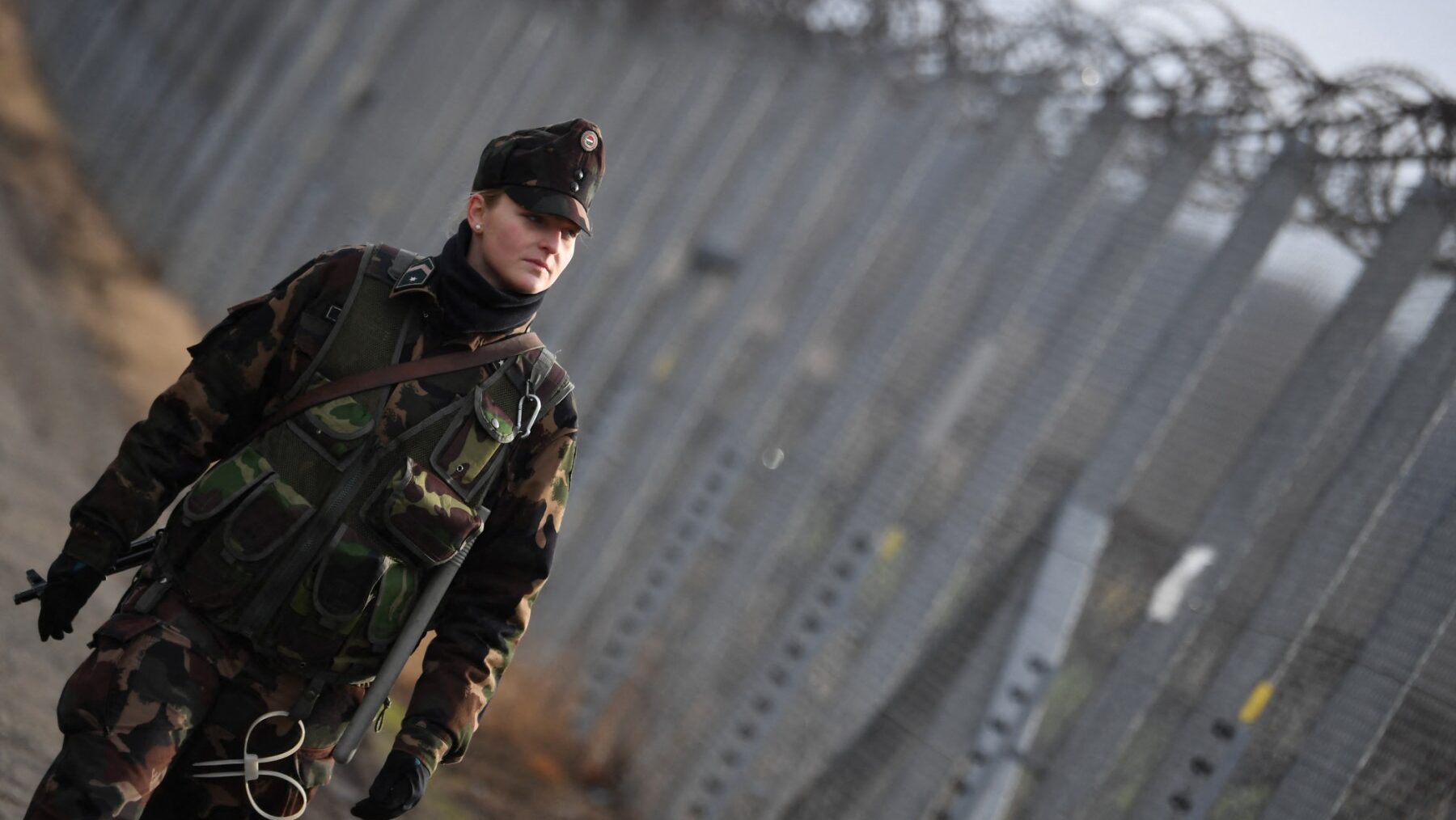
A border soldier patrols along the border fence at the Hungarian-Serbian border near Hercegszanto border station on December 14, 2017. Since July 2015 Hungary secured the more than 300-km-long border to Serbia with the construction of a fence and 24 hours a day security patrol tasks. Several thousand soldiers participate in search and sweep operations securing the surveillance of the area with UAVs and rotary-wing aircraft.
Attila Kisbenedek / AFP
A decade after being vilified for sealing its southern border during the migration crisis, Hungary marked the tenth anniversary of the erection of its border fence with Prime Minister Viktor Orbán declaring that the country had “stood firm” where others had faltered.
In a statement issued on Monday, September 15th, Orbán recalled that “Brussels slammed the table and threatened us; Western capitals smeared us,” but argued that Hungary’s resolve had prevented illegal migration and preserved public safety. “Only those we allow may step on Hungarian soil,” he said.
What happened in ten years? In Berlin, Stockholm, Vienna, and Paris, public safety is in ruins. Migrant gangs terrorise the people. Bombings, car attacks, and murders have become everyday events. In London, 100,000 people marched against migration. The British have had enough—they want their country back. Meanwhile, Hungary has become one of Europe’s safest countries. Crimes against life and property are at record lows. The number of illegal migrants: zero.
🔒@PM_ViktorOrban: Ten years. A decade. That’s how long we’ve been protecting our homeland and Europe from illegal migration. Ten years since we introduced the legal border barrier. Brussels slammed the table and threatened us; Western capitals smeared us. But we Hungarians stood… pic.twitter.com/1Pfy5emi8P
— Zoltan Kovacs (@zoltanspox) September 15, 2025
In an interview, Chief Security Advisor György Bakondi said that the Hungarian border fence had blocked more than 1.1 million illegal crossings since 2015, achieved without receiving political or financial support—“not even a good word.”
He also recalled the tenth anniversary of the so-called “Battle of Röszke,” when, on September 16, 2015, groups of illegal migrants clashed with Hungarian border guards in an attempt to force entry. “It became clear then that illegal migration was organised, directed, and financed,” he said.
Not only did Brussels not encourage Hungary to defend itself, but it also punished the Central European nation for protecting its own borders: despite European citizens’ growing frustration over pro-migration EU policies, the European Court of Justice last year fined Hungary €200 million and imposed a €1 million daily penalty.
Orbán complained that the bureaucrats in Brussels “still want to manage migration instead of stopping it.”
They said migration could be managed; we said it must be stopped. Today in Hungary the number of illegal migrants is ZERO! No street gangs, no antisemitism, no violence, no unrest. Hungary belongs to the Hungarians, and Europe must belong to the Europeans! 🇭🇺 pic.twitter.com/98FWAwBLfp
— Orbán Viktor (@PM_ViktorOrban) September 15, 2025
On Monday, Orbán also criticised Sweden for neglecting common sense and the safety of its citizens.
The abandonment of traditional values, the neglect of common sense, and weak governance have led to barbarism taking root in the home of one of Europe’s greatest nations. Criminal gangs are using underage girls as instruments of killing.
The prime minister was referring to Swedish crime statistics, according to which 280 girls aged between 15 and 17 were charged with murder, manslaughter, or assault in 2024.
The abandonment of traditional values, the neglect of common sense, and weak governance have led to barbarism taking root in the home of one of Europe’s greatest nations. Criminal gangs are using underage girls as instruments of killing.
— Orbán Viktor (@PM_ViktorOrban) September 15, 2025
The mission of the rule of law is to… https://t.co/X2X1Buh60Y
Swedish Prime Minister Ulf Kristersson dismissed the claim as “outrageous lies,” but the fact remains that left-liberal governments in Western Europe have indeed pursued pro-migration policies, allowing hundreds of thousands of unvetted migrants to arrive, create parallel societies, and live in a state of lawlessness.
Public frustration over migration is fuelling unrest and demonstrations, including recent anti-immigration protests in London.
Orbán’s message comes as anti-immigration parties across Europe have been gaining ground, capitalising on public frustration over migration and security concerns.
From the UK to Italy and Germany, these parties have seen rising support in local and national elections, challenging the policies of the ruling elites.