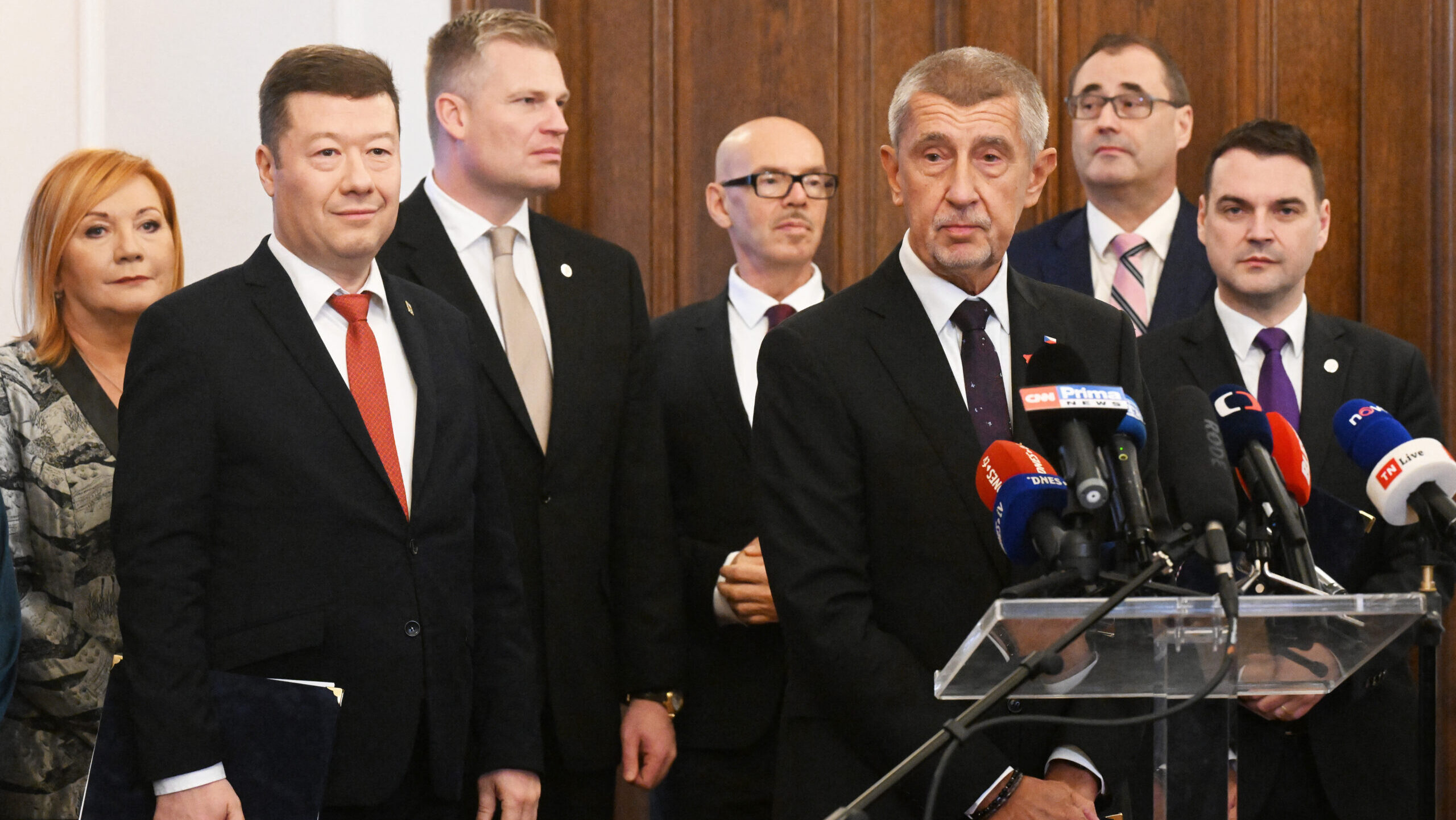
Andrej Babis (3rd R) speaks to journalists after signing a new coalition government agreement with the leader of SPD party Tomio Okamura (2nd L)
Michal Cizek / AFP
The first diplomatic controversy of 2026 in Central Europe was not about sanctions or battlefield developments, but about a political speech. A New Year’s address by Tomio Okamura, Speaker of the Czech Chamber of Deputies and leader of the Freedom and Direct Democracy (SPD) party, has triggered a public clash between Prague and Kyiv that goes beyond one politician’s remarks.
Okamura’s blunt criticism of continued military aid to Ukraine, including personal attacks on the country’s leadership, prompted sharp reactions from Ukrainian officials and renewed calls by Czech opposition parties for his removal from office.
But treating the episode as merely the excesses of a controversial politician misses a larger point. While Okamura’s language was confrontational, the underlying argument he raised—whether Czech support for Ukraine should remain open-ended and largely shielded from domestic debate—resonates far beyond his party. It reflects a broader shift underway in Prague following the change of government: one that prioritises fiscal responsibility, national sovereignty in decision-making, and clearer limits on foreign commitments.
In his address, Okamura argued that Czech public funds should first serve pensioners, families, and vulnerable citizens at home before being committed indefinitely to a distant war. He framed the war as increasingly disconnected from Czech national interests and criticised what he described as a war economy that benefits political and industrial elites in the West. His remarks about President Volodymyr Zelensky and Ukraine’s leadership crossed diplomatic norms, but the core question he raised—who pays, for how long, and under what democratic mandate—remains central to the Czech debate.
Kyiv’s response was swift and uncompromising. Ukraine’s ambassador in Prague, Vasyl Zvarych, condemned the speech as “undignified and wholly unacceptable,” accusing Okamura of reproducing Russian narratives. The chairman of Ukraine’s parliament, Ruslan Stefanchuk, went further, openly questioning Okamura’s motives and legitimacy.
Czech opposition parties quickly moved to capitalise on the controversy, announcing an initiative to remove Okamura from the speakership because he had damaged the country’s international standing. They insist that his remarks reflect only a personal view, not that of the Czech Parliament or society at large.
Procedurally, that distinction holds. Politically, it is less convincing.
The current Czech government has clearly taken a more cautious line on Ukraine than its predecessor, which positioned Prague as one of Kyiv’s most enthusiastic backers in Central Europe. While the new leadership has avoided inflammatory rhetoric, it has drawn firm boundaries: opposition to further EU joint debt for Ukraine, reluctance to commit to long-term funding schemes, and a stronger focus on domestic economic pressures.
Prime Minister Andrej Babiš has repeatedly voiced scepticism toward additional military aid and EU loans for Kyiv, even as he has sought to keep relations with Ukraine formally correct. Symbolic gestures, such as the removal of the Ukrainian flag from the parliament building, were controversial but also signalled a move away from symbolic alignment toward a more interest-based foreign policy.
In this sense, Okamura said bluntly what the government expresses more carefully: Czech support for Ukraine continues, but it is no longer unconditional, unlimited, or immune from democratic debate.
The episode also raises a broader European issue. At what point does political disagreement become unacceptable to express? Okamura’s tone warrants criticism, but the broader attempt to delegitimise scepticism itself—by equating it with disloyalty or foreign influence—risks shrinking the space for democratic debate across Europe.
In many EU member states, particularly in Central and Eastern Europe, public opinion is increasingly divided over the scale, cost, and duration of support for Ukraine. Inflation, budget strain, and social pressure are not abstract talking points but everyday realities. Acknowledging them does not weaken European democracies; ignoring them does.