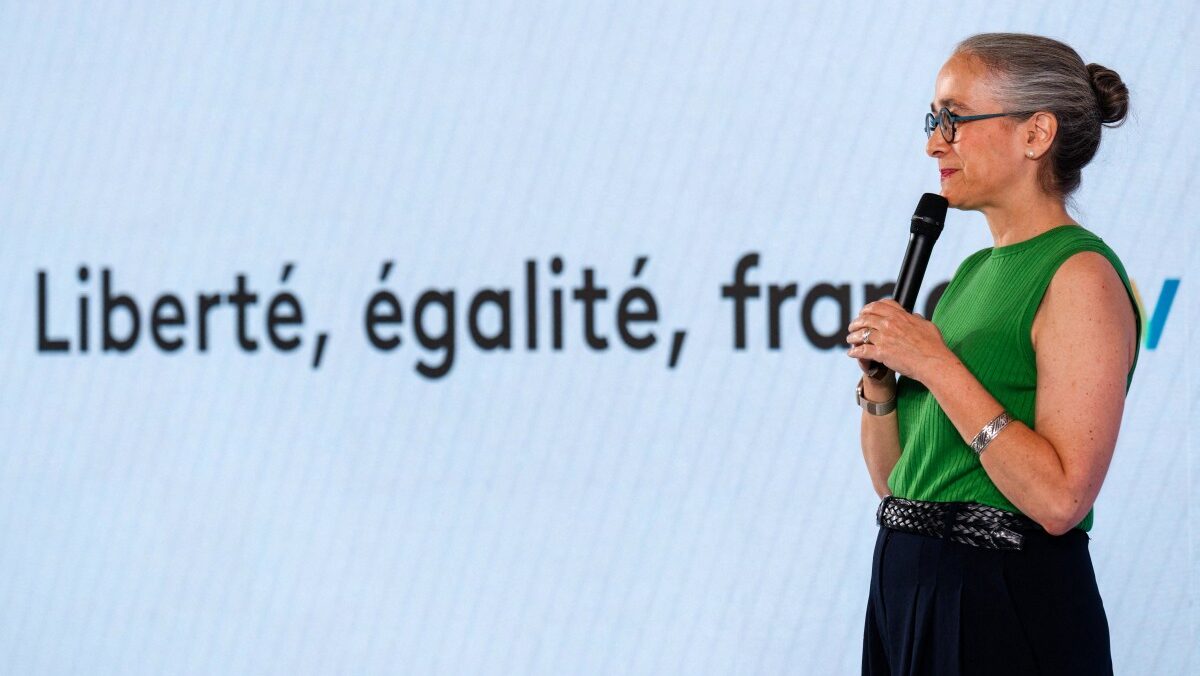
French Television chief executive Delphine Ernotte speaks during a press conference to present the new season of France Televisions audiovisual group in Paris on July 8, 2025.
DIMITAR DILKOFF / AFP
A parliamentary inquiry is now targeting France Télévisions and Radio France, the French public broadcasting and radio services. The aim is to determine whether there have been any breaches in financial management or in the ideological orientation of their programmes. The initial findings of the inquiry are damning for the executive teams—but the mainstream media, seemingly uninterested in doing their job, are currently maintaining a cautious silence in the face of these conclusions.
A commission has been officially appointed to investigate “the neutrality, functioning, and financing of public broadcasting.” It was created on October 28th at the request of deputies from the Union of the Right for the Republic (UDR), allies of the Rassemblement National (RN). Composed of 30 deputies from across the political spectrum, it began its work in November and has six months to submit its conclusions.
The UDR’s request is a response to the commission of inquiry that was requested in early 2025 by the Left against the private channels of the Canal+ group, owned by Catholic billionaire Vincent Bolloré, and, notably, the conservative channel CNews.
The press had given extensive coverage to the work of the commission launched against CNews. This time, the media are much more discreet. And for good reason.
One figure stands out in the investigation: the president of France Télévisions, Delphine Ernotte, whose appointment to this key position caused quite a stir. At the time, she made no secret of her ideological bias, in defiance of the neutrality that public service broadcasting is supposed to embody. But it is above all her disastrous management that emerges from the analyses of the Court of Auditors, the state body responsible for monitoring public spending.
As revealed by UDR deputy Charles Alloncle, rapporteur for the commission, Ernotte is responsible for incredible financial mismanagement. “After plunging France Télévisions into a state of near bankruptcy, with the risk of dissolution in 2026, accumulating a deficit of more than €81 million, multiplying strategic errors and failing to meet her commitments for more than ten years, Delphine Ernotte will nevertheless receive a performance bonus this year,” he reveals on X. Risky investments (€700 million spent on the renovation of the Maison de la Radio alone, for example) go hand in hand with exorbitant salary privileges denounced by the Court of Auditors. The average salary at France Télévisions is €71,490 per year, placing its employees among the richest 9% of French people. Added to this are an average of 12 weeks of paid vacation and up to 14 weeks for Radio France journalists. There is no justification for such high levels of remuneration or the benefits enjoyed by France Télévisions and Radio France employees. France Télévisions management has also benefited from favours in kind paid for by dependent private production companies—contrary to all ethical rules in this area.
But it gets worse. The investigation reveals that France Télévisions management allegedly intervened in May 2025 to pressure the auditors of the Court of Auditors to delay the publication of a highly critical report on the financial management of the organisation, at the very moment when Delphine Ernotte was seeking a third term as president.
The most serious aspect of these revelations is that these countless breaches of the financial restraint that any organisation operating on public funds must respect, as well as of basic ethics and professional conduct, were used to serve a left-wing ideological agenda, openly biased and endorsed by management.
Delphine Ernotte distinguished herself with violent accusations against CNews, vilified as a “far-right channel.” But CNews remains a private channel, accountable for its statements only to its listeners. Ernotte, for her part, has put the public audiovisual medium at the service of her own ideological views. Upon taking office, she declared, “We have a television channel run by white men over 50, and that has to change.”
Unease or admission of guilt? For the moment, the public service has not communicated about the ongoing investigation in its news programmes, reveals Le Journal du Dimanche. A single brief invitation was sent to Charles Alloncle to come and testify on France Info, with one-sided questions. “Isn’t the idea to destroy public broadcasting? There is clearly a political agenda behind this,” protested presenter Nathalie Saint-Cricq, who clearly did not appreciate the state media’s activities being scrutinised in this way by parliamentarians.
The tide is clearly turning for French public broadcasting, thanks in part to the groundwork laid by the Bolloré Group’s media outlets, including Europe 1 radio, Le Journal du Dimanche for print media, and CNews for television, or by independent media such as the conservative magazine L’Incorrect. The public institution is no longer in a position to impose its ideological monopoly on information. Public channels are losing audience share. Scandals are multiplying, such as the one that a few weeks ago revealed the collusion and collaboration of journalists from the public network in favour of the Socialist Party. Evidence of the rejection of pluralism is mounting, with investigations such as the one conducted by the Thomas More Institute proving the massive imbalance of public radio morning shows in favour of the left.
Delphine Ernotte is due to testify at a hearing on Wednesday, December 10th. Will she continue to twist the facts before the representatives of the nation, with the bad faith that has been her preferred professional method for so many years?