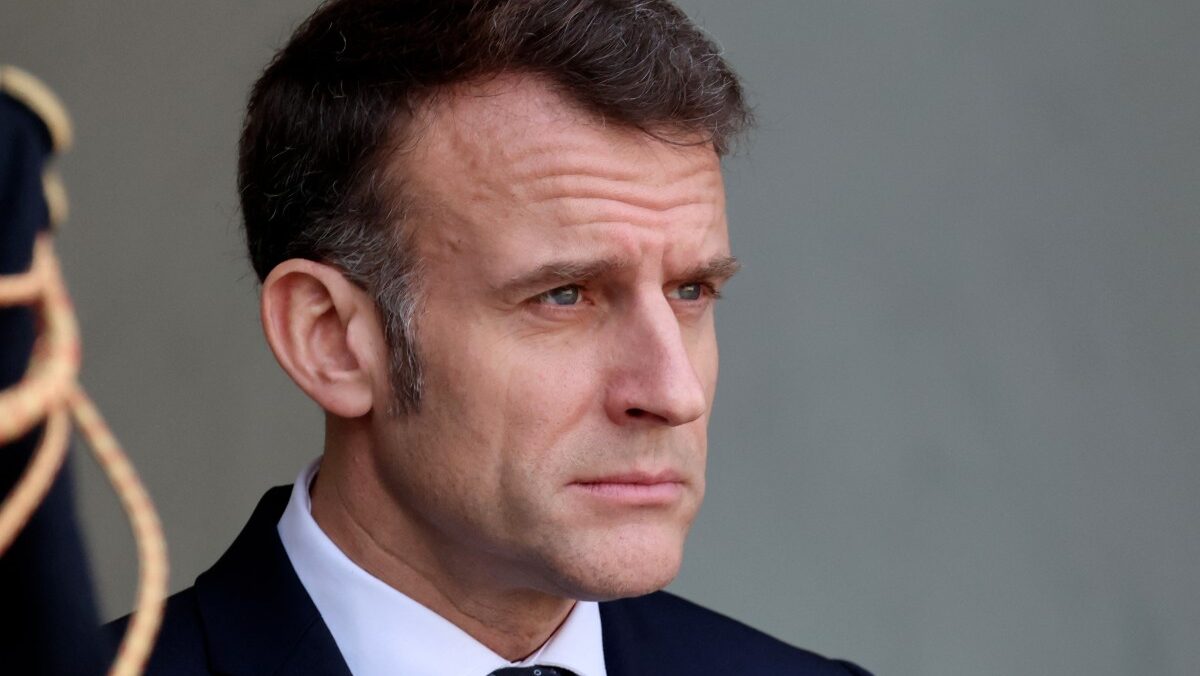
France’s President Emmanuel Macron waits for the arrival of Finland’s President Alexander Stubb for a meeting at The Elysee Presidential Palace in Paris on February 23, 2026.
Ludovic MARIN / AFP
Emmanuel Macron appears to want the world to stop talking about the brutal beating in Lyon—by leftist activists—that led to the death of Quentin Deranque, a 23-year-old patriotic activist. And it’s no wonder, given that even establishment publications say it could result in a significant political shift—“completing,” as the BBC put it, “the ‘de-demonisation’ of the Rassemblement National so fervently pursued by its leader Marine Le Pen, and making new ‘demons’ out of the radical left.”
As such, the president’s team said on Sunday that it would summon the U.S. ambassador to Paris over comments made by Donald Trump’s administration about the killing.
The U.S. Embassy in Paris on Friday shared a statement from Trump’s Department of State Bureau of Counterterrorism, pointing to information that Deranque was “killed by far-left militants,” and that this should “concern us all.”
Violent left-wing extremism is on the rise, and its role in the death of Quentin Deranque demonstrates the threat it poses to public safety.
Les informations, corroborées par le ministre français de l'Intérieur, selon lesquelles Quentin Deranque aurait été tué par des militants d'extrême gauche, devraient tous nous préoccuper.
— U.S. Embassy France (@USEmbassyFrance) February 20, 2026
L'extrémisme violent de gauche est en hausse et son rôle dans la mort de Quentin Deranque… https://t.co/90BOijTxhR
Trump’s team also denounced what it called “terrorism” in France.
French Foreign Minister Jean-Noel Barrot later told news outlets, “We reject any attempt to use this tragedy … for political purposes,” adding:
We are going to summon the United States ambassador to France, since the U.S. embassy in France commented on this tragedy … which concerns the national community.
In actual fact, the so-called ‘antifascist’ La Jeune Garde group that has been implicated in the killing—including by Macron’s own team—is understood to have links to other countries, suggesting the scope of this situation is not as limited as the president would like others to believe.
France has similarly bashed Italian Prime Minister Giorgia Meloni for (correctly) describing the crime as “a wound for all of Europe,” by asking Rome not to “comment on what is happening in other countries.”
This is illustrative of Europe’s wider inability to respond to Antifa-linked violence in the same way that, say, Trump’s administration does in the U.S., preferring instead to downplay such bloody attacks and to pretend that they are not parts of a much wider problem.