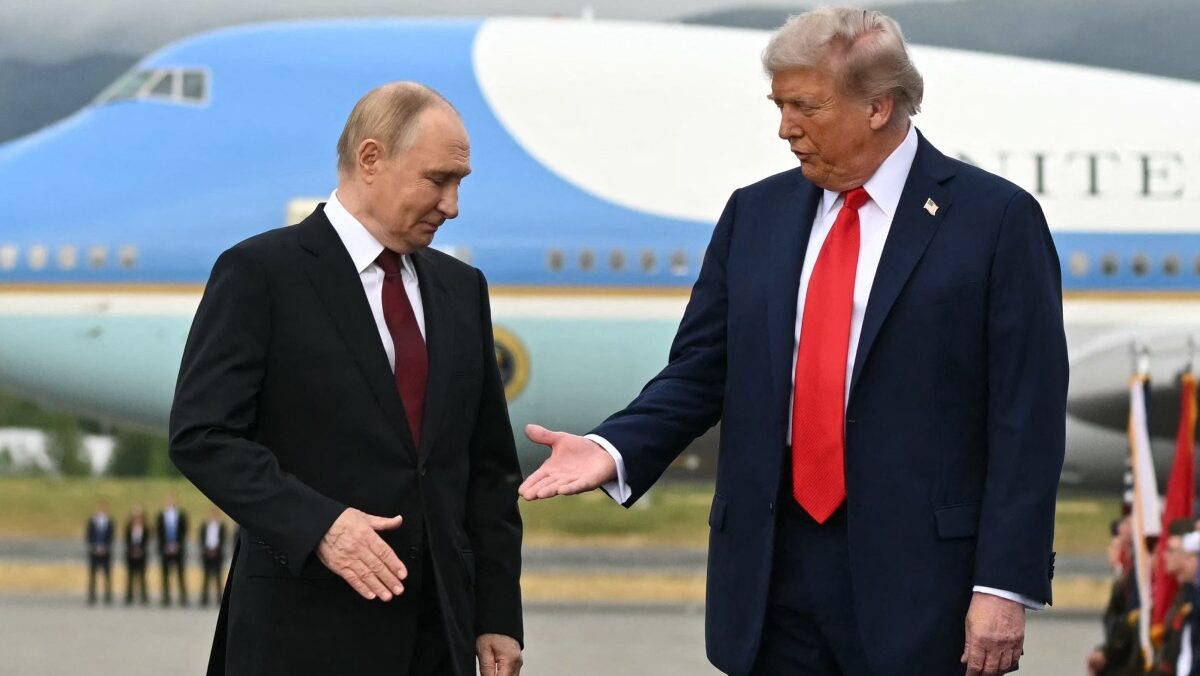
U.S. President Donald Trump (R) reaches out to shake hands with Russian President Vladimir Putin as they pose on a podium on the tarmac after arrival at Joint Base Elmendorf-Richardson in Anchorage, Alaska, on August 15, 2025.
Andrew Caballero-Reynolds / AFP
Two days after the high-stakes Alaska summit between U.S. President Donald Trump and Russian President Vladimir Putin, details of the three-hour closed-door talk have started leaking to the media.
According to several sources, Putin’s demands include the largely Russian-populated Donbas region in eastern Ukraine. In exchange, Russia would return occupied territories in northern Ukraine and freeze the front lines in the southern regions of Kherson and Zaporizhzhia.
Sources—who admitted they may not have the entire picture—also told Reuters Russia is seeking formal recognition of Russian sovereignty over Crimea, which Moscow annexed in 2014.
The discussed agreement would reportedly prohibit Ukraine from joining NATO—a point of contention for Russia from the outset. However, Trump reportedly offered NATO Article 5 ‘security guarantees’ to Ukraine if a peace agreement is reached, meaning NATO countries would be obligated to intervene if Russia again attacked Ukrainian territory.
Moscow would also demand guarantees that the Russian Orthodox Church can operate in Ukraine without government interference and that the Russian language is given official status.
Putin said the talks had been “timely” and “very useful” and warned Ukraine and Europe to not engage in any “behind-the-scenes intrigues” that could disrupt “this emerging process,” AFP reported.
On the social media platform Truth Social, Trump called the meeting “very successful” and announced that the next step would be Ukrainian President Volodymyr Zelensky flying to Washington, D.C., on Monday, which Zelensky verified on Telegram on Saturday night. Trump also said there was agreement that going for a full peace agreement rather than a ceasefire was the best way to move forward.
A number of European leaders have also been invited to the U.S. gathering. If that meeting goes well, Trump said, a trilateral meeting between himself, Zelensky, and Putin could be planned. The move was supported by European leaders, who held two calls with Trump on Saturday—one with and a later one without Zelensky.
German Chancellor Friedrich Merz proposed in a TV interview on Saturday that such a meeting take place in Europe—a suggestion that might pose a problem for President Putin, who has an arrest warrant out for him from the International Criminal Court (ICC). The U.S. is not a party to the ICC, and Hungary is in the process of withdrawing from the treaty.
The ‘coalition of the willing’ was expected to hold a video conference Sunday to discuss the latest developments.
Hungarian Foreign Minister Péter Szijjartó welcomed the progress made at the Alaska summit and said Hungary has “been arguing for ceasefire and peace negotiations for three and a half years, because we know that the solution is only at the negotiating table and not on the battlefield. … It would be nice if the process started in Alaska was not suspended this time!”
EU High Representative Kaja Kallas, however, was less optimistic. While calling Trump’s efforts “vital,” she said, “Russia has no intentions of ending this war any time soon,” and emphasized that the EU will continue its work on another sanctions package against the country—the bloc’s 19th.
President Trump’s resolve to get a peace deal is vital.
— Kaja Kallas (@kajakallas) August 16, 2025
The EU and our European partners worked to coordinate with President Trump ahead of Alaska meeting.
But the harsh reality is that Russia has no intention of ending this war anytime soon.