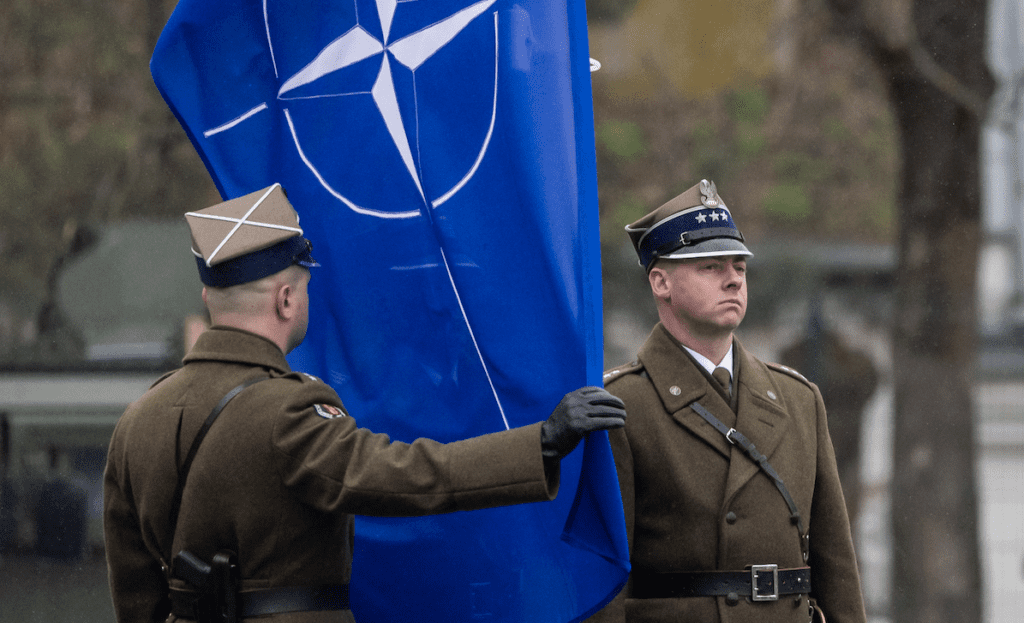
Polish soldiers raising a NATO flag during a March 2024 ceremony commemorating the 25th anniversary of Poland joining NATO.
Wojtek Radwanski/AFP
Brussels is preparing for the 2024 European Parliamentary elections beneath the shadow of conflict in Europe. You may not be interested in war, but war is interested in you.
A Trump victory, Putin’s Russia, an ascendant China: all are prompting the European Union to rethink its military standing. Far removed from its origins as a Franco-German-led trading bloc, today’s EU would gladly transform itself into a ‘geopolitical union’ capable of picking up the reins from the United States—whoever is in the White House— and even NATO in a changing world. How you vote can influence this process, signaling whether or not you accept this risky direction of travel.
Should slow-moving Brussels officials be running a wartime economy for the next five years? No. However, the EU will be flexing its defense policy biceps by trying to encroach more on territory traditionally occupied by both NATO and the member states themselves.
Europe is not an entirely negligible force in arms manufacturing, but Brussels believes it will shortly need more boots on the ground and an autonomous military infrastructure to grapple with a multipolar world. Washington is looking more and more to the Indo- Pacific, giving Europeans a larger responsibility for their own defense.
Eurocrats have used the Ukrainian invasion to accelerate pre-existing plans for further centralization, masterminded by Thierry Breton, a former French finance minister who has served as commissioner of the EU’s Internal Market since 2019. He has spearheaded various defense initiatives such as the Act in Support of Ammunition Production (ASAP) and the EU’s euphemistically named Peace Facility, aiming to pool Europe’s defense capabilities.
Seen through the lens of Brussels bureaucrats, the European countries’ separate military budgets are simply a nostalgic hindrance to protecting the besieged bloc. The EU hopes to get better bang for its buck by sharing the costs and duties of defense at a transnational level.
This worldview is not shared by defense manufacturers and military experts, who view the Brussels circus as too sluggish to handle real military matters. Most expect true military competencies to stay firmly with NATO and various European capitals for the time being, regardless of the Eurocrats’ rhetoric.
If the working concept of an EU army still looks more like a federalist fantasy, there is no denying that initiatives regarding collective defense have advanced considerably since 2022 and will continue to do so into the next mandate period, offering smaller European militaries better economies of scale by ‘pooling’ (i.e. surrendering) sovereignty.
The recently launched EU naval mission to protect shipping in the Red Sea (Operation ASPIDES) could be seen as a trial run for future deployments outside of Europe. Also away from NATO, EU rapid response battlegroups could see action in Armenia, North Africa, or even the Western Balkans.
European countries are rapidly increasing their defense budgets. NATO chief Jens Stoltenberg expects 18 of the alliance’s 32 member states—including France and Germany—to reach the goal of 2% of GDP in 2024. Few will match Poland’s commitment to this target, but all are nervous that an incoming Trump administration would make NATO members ‘pay their way’—or else!
Germany, the former powerhouse of European defense despite its restrictive— almost pacifist—constitution, is slipping behind, not helped by various espionage scandals within the Bundeswehr. It’s worth remembering the mismanagement of Germany’s military began under EU Commission President von der Leyen herself when she was the country’s defense minister.
Neighboring France continues a phased withdrawal from Africa in the face of a series of Russian-influenced revolts in the Sahel—the southernmost region of North Africa between the Atlantic and the Red Sea. French martial prestige has declined in reputation over the past five years with the ongoing dissolution of the Françafrique bloc. Non-state actors such as Russia-based Wagner mercenaries have proved more agile on the modern battlefield, while America, Russia, Islamists, and local junta leaders fill the vacuum left by fading French influence.
Outside the ‘Eurobubble,’ the invasion of Ukraine jump-started a new era of European rearmament and boosted Poland’s military standing, with Warsaw committing 4% of its GDP to defense spending and becoming America’s preferred EU partner for dealing with Russia, edging out an ailing Germany.
Within the ‘Eurobubble,’ Ukraine has proved a divisive issue. Pledges of military aid go unfulfilled, inviting complaints from Kiev. Hungary—proponent of peace talks and a conventional EU accession process for Ukraine—has been scapegoated and defamed as Putin’s ally. Special treatment of Ukrainian agricultural produce has angered European farmers.
‘Pooled sovereignty’ cannot overcome the divergent interests and political strategies of the different member states.
Defense is no exception, as even centrists fear the effect the dead hand of Brussels bureaucracy could have in mismanaging military matters.
As to future relations with China, the Netherlands, Czechia, the Baltics, and more recently Italy, appear to be taking a firm Atlanticist line going forward, as opposed to the more open-minded Hungary and Spain. The EU is far from nailing down a common foreign policy line, despite continued attempts to remove national vetoes under the guise of ‘rule-of-law’ disputes.
The defining theme of the EU’s treatment of defense and security in this year’s European elections is division. As Brussels scrambles to act like a superpower in a multipolar era, it can scarcely understand the world around it, let alone develop a coherent policy.
When deciding who to vote for, we should recognise that the current belligerent mindset in the EU institutions could lead us to disaster. In contrast, a strong emphasis on national sovereignty—reflected in the representatives we sent to the European Parliament—could help to scrutinize properly the potential dangers we now face or, better still, rein them in.