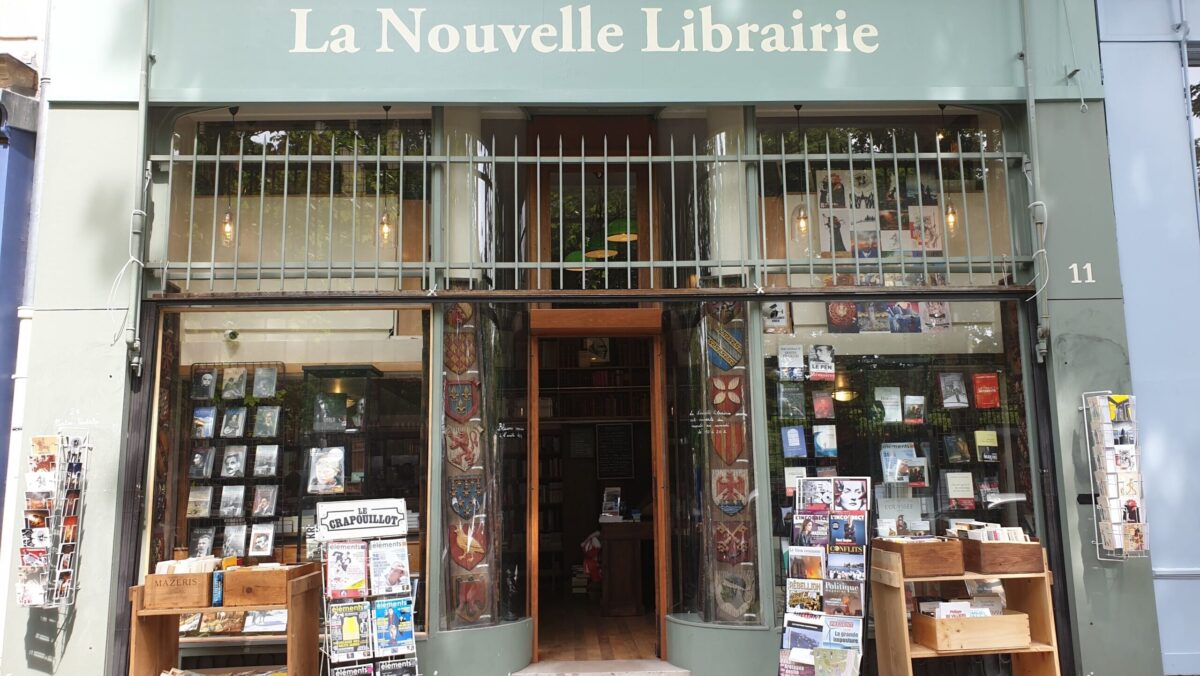
In the leafy streets of Paris’ Latin Quarter, where the Seine in the sun reflects the ancient buildings, a small bookshop once stood as a defiant sentinel. But La Nouvelle Librairie, at 11 rue de Médicis, was no mere vendor of texts. It was a sanctuary for intellectual refugees—a place where ideas of tradition, identity, and heritage were debated, celebrated, cherished.
Founded in July 2018 by the journalist François Bousquet—editor of the dazzling journal Éléments—the bookshop shone like a beacon for six years. In a city that prides itself on ideas—yet recoils from anyone who challenges its liberal-Left, progressive orthodoxies—it became, to its devotees, a shrine of free, heterodox thought; to its foes, a provocation. Both glimpsed a fragment of truth.
Bousquet—a wiry intellectual with the intense, impatient zeal of a modern prophet—envisioned the bookshop as a cultural redoubt, a salon where the ghosts of Burke, Chateaubriand, Maurras, and Spengler might all converse with the living. Its shelves brimmed with a curated selection of new and vintage books, weaving past and present into a rather defiant narrative. Works by Alain de Benoist and Guillaume Faye, both theoreticians of the French New Right, could be found next to old, weathered tomes, such as rare editions of Maurras’ nationalist tracts, forgotten chronicles of empire, and memoirs of heroic figures like Raoul Salan—the French general whose leadership in the Algerian War, and role in the 1961 putsch against de Gaulle, as in the founding of the O.A.S. (Organisation armée secrete), a clandestine terrorist organization, marked him as both patriot and pariah. (It was here, amid the scent of old leather and fresh ink, that this writer once acquired a signed four-volume hardcover set of Salan’s 1970-74 memoirs (with pages that could be described as “heavy with the anguish of a fractured France”)—a testament to the shop’s knack for unearthing relics of a forgotten, forsaken Europe.
In the bookshop, Bousquet—often found amid the stacks—was no mere shopkeeper but a Virgil to his visitors, guiding them through the historical labyrinth of conservative thought with an easy erudition that disarmed even the skeptical. The shop fostered a conversation across centuries, connecting the battles of today to the struggles of yesterday—from the Dreyfus Affair to the fall of Algérie Française.
The Latin Quarter, with its ghosts of revolutions—Abelard’s medieval disputations, the barricades of 1848, the student riots of May 1968—was certainly an audacious stage for a right-wing bookshop. This was the neighborhood of Camus and Sartre, a bastion of left-wing radicalism where the air used to crackle with the slogans of utopian revolutionaries. Bousquet knew the peril of planting a conservative flag in this hallowed ground.
Upon its opening, the French media described the shop as “non-conformist” and described its opening as a bold event in an already polarized city. But hostility struck swiftly. In September 2018—less than two months after opening—‘antifascist’ vandals smeared the shop’s windows with graffiti and glued its locks shut, a petty but pointed assault. Such attacks were later fueled by other provocative articles decrying “the Latin Quarter under assault by a bookshop of the extreme Right.” Bousquet responded with silence—one that spoke to his resolve to let the shop’s existence be its own retort.
Such attacks of course increased the shop’s renown. La Nouvelle Librairie became a symbol for France’s conservative and populist movements—a lighthouse in a storm of cultural erasure.
In February 2019, during the gilets jaunes protests against the Parisian elites, the shop faced another assault. Masked Antifa radicals, splintering from a nearby march, began hurling threats and insults at the shop. Yet, in a moment of providential irony, the gilets jaunes—thought to be unlettered members of the working class—formed a protective cordon around the shop, fending off attackers. Bousquet later told the magazine Causeur that it had been “the people not intellectuals” who had protected the shop. One could say that, for an instant, the bookshop seemed to bridge the chasm between the world of heady ideas on its shelves and the visceral rage on the streets of France.
La Nouvelle Librairie was more than a bookshop; it was a node in a growing network of right-wing cultural projects—from Éléments magazine to the Institut Iliade, a think-tank dedicated to European heritage. Bousquet’s mission extended beyond the shop’s walls through Éditions La Nouvelle Librairie, a publishing division launched in August 2019. The imprint brought forth works that upheld the European spirit—cultural polemics, historical reappraisals, philosophical treatises—ensuring ideas too bold for mainstream presses found a home. By 2022, it had published over 100 titles, gaining prominence in identitarian right-wing circles and cementing its role as a cultural force.
Bousquet saw publishing as a metapolitical act, drawing inspiration from the New Right’s adaptation of Antonio Gramsci’s concept of cultural hegemony. By seeding the intellectual landscape with works that challenged globalism’s homogenizing tide, Bousquet aimed to shift France’s center of gravity—fostering a renaissance of identity, heritage, roots. He plans to continue with book publishing. And with its steady output of provocative titles, Éditions La Nouvelle Librairie will continue to serve as an intellectual engine in the ecosystem of the French Right, publishing works that echo the shop’s ethos and reach readers far beyond Paris.
Within its walls, La Nouvelle Librairie was a haven of camaraderie and argument. Its events were eclectic and electric: lectures on Spengler’s Decline of the West; signings for Bousquet’s own La Droite buissonnière (a meditation on France’s conservative revival); discussions with French patriots like Éric Zemmour, Jean-Marie Le Pen, and Renaud Camus. The crowd was a tapestry of France’s conservative undercurrent: young, fresh-faced activists from Génération Identitaire; grey-haired monarchists dreaming of a lost Orléans; disillusioned Republicans seeking a new banner; and even the occasional leftist, drawn like a moth to the flame of intellectual combat—for here, the air seemed to crackle with the thrill of the forbidden.
Bousquet’s vision was nothing less than a cultural reconquest, a highbrow counterpart to the populist surge of Marine Le Pen’s National Rally and Éric Zemmour’s Reconquête. For a time, it seemed possible. The shop’s opening seemed to coincide with a broader awakening across Europe—Viktor Orbán’s Hungary, Matteo Salvini’s Italy, the stirring of national identities from Warsaw to Lisbon. La Nouvelle Librairie rode this wave, offering a space where ideas could breathe, where the European soul could find its voice amid the clamor of globalism’s siren song.
Yet the world is unkind to those who swim against the tide. The bookshop’s niche—its very strength—was its Achilles’ heel. Its focus on conservative, identitarian, and counter-revolutionary texts, whether newly minted or salvaged from the discard pile at a local library, limited its market in a city bewitched by the glitter of cosmopolitanism. In addition, the rise of Amazon’s algorithmic juggernaut chipped away at sales. The Latin Quarter’s prestigious address also came with a punishing rent, a constant drain on the shop’s coffers. Vandalism and protests, ever a threat, necessitated costly security measures, each incident a reminder of the price of dissent.
By April 2024, the writing was on the wall and Bousquet announced the closure. Its final weeks were a bittersweet requiem, as loyal patrons flocked to buy books and share memories of debates that had set their minds ablaze. On May 28 of last year, the shop closed its doors for the last time, and a silence fell upon rue de Médicis.
It is no exaggeration to say that the bookshop’s closure has been a loss not just for Paris but for the West. It is a betrayal of the intellect—and a reminder that this ultimately is a battle for cultural survival. (It’s also a reminder that in today’s public square there is no room for conservatives.) The shop stood as a challenge to the homogenizing forces of globalism, to the intellectual conformity that stifles debate, to the erosion of the particular in favor of the universal. It was a library of resistance—a bulwark against forgetting.
A regular visitor on my occasional visits to Paris, I can attest that the shop was neither fascist nor revolutionary. Simply put, you could find anything that was not Left or Marxist. More importantly, it was a testament to the enduring power and importance of books [something this journal, too, celebrates]—those fragile vessels of human thought—in an age increasingly dominated by the ephemeral flicker of screens and the cacophony of social media.
While Bousquet continues to wield his pen at Éléments, there are rumors of new projects: perhaps an expansion of Éditions La Nouvelle Librairie, or another cultural outpost to carry the torch. Meantime, La Nouvelle Librairie is survived by a loyal readership, a battered but unbowed conservative subculture, and thousands of books now scattered across private shelves. Its story is a testament to the power—and peril—of standing athwart history, yelling “Stop!”
This tribute appears in the Summer 2025 issue of The European Conservative, Number 35: 128-130.