Ever true to his origins, Jean-Marie Le Pen liked to say that his surname meant ‘boss’ in Breton. Yet it is ironic to hear his enemies and detractors now calling him that. An intelligent man and a cunning politician, he was also ironic, and he often used irony as a weapon in verbal confrontations.
His career was as difficult as it was formidable: from his humble beginnings to his election as MP when he was just 27 years old; from his experience as a volunteer fighter to the founding of the Front National (FN); from 1972 onwards until he reached the second round of the presidential elections, 30 years later, to general astonishment. He inspired passion and hatred, and he suffered political, personal, and family attacks; but he never gave up.
The press was eager to see his failures, but Le Pen was able to combine erudition with truculence into a combative eloquence. Unsurprisingly, he became a media phenomenon and an important political figure in France and Europe. He was an inspiration for many European movements and parties. It is therefore easy to understand why a man who had lived through war and political struggle with the greatest of his time would regard today’s politicians in the way that a giant would view a bunch of dwarfs.
In 1997, in Libération, Jean Baudrillard wrote that “The only political discourse in France today is that of Le Pen. All the others are moral and pedagogical, the rhetoric of teachers and lecturers, managers and programmers.” He made mistakes and excesses, he was uncompromising, provocative and aggressive, but he always defended his France, his people, and his civilization. He was eternal in resistance.

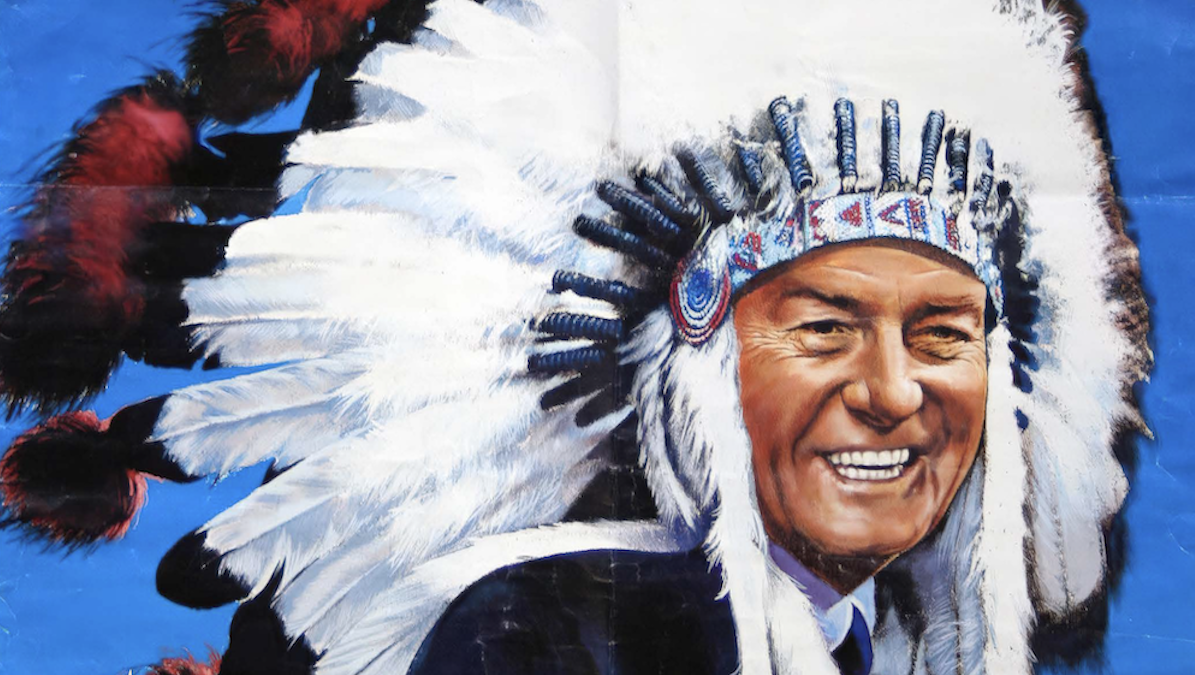
There is an iconic poster from the 1990s, made by the FN Youth, showing a smiling Le Pen, wearing an Indian ‘war bonnet’ with feathers on his head, that reads: “Let’s get out of our reservation!” The iconic image was as attractive as it was intriguing. After all, were the French the new redskins? In the second volume of his memoirs, Jean-Marie Le Pen wrote that he wanted to “speak our truth” and asserted himself as “the tribune of a disappearing tribe, the last of the French Mohicans.” For him, the Indian reservation of the French was “silence” and he described the condition of his compatriots today:
We still have the right to exist, to live, or rather to survive, but this lifelong tolerance comes with one condition: we must remain silent, not appear in the visible country that has replaced the real country. We are tolerated only as long as we do not officially exist.
In this deafening silence, Le Pen was the cry of resistance.
His enemies—experts in deceptive caricature—will inevitably point to all his faults; but these matter little because they are just minor aspects of an extraordinary life dedicated to the defence of country. Demonstrating remarkable intuition, Le Pen foresaw the coming migratory flood and its catastrophic consequences for France and Europe. He also denounced the globalism that was destroying many countries.
Jean-Marie Le Pen was a prophet whom no one believed, with his warnings about mass immigration—the vital threat to Europe that has today become our most fundamental challenge. But by his example and tenacity, as well as by his firmness and longevity, he showed that nothing is doomed from the start—and that in the face of defeatist fatalism, we must always remember that where there is a strong enough will there is a sure enough way.
This essay appears, along with seven other pieces, in the 20-page section “The Complicated Legacy of Jean-Marie Le Pen” in the Summer 2025 issue of The European Conservative, Number 35:32-33. The tribute was originally published in the Folha Nacional on January 9, 2025. It has been translated, edited for clarity, and appears by kind permission of the author.
Duarte Branquinho holds a degree in history and a post-graduate diploma in Medieval Studies. He was formerly a journalist and editor-in-chief of a Portuguese newspaper. He is the author of Ideias a Contracorrente and Livros lidos, Amigos idos and currently writes and translates articles for several magazines.