





Issue 35 of The European Conservative features an exploration of Jean-Marie Le Pen’s controversial legacy, including his prescient warnings on immigration, national identity, and sovereignty. The editorial “Against Cronies and Rascals” sets the tone, while commentaries address Trump and transatlantic relations; identity; and ‘demographic vandalism’ in the UK. A 20-page feature on Le Pen includes perspectives from historians, journalists, and family. We examine Croatian history with essays on Zagreb in 1945; Croatian dissidents; and the country’s role as the ‘Forgotten Bulwark of Europe.’ Interviews with ECR, Patriots, and Europe of Sovereign Nations leaders, ‘Conservative Bookshelf’ and book reviews, round out the issue.
€24.99

In this issue, we examine one of the most influential, and most polemic, figures in recent history: Jean-Marie Le Pen. In doing so, we remind our readers that The European Conservative exists to engage ideas, however disagreeable or forbidden. We think Le Pen’s legacy—and the undeniable role he played in the growth of the French Right—demands scrutiny, not silence. If we cannot grapple with the ideas of those who have shaped our political landscape, how can we claim to think for ourselves?
This issue begins with our editorial statement (“Against Cronies and Rascals”) in which we discuss Le Pen’s historic role—his prescience on matters that affect us today is undeniable.
Our Commentary section opens with Anthony Daniels on identity, Harrison Pitt on “How a Clique of Demographic Vandals Betrayed Britain,” and Fr. Benedict Kiely on how the “theological bell-bottoms” of older Catholic priests contrast with the desire for traditionalism on the parts of young people. The section closes with Todd Huizinga, author of Was Europa von Trump lernen kann, on transatlantic relations in the age of Trump.
The issue features a 20-page section on “The Complicated Legacy of Jean-Marie Le Pen.” While most English-language publications included—at most—a short obituary or, in rare cases, a long post-mortem predictable critique of the man, we have chosen to give our readers a multi-faceted view. Le Pen’s warnings—however unpalatable at the time—anticipated today’s battles: the perils of unchecked immigration, the dilution of national identity, cultural decline, the erosion of sovereignty, and the betrayal of the working class by globalist elites.
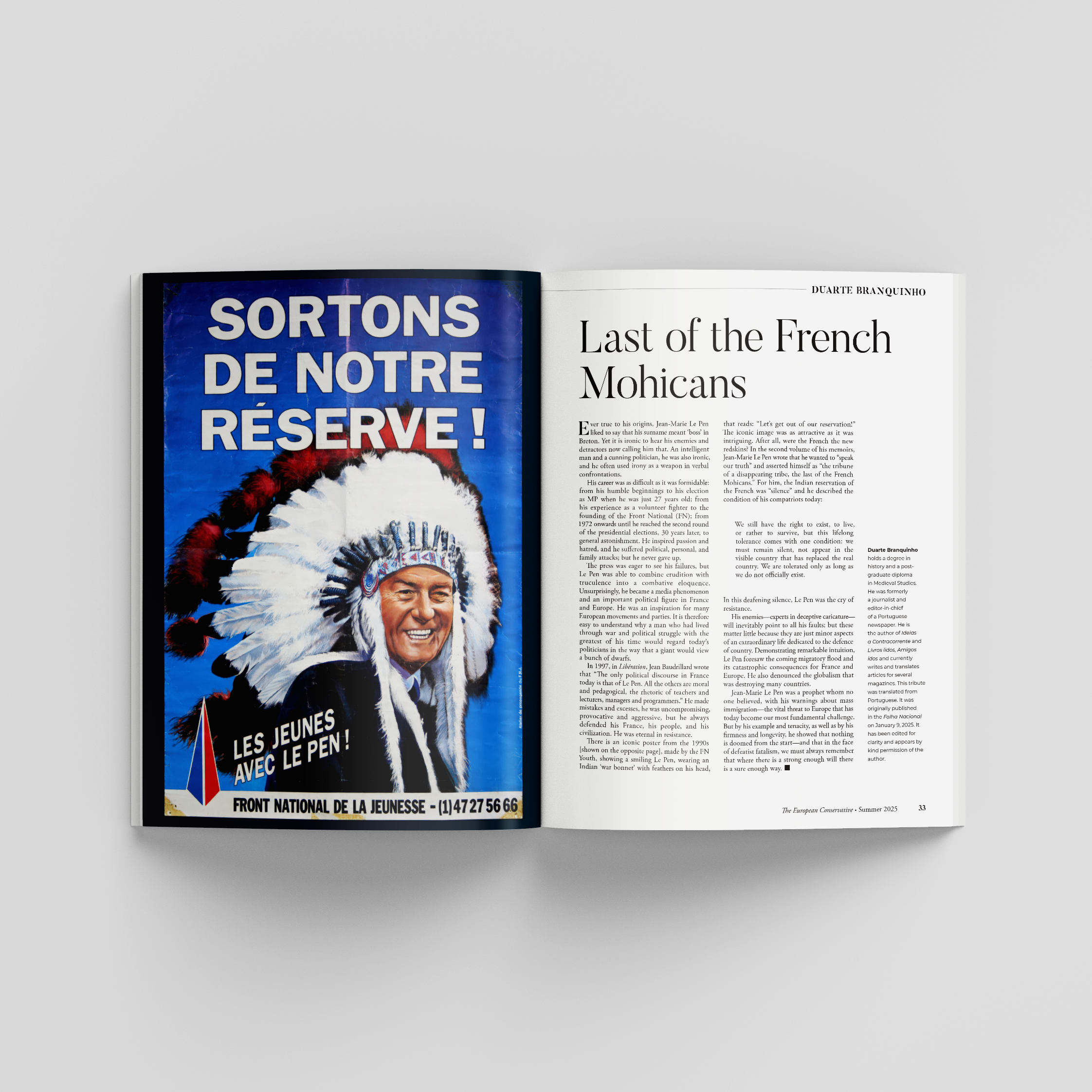
In this section: “Last of the French Mohicans” by Portuguese historian and journalist Duarte Branquinho; remarks by Le Pen’s niece, Marion Maréchal, during his Requiem Mass; Polish Le Pen expert Kacper Kita’s “A Voice in the Wilderness”; Spanish professor Domingo González on Le Pen’s “Divided Legacy”; French publisher Guillaume de Thieulloy’s account of publishing Le Pen’s memoirs: “je ne regrette rien”; “An Italian Retrospective” by journalist Max Ferrari; and Hélène de Lauzun takes a nuanced look at Le Pen’s political life in “The Cost of Audacity.”
The issue also features several pieces on Croatia’s history: Robin Harris on Zagreb in 1945 “Liberation or Enslavement?”; Albert Bikaj interviews historian Stipe Kljaić about the role of Catholic conservative intellectuals in “Forgotten Bulwark of Europe: Croatia between Conservatism and Totalitarianism”; and historian Luka Knez talks with Álvaro Peñas about Western failures to support Croatia during socialist Yugoslavia in “Croatian Dissidents, Tito, and the West.”
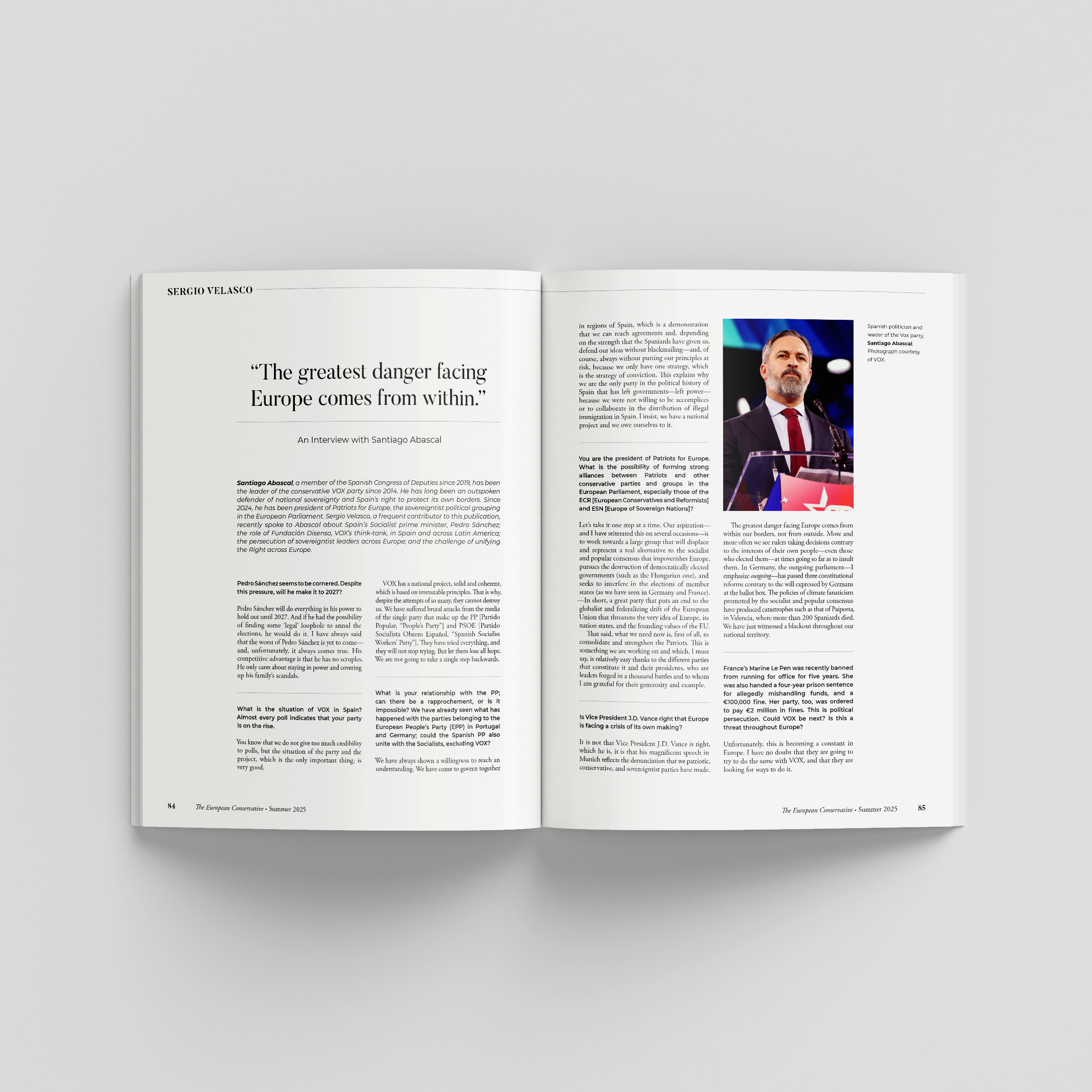
We include interviews with leading figures from the three right-wing political groupings in Brussels: Spanish VOX leader Santiago Abascal, president of Patriots.eu; Italian MEP Nicola Procaccini, co-chair of the European Conservatives and Reformists; and AfD MEP Marc Jongen of the European of Sovereign Nations.
We have the second installment of our Editor-in-Chief, A.M. Fantini’s wide-ranging interview with T. John Jamieson, “No Civilization Without the Spiritual.”
Every issue of The European Conservative features Reviews of works that will be of benefit for the intellectually curious reader: The Conservative Bookshelf features a generous selection of summaries and short-form analyses, whilst Shawn Phillip Cooper reviews The Post-Liberal Turn and the Future of Conservatism, edited by Daniel Pitt and Phillip Blond (Ludovika University Press), and David Deavel on the new collection of Aleksandr Solzhenitsyn’s speeches (University of Notre Dame Press).
Sebastian Morello explores Carmelite spirituality and Tripel Karmeliet beer; David Engels writes about a “Catholic Polis in a Postmodern Swampland” in Ave Maria, Florida; and Paul du Quenoy reviews the restored Frick Collection in New York.
Giorgia Meloni pays tribute to Italian youth activist Sergio Ramelli (1956-1975) and we remember La Nouvelle Librairie bookshop (2018-2024), a sanctuary for intellectual refugees in Paris. The issue closes with Mark Dooley on the rosary, “The Sweetest Devotion.”
As is true for every edition, all of the contributions were curated or commissioned by Alvino-Mario Fantini, editor-in-chief. The writers have diverse professional and intellectual backgrounds from politics and philosophy to the arts and popular culture.
€24.99
