



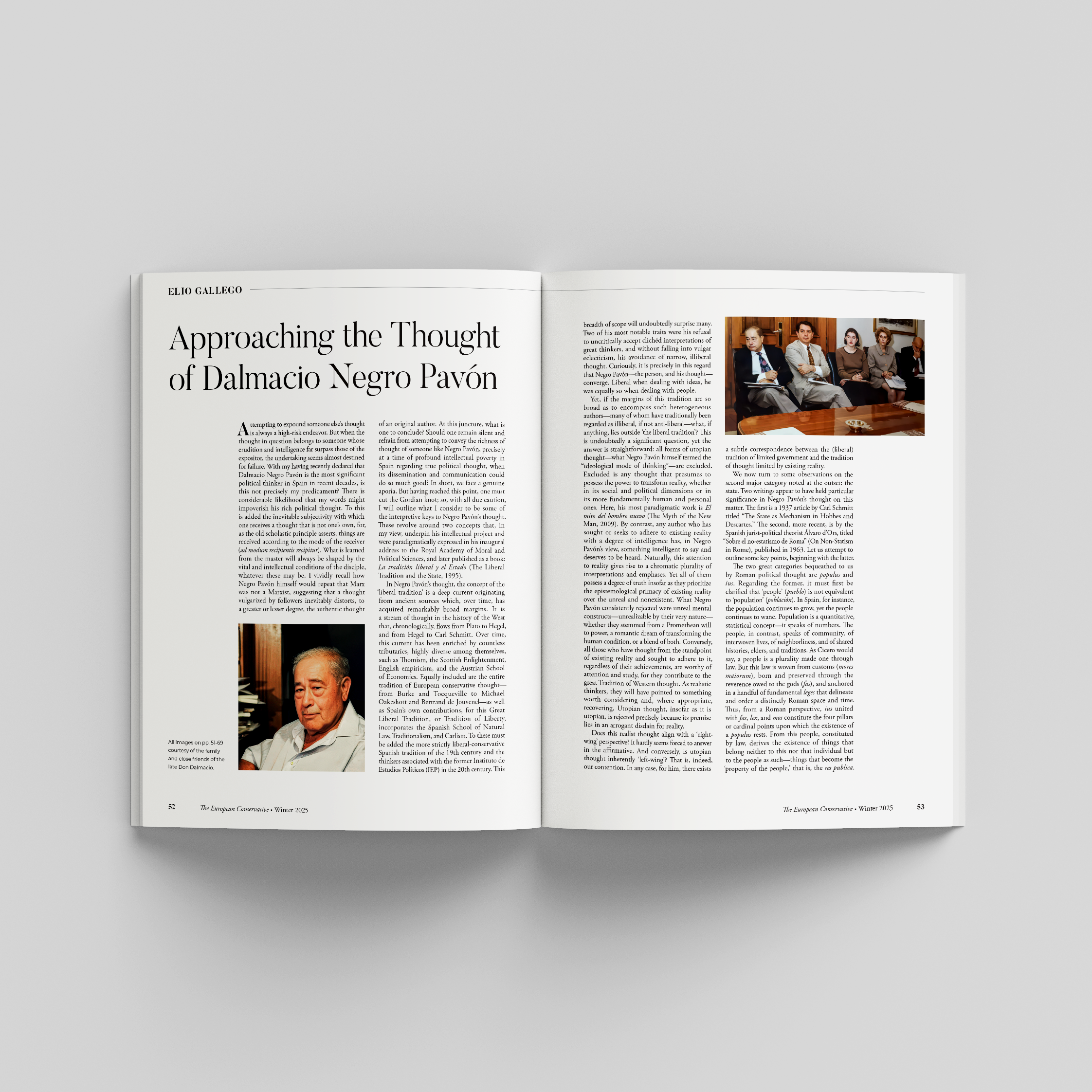


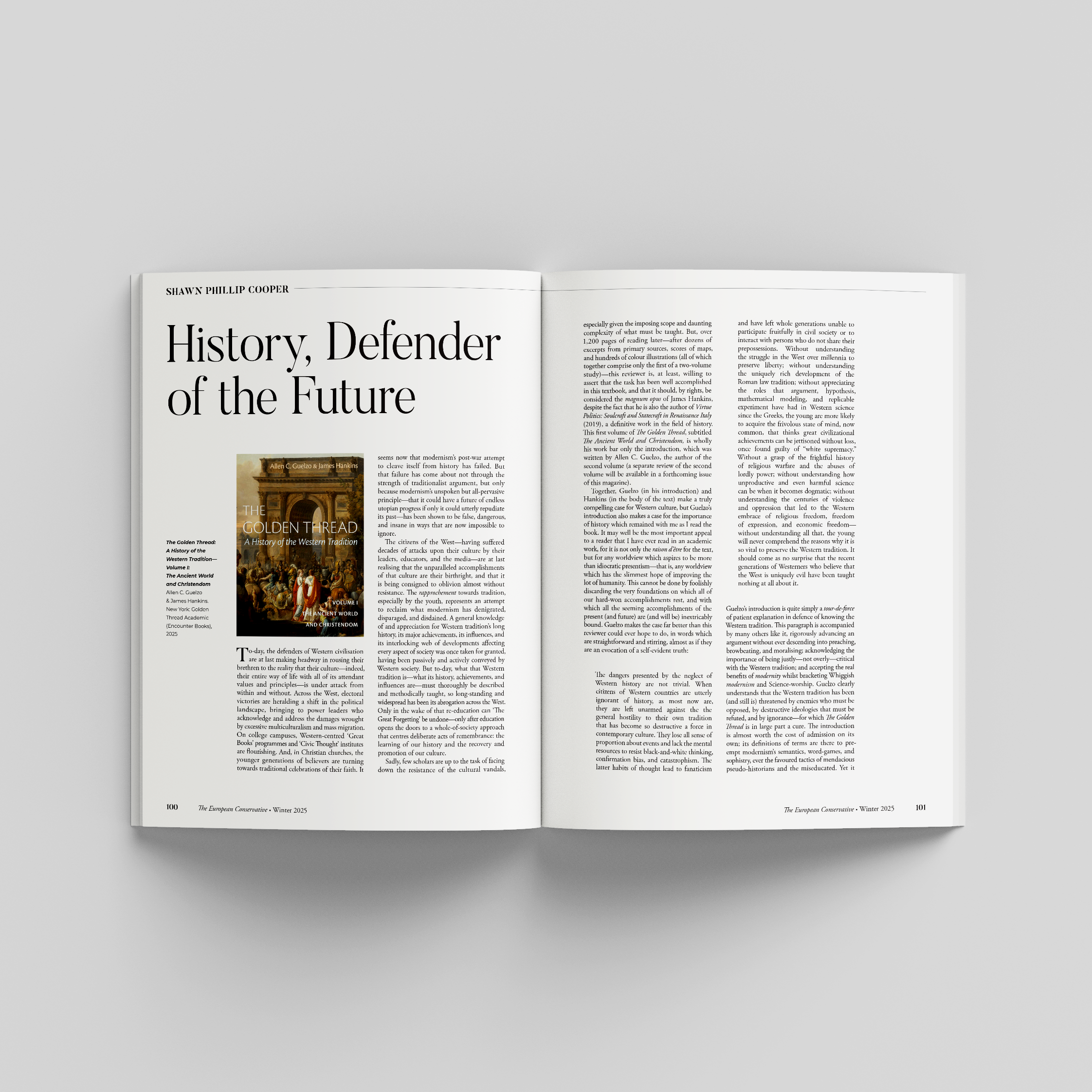
Issue 37 faces down the Left’s burgeoning anarchotyranny and its tragic cost. Our editorial statement catalogues a few of the many injustices faced by conservatives today, whilst our features engage with aspects of the progressive dystopia: violence, Islamo-fascism, communism, mass immigration, and the rejection of tradition. A dedicated section of essays memorialises the life and work of Spanish political thinker, Dalmacio Negro Pavón. Interviews include a discussion with Curtis Yarvin. Our book reviews include The Golden Thread, followed by essays on the good life, which remind us what we seek to conserve. The issue closes with tributes to Juan Fernando Segovia, Anna Záborská, and Iryna Zarutska, alongside a pair of meditative closing thoughts.
€24.99
This newest issue responds to two pillars of the Left’s ever-developing anarchotyranny: their silencing of those who speak out against the progressive orthodoxy and their winking at brutal violence—whether as a result of their policies, as in the case of Iryna Zarutska (memorialised in this issue), or whether incited against their political foes, as in the case of Charlie Kirk.
Our editorial statement confronts the stark reality of the supposedly ‘democratic’ societies of the West, where the Left continues to advance from the smiley face of socialism towards the iron frown of totalitarianism—the omnipresent and all-encompassing ‘Big Brother’ style government that was a terrifying dystopian nightmare for writers like George Orwell, but which is now presented as a desirable policy in the public speeches of leftist politicians like Zohran Mamdani, mayor-elect of New York City.
Our Commentary & Features engage with the multiple heads of this totalitarian hydra: Anthony Daniels addresses whether to-day’s violence is an aberration or a sign of worse to come; Fr. Benedict Kiely observes that pushing back against the anticulture will require engaging with the sacramental world; Filip Styczynski identifies the synergy of Islamo-fascism, socialism, and communism; Todd Huizinga explores how radical progressivism is deepening societal divisions; Nathan Pinkoski defends the prophetic insights of Jean Raspail’s The Camp of the Saints; Vanja Södergren discusses the cardinal virtue of Sophrosyne (temperance); Dušan Dostanić reflects on the legacy of the German Conservative Revolution; Paweł Figurski considers the significance of Poland’s first royal coronation one thousand years later; Harry Readhead identifies the importance of participating in our ongoing cultural conversation, from the Desert Fathers to Nina Simone; and a work by Aurelio Espionsa Pólit, S.J. rounds out the section by shewing the connexions that bind Rome and the Americas.
The issue features six essays Remembering the Life of Dalmacio Negro Pavón (23 Dec. 1931 – 23 Dec. 2024) which remind us of his enduring legacy on this sad first anniversary of his death. Elio Gallega provides a primer to Negro Pavón’s thought with his essay “Approaching the Thought of Dalmacio Negro Pavón”; Jerónimo Molina Cano considers the philosopher’s foresight in “Dalmacio Negro Pavón, Pointing to the Future”; Domingo González considers sources and influences in a study of “The Political Anthropology of Dalmacio Negon Pavón”; Bernard Dumont considers Negro Pavón’s assessment of modern politics as “A Philosophical Observer of Modernity”; Carlo Gambescia connects two great thinkers by looking at “State and Government in Benedetto Croce and Dalmacio Negro Pavón”; and, Anthony Petros Spanakos thinks about the Greek foundations behind Negro Pavón’s political thought “From the Polis to the State.”
Our Essays & Interviews sees Filip Gašpar conduct a wide-ranging interview with Curtis Yarvin; our fourth part of A.M. Fantini’s interview with T. John Jamieson addresses “The Religion Problem”; Álvaro Peñas interviews Miguel Ángel Quintana Paz on Nietzsche, Fukuyama, and Greta Thunberg; and, Ferenc Hörcher reflects on the “Wit and Learning” of the Hungarian scholar Antal Szerb.
Every issue of The European Conservative features Reviews for the intellectually curious reader. Short-form reviews in The Conservative Bookshelf cover Matthijs Lok‘s Europe against Revolution: Conservatism, Enlightenment, and the Making of the Past; Ulrich L. Lehner’s Spion für Papst, Kaiser und British Empire; J.C. Scharl’s The Death of Rabelais; Bart de Wever’s Over Woke; Marianna Davidovich’s The Buried Stories of Communism and Socialism: A Historical Primer and Contemporary Analysis; Nils Goldschmidt and Stefan Kolev’s 75 Jahre Soziale Marktwirtschaft in 7,5 Kapiteln; and, Attila Szalay-Berzeviczy’s second volume of In the Centennial Footsteps of the Great War: 1916, 1917, 1918. Our long-form reviews see Shawn Phillip Cooper praise the first volume of The Golden Thread, by Allen C. Guelzo and James Hankins, for its forthright defence and thorough survey of Western civilisation from the Battle of Marathon; and, Alex Taylor reviews Joshua Hren’s novel Blue Walls Falling Down in the context of modern politics, Christian religion, and the works of Dostoevsky and Bakhtin.
In our celebration of The Good Life, Sebastian Morello welcomes the convivial mood that may be brought on with “Gordon’s Morello Cherry Gin,” while David Engels ponders the beguiling hold on that Liberland has upon the imagination, especially in the wake of other microstates, such as Sealand.
Miguel Ayuso remembers Juan Fernando Segovia (1956-2025), in a personal tribute to the prolific doctor of law and history, long-time researcher at CONICET, and “one of the finest minds in Catholic and Hispanic traditionalism.” Patrik Daniška praises Anna Záborská (1948-2025), the Slovak doctor and anti-abortion champion whose principled stance earned her the respect of politicians from all parties. And Darina Rebro reflects on the devastating murder of Iryna Zarutska, a Ukrainian refugee who fled the violence of her homeland only to meet her death at the hands of a deranged repeat offender in front of a group of indifferent bystanders on an American subway.
The issue closes with Gabriela Hernández on “The Christ of the Good Death: Art, Memory, and Hope,” reflecting on the 20th century sculpture and its meaning for to-day’s believers; and Mark Dooley reflects on his friendship with the American pragmatist Richard Rorty in “Theoretical Hallucinations.”
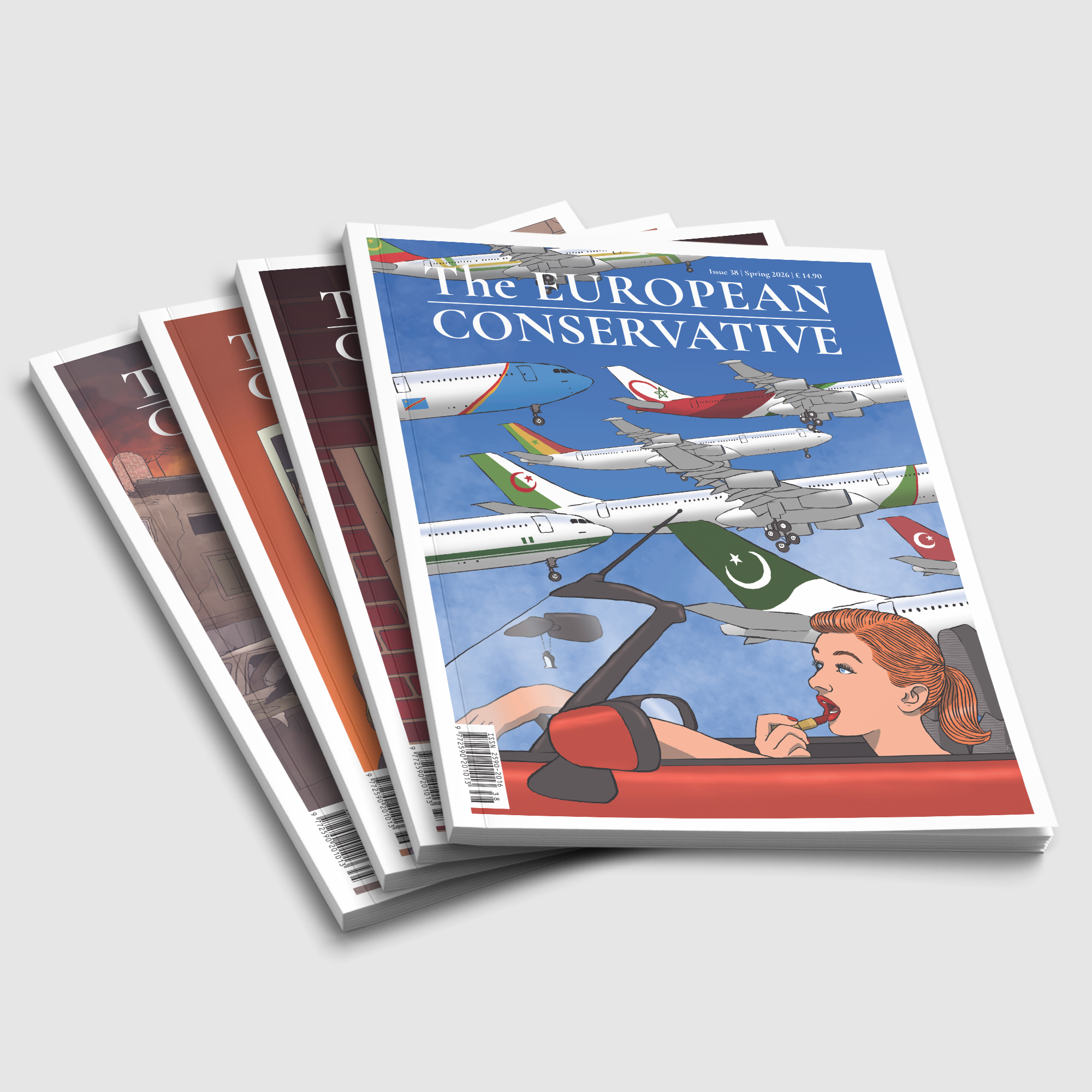
Our Winter 2025 cover image was designed by Romée de Saint Céran.
As is true for every edition, all of the contributions were curated or commissioned by Alvino-Mario Fantini, editor-in-chief. The writers have diverse professional and intellectual backgrounds from politics and philosophy to the arts and popular culture.
€24.99
