


Issue 38 addresses a topic long deemed unspeakable: remigration. For years, Europe has grappled with the cultural and societal degradation that has followed an influx of countless unassimilated migrants. In this issue, we feature voices that have been courageously outspoken on this topic, including Renaud Camus, Martin Sellner, Rupert Lowe, and Enoch Powell. We review the second volume of The Golden Thread, followed by articles on the good life to ground us in this age of anxiety. And our issue closes with tributes to Dominik, Cardinal Duka, O.P. and Quentin Daranque, along with a final word from Mark Dooley on the loveless motivations of the Left.
€24.99

For decades, mass immigration has been a major political issue across Europe, with little movement on the part of the parties in power—Left or Right. In this, our Spring 2026 issue, we examine a policy that might at last provide an answer: remigration. It is this policy, humanely but firmly enforced, that offers the prospect of restoring the population balance that once existed; and it is this policy that might check the spread of a militantly anti-Christian and anti-European culture that threatens not only European people, but the very societies they inhabit.
Our editorial statement connects the policy of remigration to its roots as a matter of proper conservation—not a radical notion, but a prosaic one, grounded in an observable natural order that is visible in all other species and environments. The tragedy of the commons, theoretically formulated by Garrett Hardin, is for us no longer a matter of worrying theory, but rather of unhappy fact. Our policies must address the challenge whilst there is yet time.
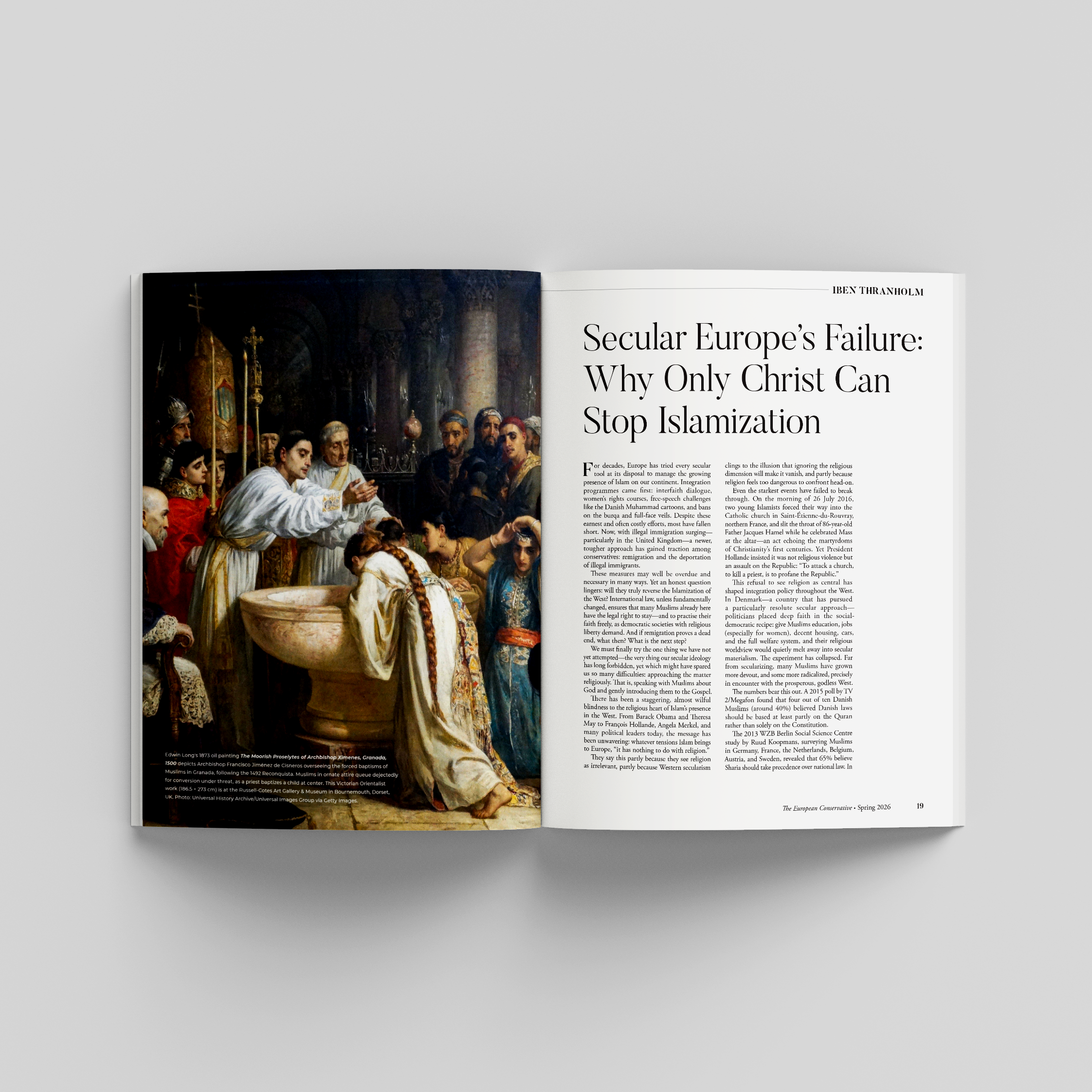
Our Commentary & Features explore different aspects of conservation as the most conservative of ideas. Anthony Daniels considers the hidden costs of so-called ‘green tech’ and environmentalism; Brigitta Hidvéghiné Pulay grounds an important distinction between unhinged environmentalism and responsible stewardship in the teachings of the Church; Father Benedict Kiely wonders whether our failure to conserve the truth of language can be undone; Iben Thranholm interrogates the failure of European secularism to manage the rise of Islam in Europe; Nuno Lebreiro refutes the cult of ‘progress’ and the internal contradictions of progressive liberalism; Sammy Rohner examines the development of conservative Zoomer politics, and the failures that led to the prominence of Nick Fuentes and Candace Owens; and Miguel-Ângelo Martins Machado muses on fashion trends old and new, and the rise of the ‘coolservative.’
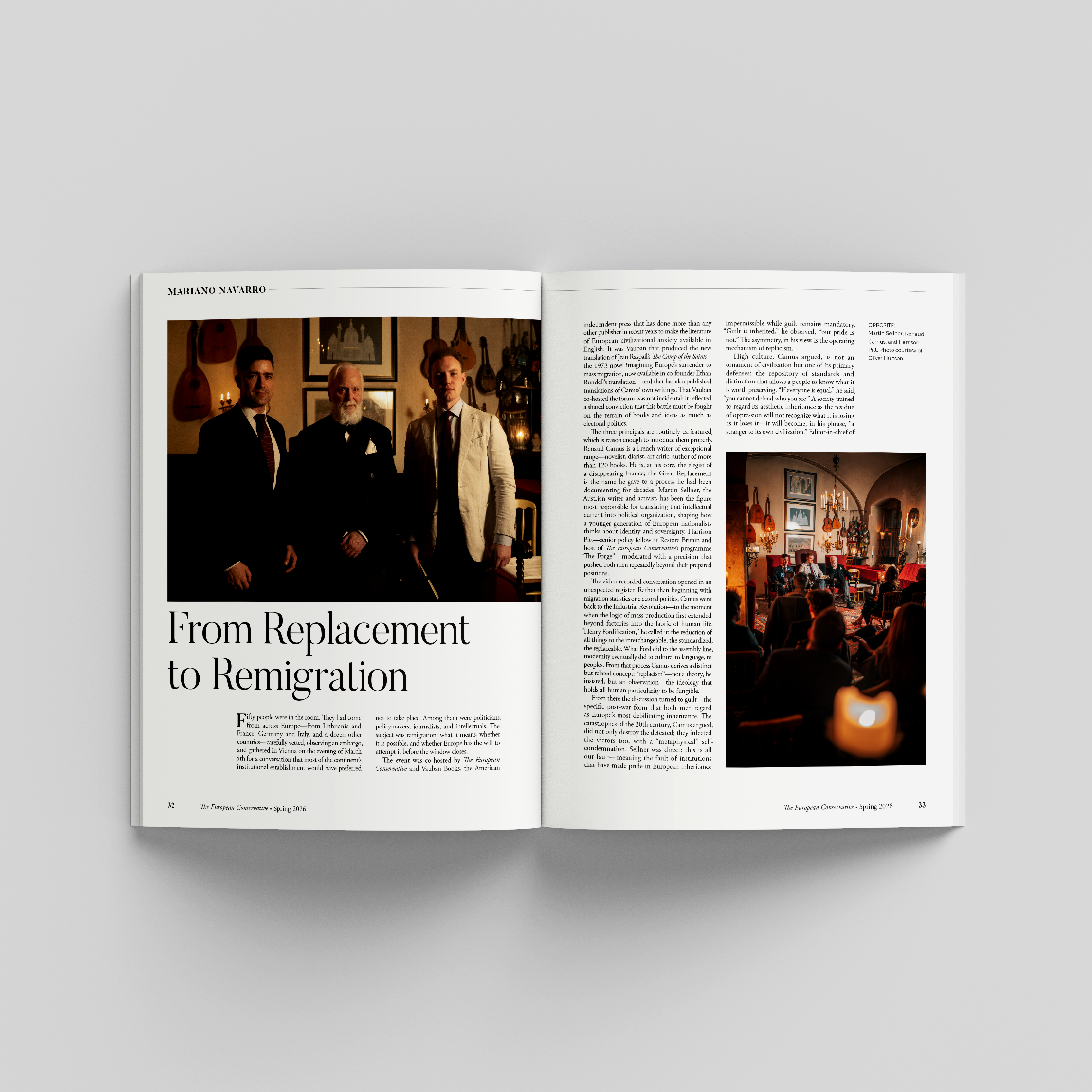
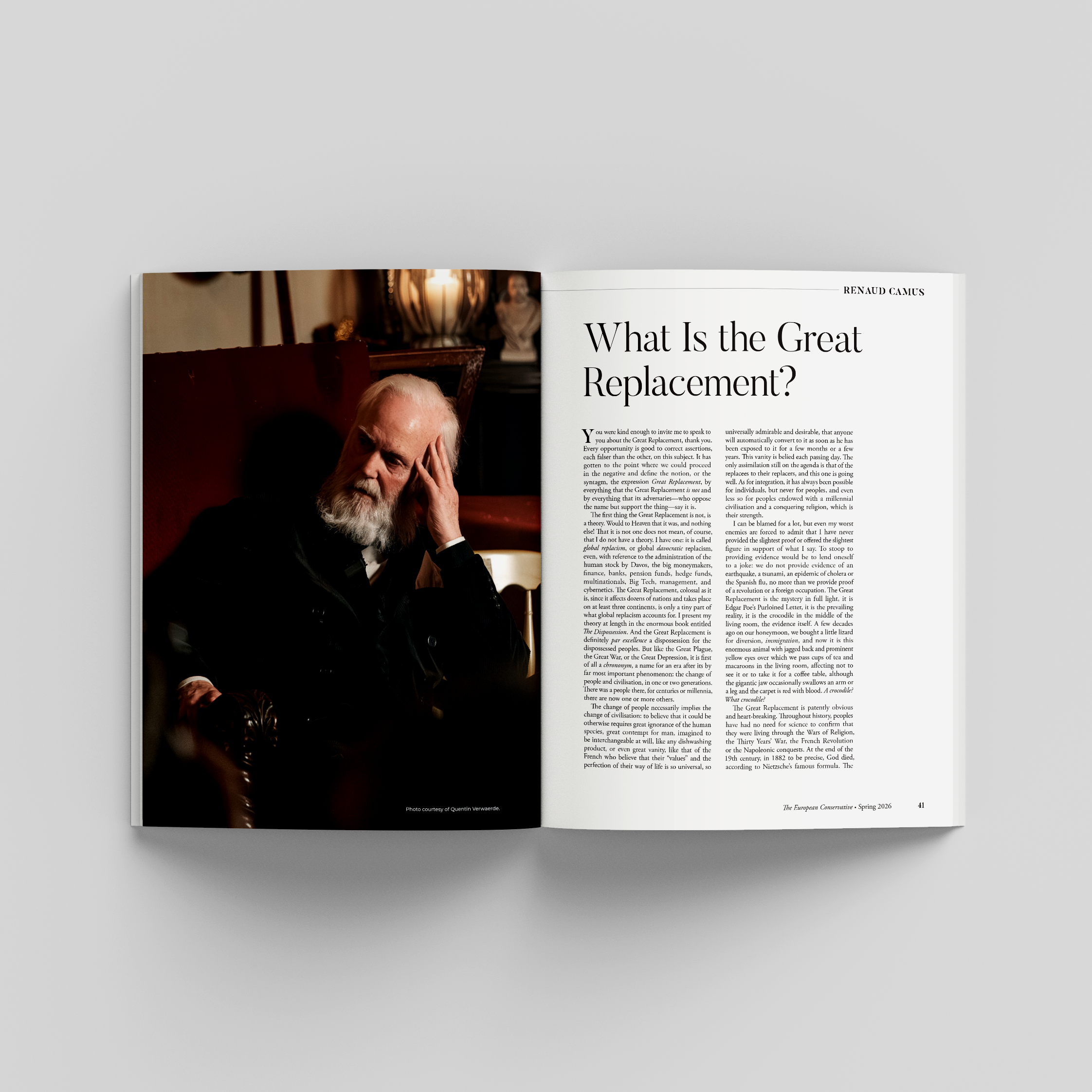
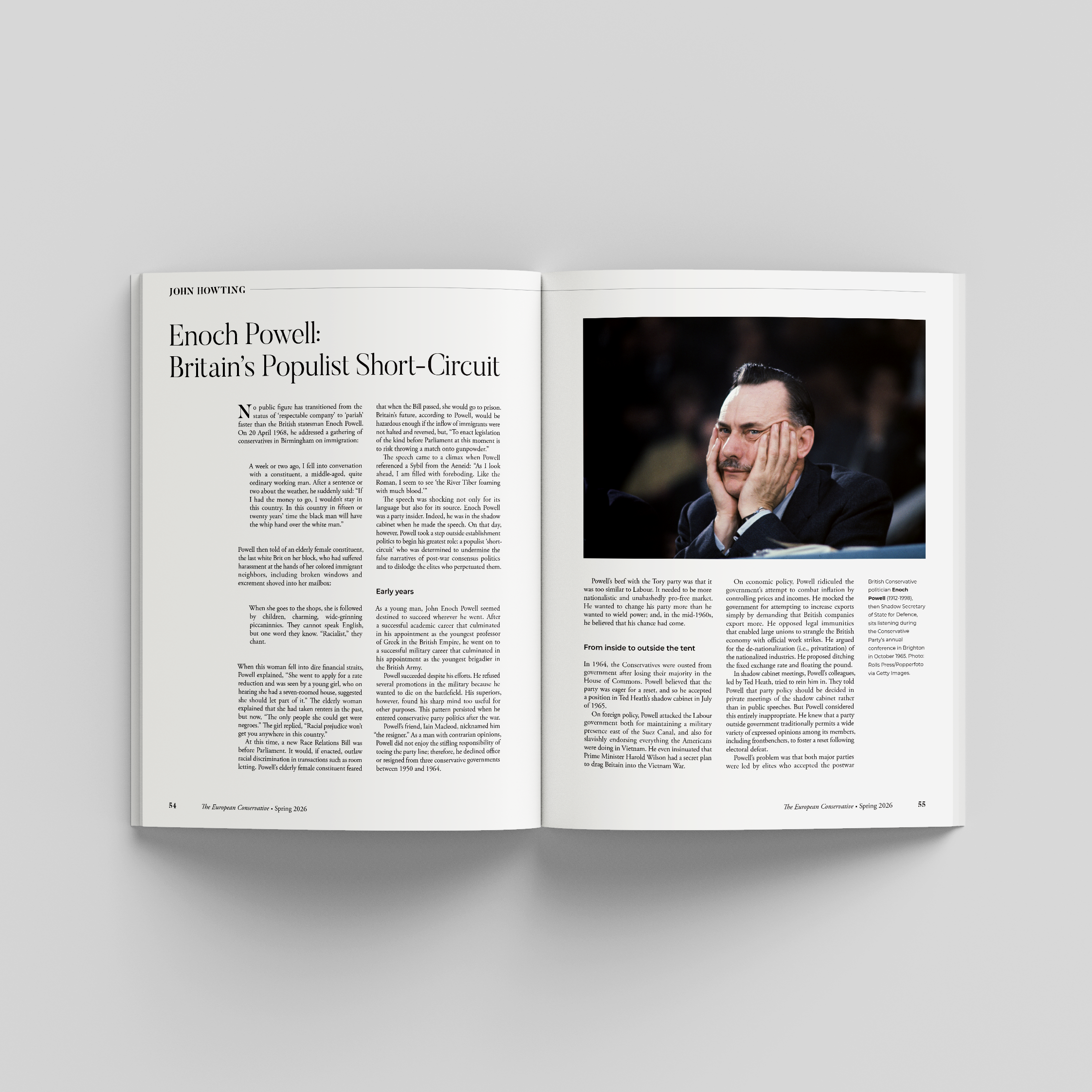
Our special topic on The Conversation Europe Refuses to Have includes five pieces especially focused on the topic of mass immigration and remigration. Mariano Navarro reports on a moderated conversation between Renaud Camus and Martin Sellner (now available for viewing on the YouTube channel of The European Conservative); Harrison Pitt, Rupert Lowe, and the Restore Britain team provide an excerpt from the Restore Britain policy paper on Mass Deportations; Renaud Camus presents a copy of his speech on the topic of ‘the great replacement’; Alberto Garzoni relates the chaotic debate on remigration in the Italian parliament; and John Howting offers a retrospective appraisal of the political life of Enoch Powell.
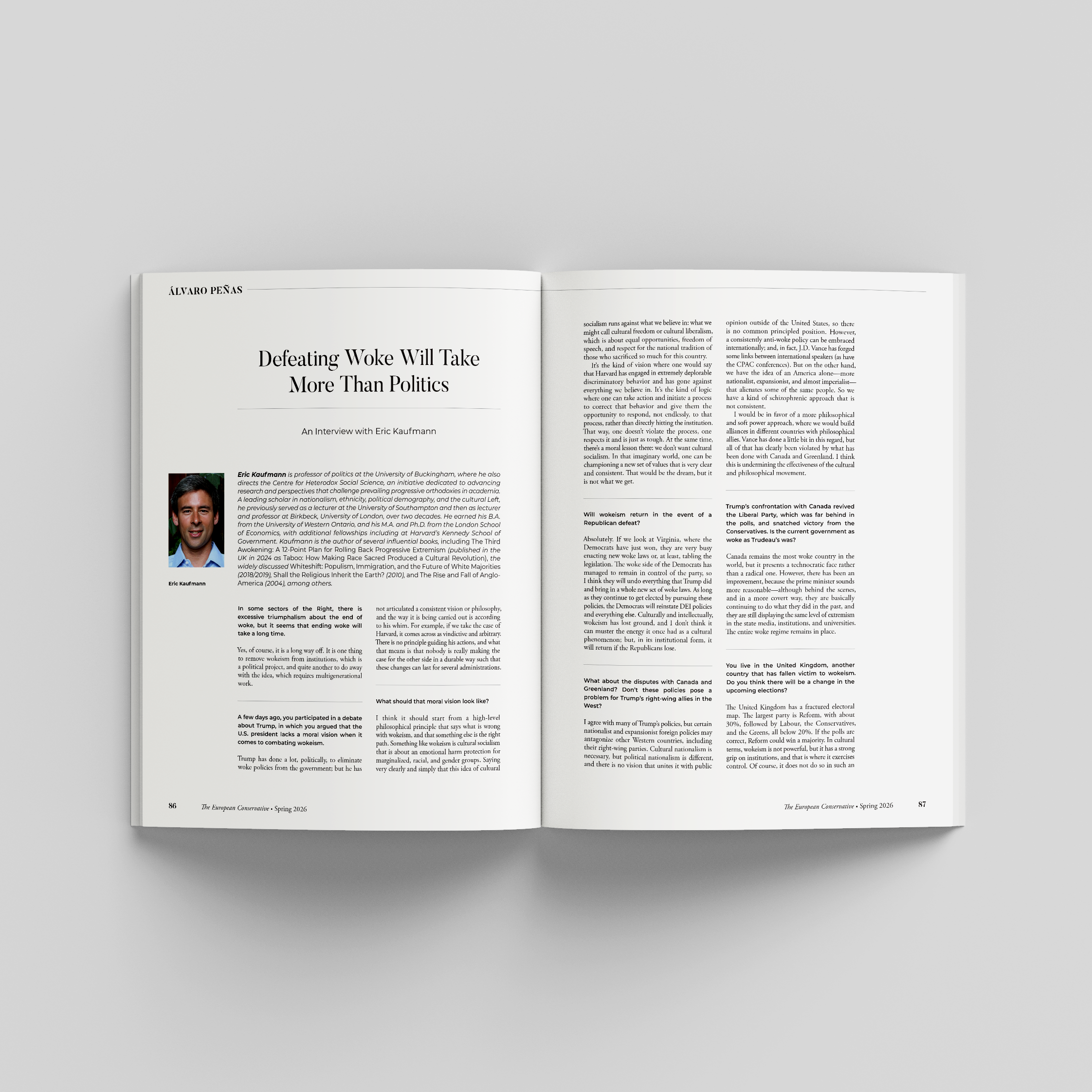
In our section of Essays & Interviews, Sebastian Morello brings the work of René Guénon into conversation with modernity, Catholicism, and the Kali Yuga; Miklós Pogrányi Lovas draws on thinkers from the classical era to the present to demonstrate the importance of state sovereignty; Guido Mina di Sospiro charts the decline of a cultural necessity—patronage; Ashby Neterer discusses the importance of natural law as an alternative to liberal constitutionalism; Mariano Navarro interviews Stefan Korte on U-Turn for Europe and the plan for a “Vienna Declaration”; Álvaro Peñas interviews Eric Kaufmann about wokeism on the Left and on the Right; we present the fifth part of A.M. Fantini’s interview with T. John Jamieson; and we present an excerpt from Walter McDougall‘s new book, The Mighty Continent: A Candid History of Modern Europe.
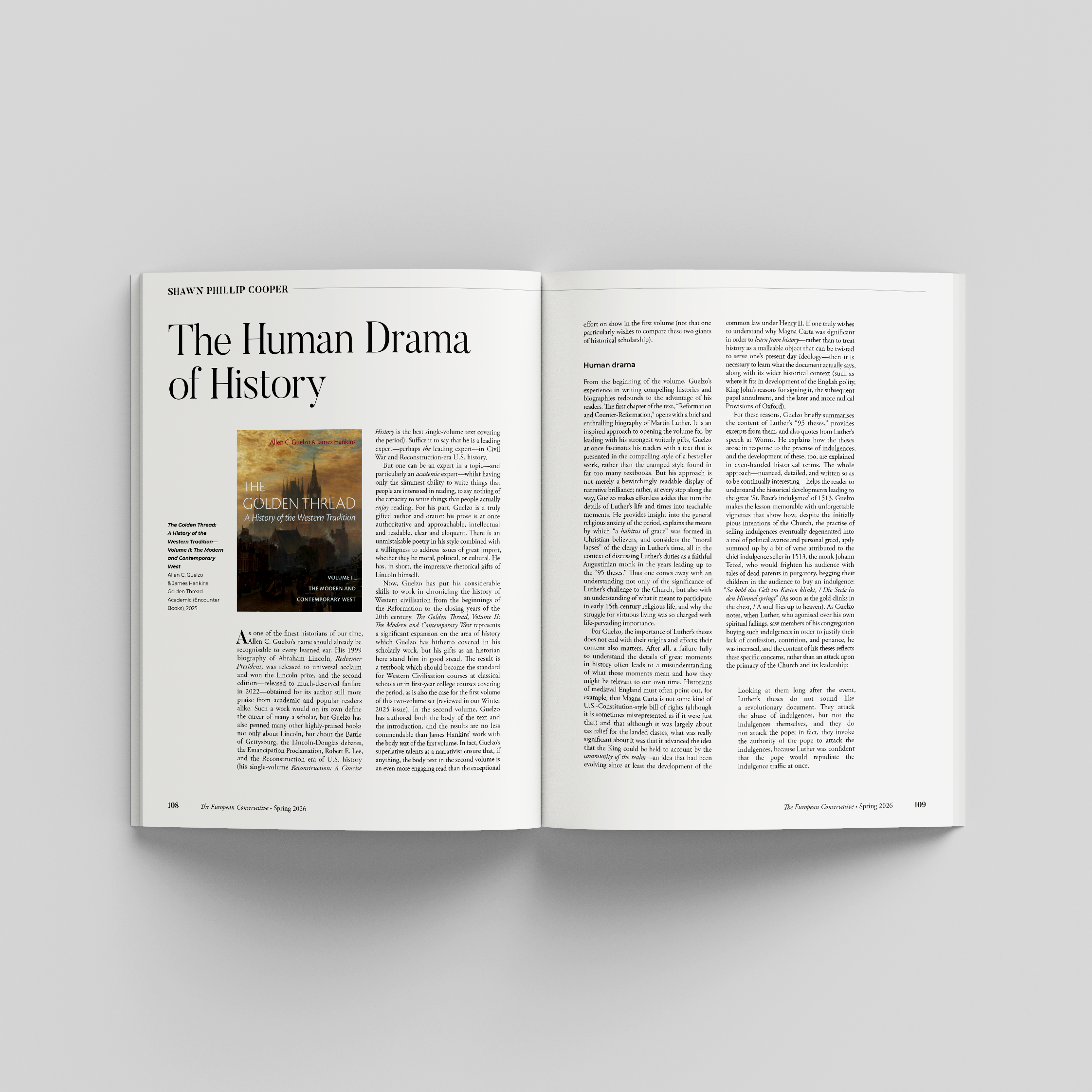
Every issue of The European Conservative features Reviews for the active, thinking reader. Short-form reviews in The Conservative Bookshelf covers Éric Zemmour‘s La messe n’est pas dite; Seth Wieck‘s Call Out Coyote; Philippe de Villiers‘ Populicide; Wolfgang Münchau‘s Kaput: The End of the German Miracle; Sean McMeekin‘s To Overthrow the World: The Rise and Fall and Rise of Communism; Andreas Fulda‘s Germany and China: How Entanglement Undermines Freedom, Prosperity and Security; Jordan Bardella‘s Ce que veulent les Français; Matthew Bell‘s Goethe: A Life in Ideas; Andrew Doyle‘s The End of Woke; and Rhina P. Espaillat‘s For Instance. In our long-form reviews, Shawn Phillip Cooper is deeply impressed by the biographical approach of the second volume of The Golden Thread by James Hankins & Allen C. Guelzo; and Jonathon Van Maren recommends Coping with Conscience in Political Life by Patrick Overeem & Christiaan Alting von Geusau.
We never fail to celebrate The Good Life, with Sebastian Morello taking us from Democritus to Galileo, and from Descartes to the bottom of a bottle of “Saffredi 2019 Fattoria le Pupille”; then, David Engels unearths the lost utopian schemes of the phalanstères—planned communities built along theoretical lines—in Europe and the New World.
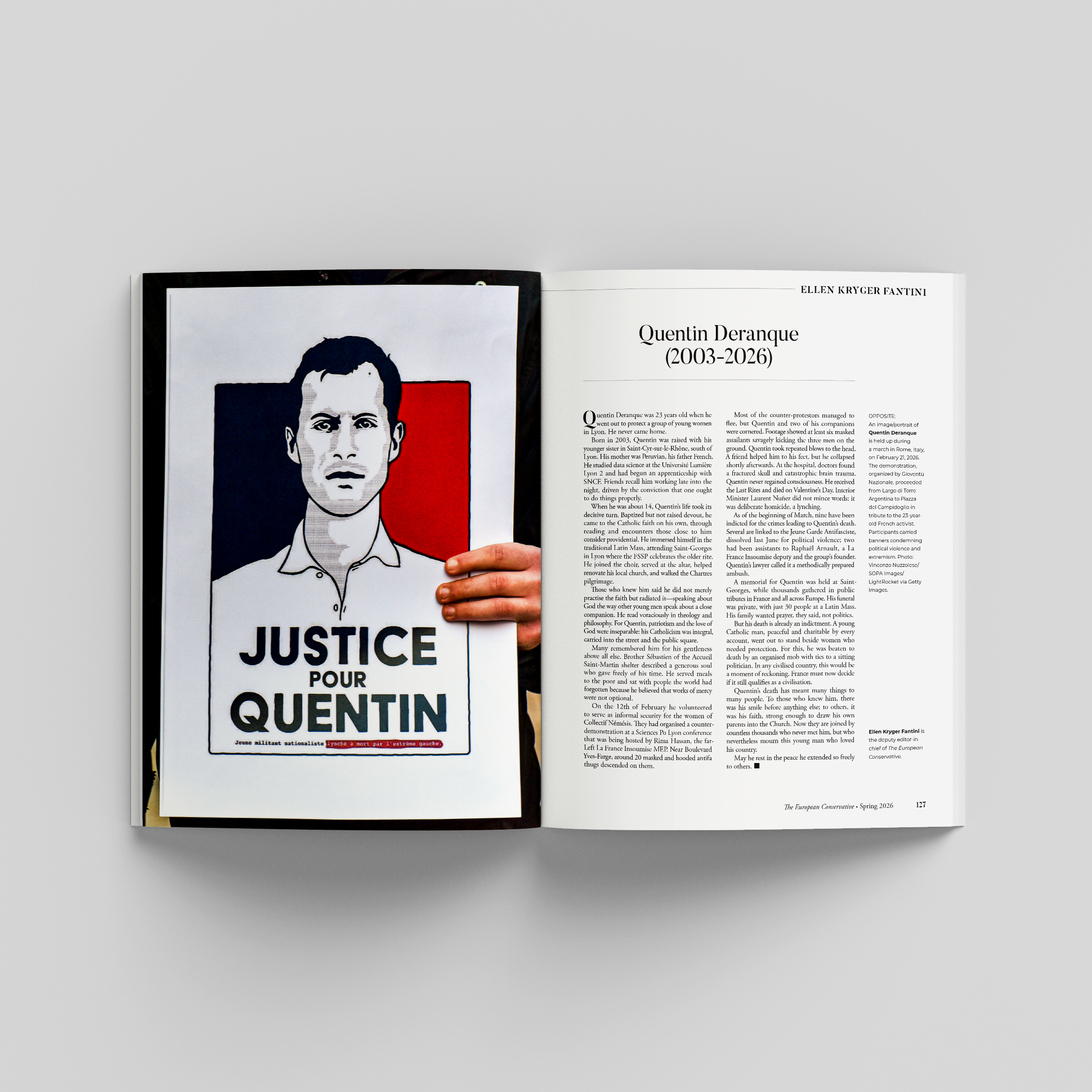
Mariano Navarro pays tribute to the late prelate Dominik, Cardinal Duka, O.P. (1943–2025), who secretly entered the Dominican order as a young initiate in repressive Czechoslovakia, before he helped rebuild Dominican life over the years that followed, in spite of persecution and arrest; and Ellen Kryger Fantini remembers Quentin Deranque (2003–2026), the young Catholic man who volunteered to protect the women of Collectif Némésis at a Sciences Po conference in Lyon, only to be viciously beaten and murdered by masked antifa thugs.
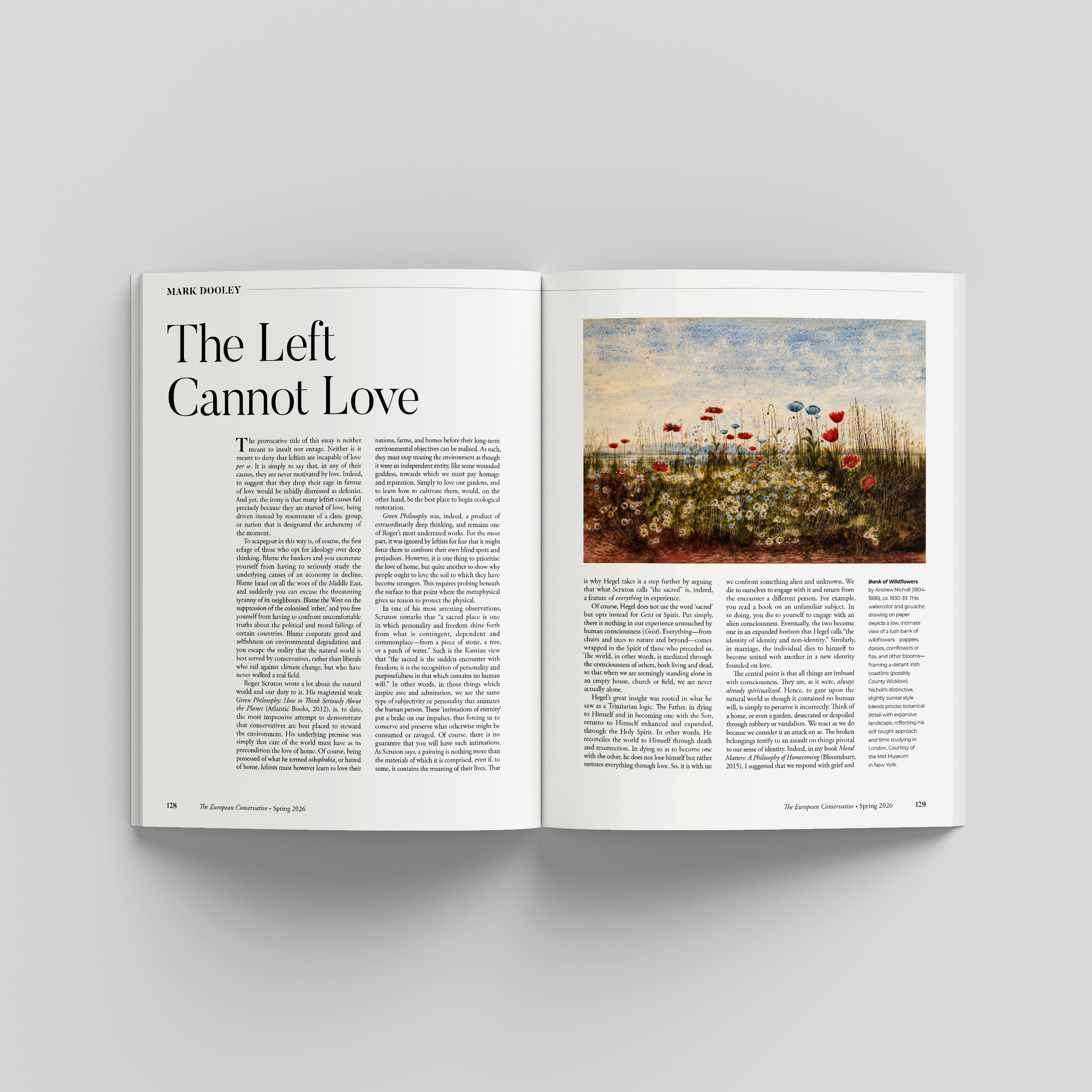
The issue closes with Mark Dooley‘s discussion of the resentful and rage-filled motivations of the Left, leading him to argue that “The Left Cannot Love.”
Our Spring 2026 cover image was designed by Romée de Saint Céran.
As is true for every edition, all of the contributions were curated or commissioned by Alvino-Mario Fantini, editor-in-chief. The writers have diverse professional and intellectual backgrounds from politics and philosophy to the arts and popular culture.
€24.99
