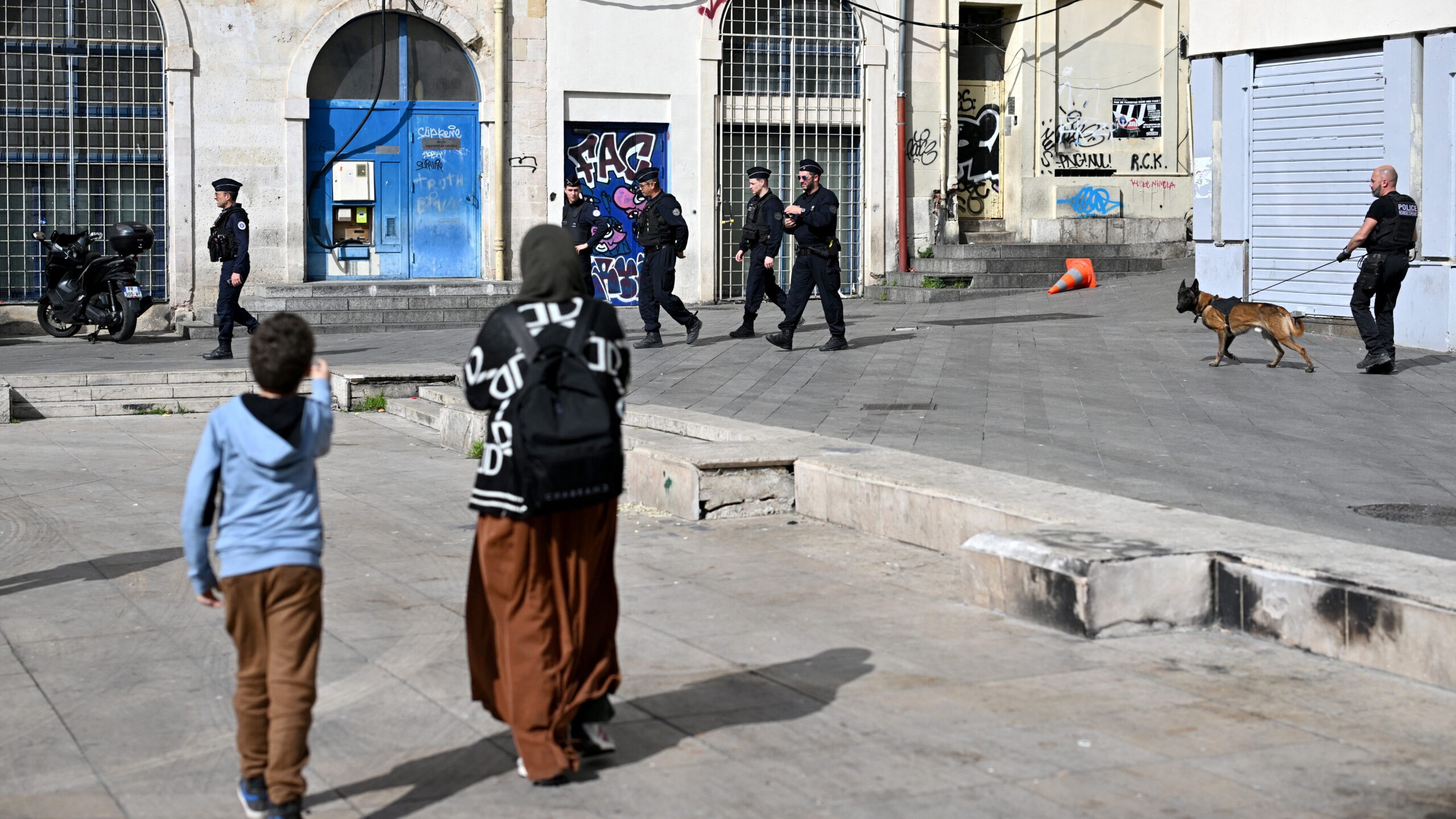
Police officers patrol near a drug dealing point in downtown Marseille on March 21, 2024, two days after the visit of the French President, focused on security and drug trafficking.
Nicolas Tucat / AFP
Marseille, once a celebrated port city, is now a symbol of urban decay, state failure, and the collapse of France’s internal borders. Today known as the capital of heroin trafficking of Europe, it has transformed into the epicenter of a gang war that is drenching its working-class neighborhoods in blood. Narco is the boss; bullets are its language.
In 2023 alone, 49 people were killed in drug-related score-settling. Nearly all were gunned down. Some were minors. Others were bystanders caught in the crossfire. A 10-year-old boy in Nîmes, a 24-year-old law student in her bedroom in Marseille: collateral victims of a system in ruins. The housing project of La Paternelle, in the northern part of the city, symbolizes this tragedy. There, the DZ Mafia and Yoda clans fought fiercely for control of a single drug-dealing spot, generating tens of thousands of euros daily.
The business is profitable. The labor force is abundant. Most of these young people are recruited through social media, often from small towns or Parisian banlieues, and are underage immigrants, lured by the promise of easy money, brand-name clothes, and status. “I started at 16 earning €500 a day,” says one of them. But once they try to leave, they discover they are trapped: they face fake debts, threats, kidnappings, torture, and modern-day slavery. The drug trade doesn’t forgive.
The connection to immigration is clear and increasingly undeniable. Criminal networks in Marseille have been operating for decades in symbiosis with mismanaged migratory flows. The gangs of North African, Sub-Saharan, or mixed origin have taken over entire neighborhoods that no longer answer to the laws of the Republic, but to those of the clan. Violence has become normalized. Authority, when not absent, is overwhelmed. As one police officer said, “The medicine we practice in Marseille’s hospitals is battlefield medicine.”
Faced with this reality, the state reacts slowly. In La Paternelle, concrete blocks have been erected to seal off access points, police presence has been reinforced, and the drug-dealing hub has been dismantled—at least temporarily. But the drugs don’t disappear; they migrate. The model is evolving into systems like “Uber shit”—home delivery. Criminal structures are flexible, adaptive, and better organized than many public institutions. And most importantly, they are not restricted by regulations that render them ineffective.
At the same time, local civic initiatives have emerged to restore dignity to the neighborhood. Fadela, leader of a regional association, organizes activities and workshops to promote community reappropriation of public spaces. But the scars run deep. Not speaking up is tacitly agreed upon. “We lived with this violence, but we learned to stay quiet,” says a volunteer.
Marseille now stands at a crossroads: it will either regain control of its territory or become a blueprint for what awaits the rest of France.