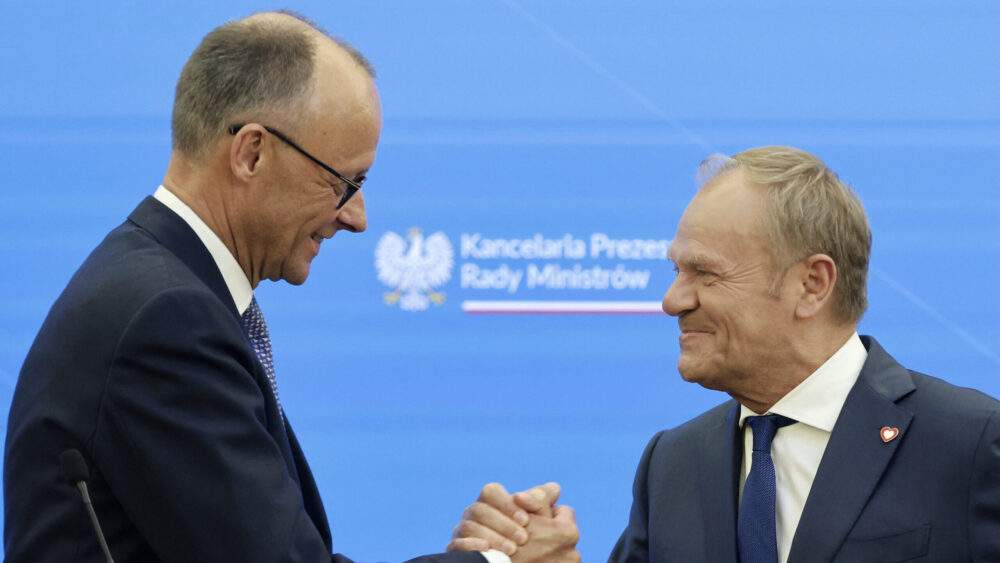
Merz and Tusk
Wojtek RADWANSKI / AFP
Poland has rejected Germany’s call for joint border patrols, saying German police are still sending migrants back across the border into Polish territory without warning.
The German proposal, presented by Interior Minister Alexander Dobrindt, was meant to strengthen control over migrant movements—but it was immediately rejected by Poland’s Defence Minister, Władysław Kosiniak-Kamysz.
“No, there will be no joint patrols. On the German side, the Germans patrol; on the Polish side, the Poles patrol. The German minister will not tell us what to do in our own country,” Kosiniak-Kamysz told TVN24.
The dispute follows allegations that Germany has been secretly sending illegal migrants back into Poland. According to multiple reports, including those from residents, German police have been dropping off migrants at the Polish border without any formal coordination, thus violating procedures laid out in the EU’s Dublin Regulation.
A similar phenomenon has occurred for years between France and Spain—yet the European Commission has not even addressed it. While the European Court of Justice heavily scrutinises pushbacks at the EU’s external borders for alleged human rights violations, it seems to raise no such concern inside the Schengen Area.
In response, Prime Minister Donald Tusk announced on July 1 the reintroduction of border controls with Germany and Lithuania—a measure his government had tried to avoid until internal political pressure and growing citizen protests forced him to act.
“The goal is to reduce the uncontrolled flow of migrants crossing back and forth,” Tusk explained. Although he formally referred to individual movements, the measure comes after weeks of rising public outrage
Poland’s rejection of joint patrols also comes from growing civic mobilisation. Activists, under the umbrella of the newly created “Border Defence Movement” led by conservative figure Robert Bąkiewicz, have begun organising voluntary patrols along the border with Germany. While the government has criticised these actions, they reflect the popular discontent.
President-elect Karol Nawrocki, backed by the opposition Law and Justice (PiS) party, spoke out strongly: “While the government does nothing, citizens are forced to protect our borders themselves,” he stated.
Jarosław Kaczyński, leader of PiS, described the situation as evidence of a “failed state,” and announced that the party would support border residents, including a visit by MPs and volunteers to show solidarity.
The controversy also casts doubt on the functioning of the Schengen Area. Although German Chancellor Friedrich Merz promised “close cooperation” with Poland on border control, he avoided explicitly condemning the actions of German police. Instead, he emphasised the importance of preserving freedom of movement within the EU, “as long as it is not abused by criminal networks smuggling migrants.”
From Warsaw, however, Merz’s words are perceived as evasive and non-committal. “Poland’s patience is not unlimited,” Prime Minister Tusk warned during a conversation with his German counterpart, in which, according to diplomatic sources, he expressed concern over the lack of concrete guarantees that the irregular transfers of migrants would stop.