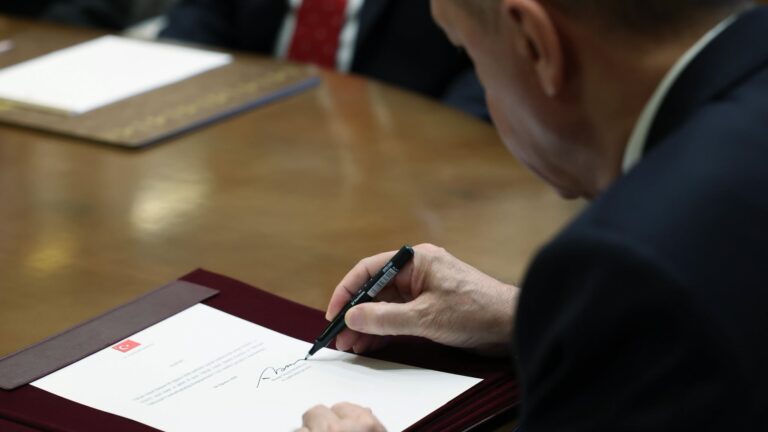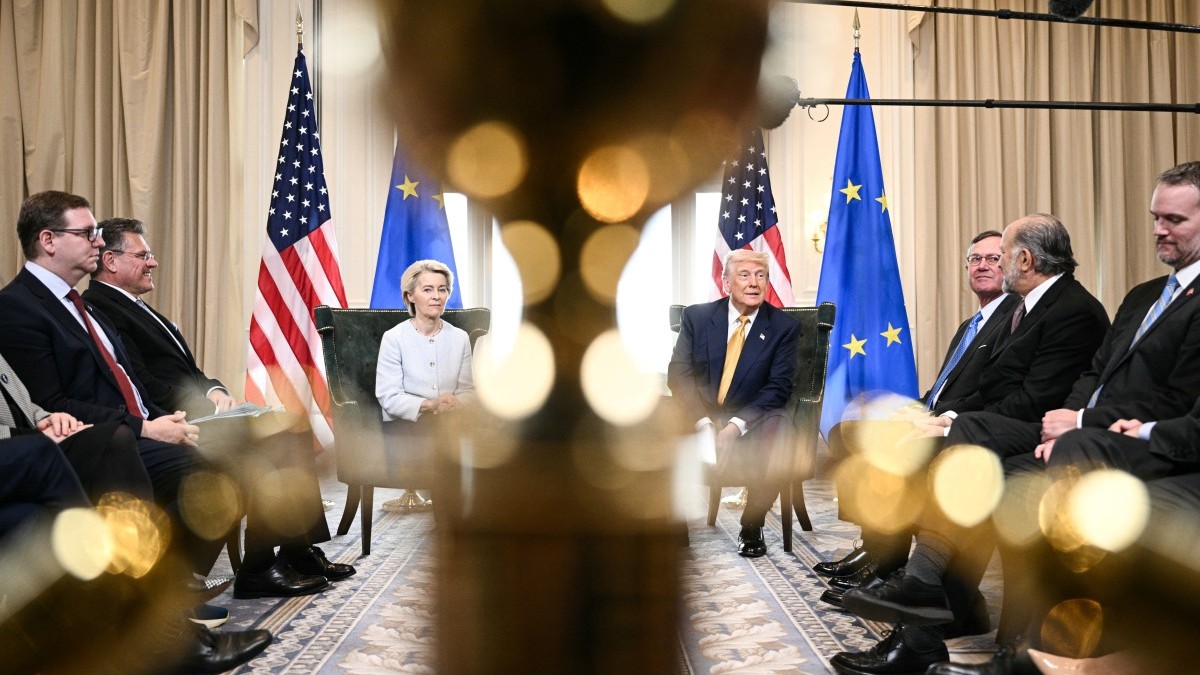
U.S. President Donald Trump (R) and European Commission President Ursula von der Leyen (L) speak to the press after agreeing on a trade deal between the two economies following their meeting, in Turnberry, Scotland on July 27, 2025.
Brendan Smialowski / AFP
The United States and the European Union clinched a trade agreement on Sunday, July 27th, that will see EU exports taxed at 15%, in a bid to resolve a transatlantic tariff stand-off that threatened to explode into a full-blown trade war.
U.S. President Donald Trump emerged from a high-stakes meeting with European Commission President Ursula von der Leyen at his golf resort in Scotland, describing the deal as the “biggest-ever.”
The deal, which the leaders reached after an hour of talks, came as the clock ticked down on an August 1 deadline to avoid an across-the-board U.S. levy of 30% on European goods.
“We’ve reached a deal. It’s a good deal for everybody. This is probably the biggest deal ever reached in any capacity,” said Trump.
Trump said a baseline tariff of 15% would apply across the board, including for Europe’s crucial automobile sector, pharmaceuticals, and semiconductors.
As part of the deal, Trump said the 27-nation EU bloc had agreed to purchase “$750 billion worth of energy” from the United States, as well as make $600 billion in additional investments.
Von der Leyen said the “significant” purchases of U.S. liquefied natural gas, oil, and nuclear fuels would come over three years, as part of the bloc’s bid to diversify away from Russian sources.
She added that bilateral tariff exemptions had been agreed on a number of “strategic products,” notably aircraft, certain chemicals, some agricultural products, and critical raw materials.
Von der Leyen aded the EU still hoped to secure further so-called “zero-for-zero” agreements, notably for alcohol, which she hoped to be “sorted out” in the coming days.
Trump also shared that EU countries—which recently pledged to ramp up their defence spending within NATO—would be purchasing “hundreds of billions of dollars worth of military equipment.”
Most stock markets rose with the euro on Monday, July 28th, after the European Union and United States announced the deal.