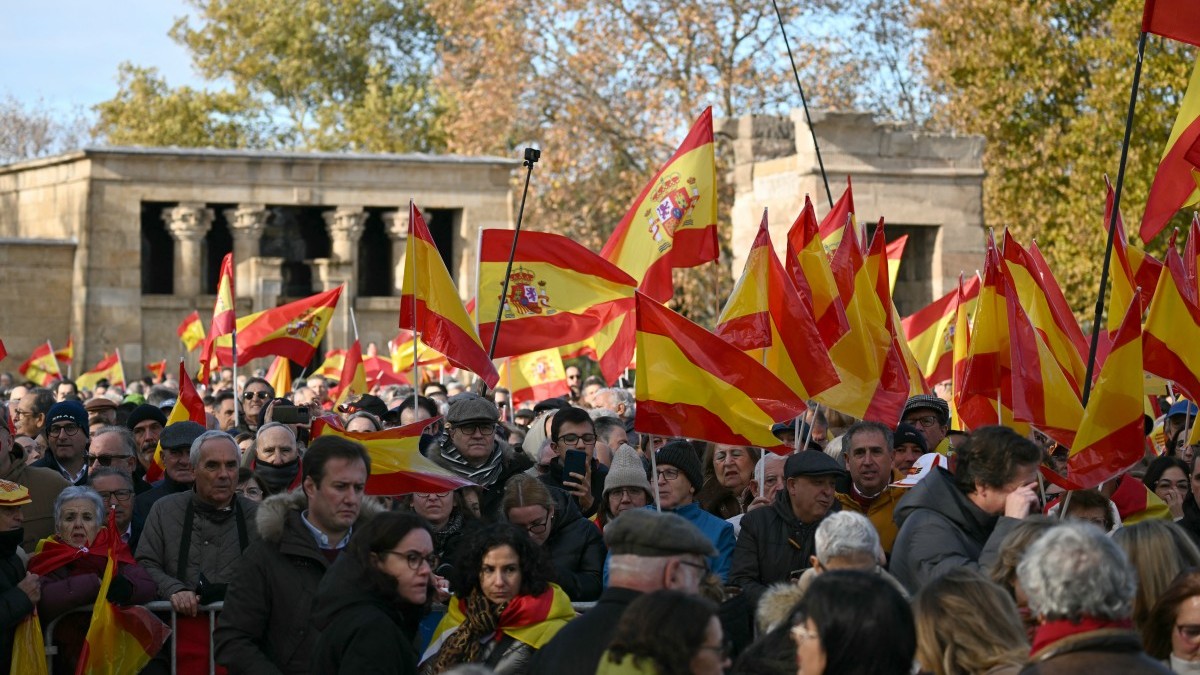
Protestors hold Spanish flags during a demonstration against corruption called by the right-wing opposition party Partido Popular (PP) in Madrid on November 30, 2025.
Javier Soriano / AFP
The demonstrations held this Sunday, November 30th, in the capital and in more than 20 Spanish cities revealed growing social pressure on Pedro Sánchez’s government.
The protests called by the Partido Popular (PP) and Revuelta—the fast-rising conservative youth organisation of Generation Z— were joined by self-employed workers after nationwide mobilisations. Outraged by rising fees and taxes, the demonstrators denounce a fiscal burden that has reached historic highs. Spain is thus entering a climate of dissent that is no longer sector-specific, but fully transversal.
In Madrid, thousands gathered outside the headquarters of governing socialist party PSOE in a protest led by Revuelta, demanding answers as corruption cases continue to close in on the president’s inner circle. The organisation has successfully channelled Gen Z’s political frustration through a message centred on democratic renewal, transparency, and the defence of fundamental freedoms. Their argument is straightforward: if all of the president’s closest allies are implicated in alleged criminal schemes, it is increasingly difficult to claim he knew nothing about an operation that ran for years.
¡No habrá paz para Ferraz! 🔥 pic.twitter.com/qu5typLteD
— Revuelta (@revuelta_es) June 13, 2025
The recent imprisonment of José Luis Ábalos and Koldo García, together with the investigation into Santos Cerdán and the judicial fronts involving the prime minister’s wife and brother, have triggered a national debate: how can the president continue to plead ignorance when all his key associates are under investigation, charged, or already behind bars?
Adding fuel to the political crisis, self-employed workers held demonstrations over the weekend in Barcelona, Valencia, Seville, Bilbao, Málaga, and Zaragoza to protest the continuous rise in social security quotas, taxes, and municipal fees that has pushed many to the brink. The new fiscal burdens—especially those expected for 2025—place Spain among the European countries with the highest burdens on small businesses and freelancers.
Miles de autónomos se han manifestado hoy en distintas ciudades de España.
— 🇪🇸 ☆ 𝐏𝐫𝐨𝐠𝐫𝐞𝐬𝐭𝐨𝐧(A) ☆ 🇪🇸 (@progrestonnn) November 30, 2025
¿Dónde estaban CCOO Y UGT? COMIENDO GAMBASpic.twitter.com/lPWLI6fyfD
Sector federations describe the situation as “the worst in two decades” and warn that thousands of self-employed workers are now at risk of shutting down. Discontent has also spread among liberal professionals, transport workers, and small retailers, adding an economic dimension to the political protests at a moment of maximum vulnerability for the government.
With their inclusion, the map of demonstrations takes on a different texture. This is no longer an ideological dispute, but a broad rejection of policies widely perceived as suffocating for ordinary citizens.
The convergence of political, youth, and economic protests shows a level of social wear on the government unseen since the 2010 crisis. The combination of corruption scandals and rising fiscal pressure is creating a volatile climate that could have direct consequences for parliamentary stability and the approaching electoral cycle.