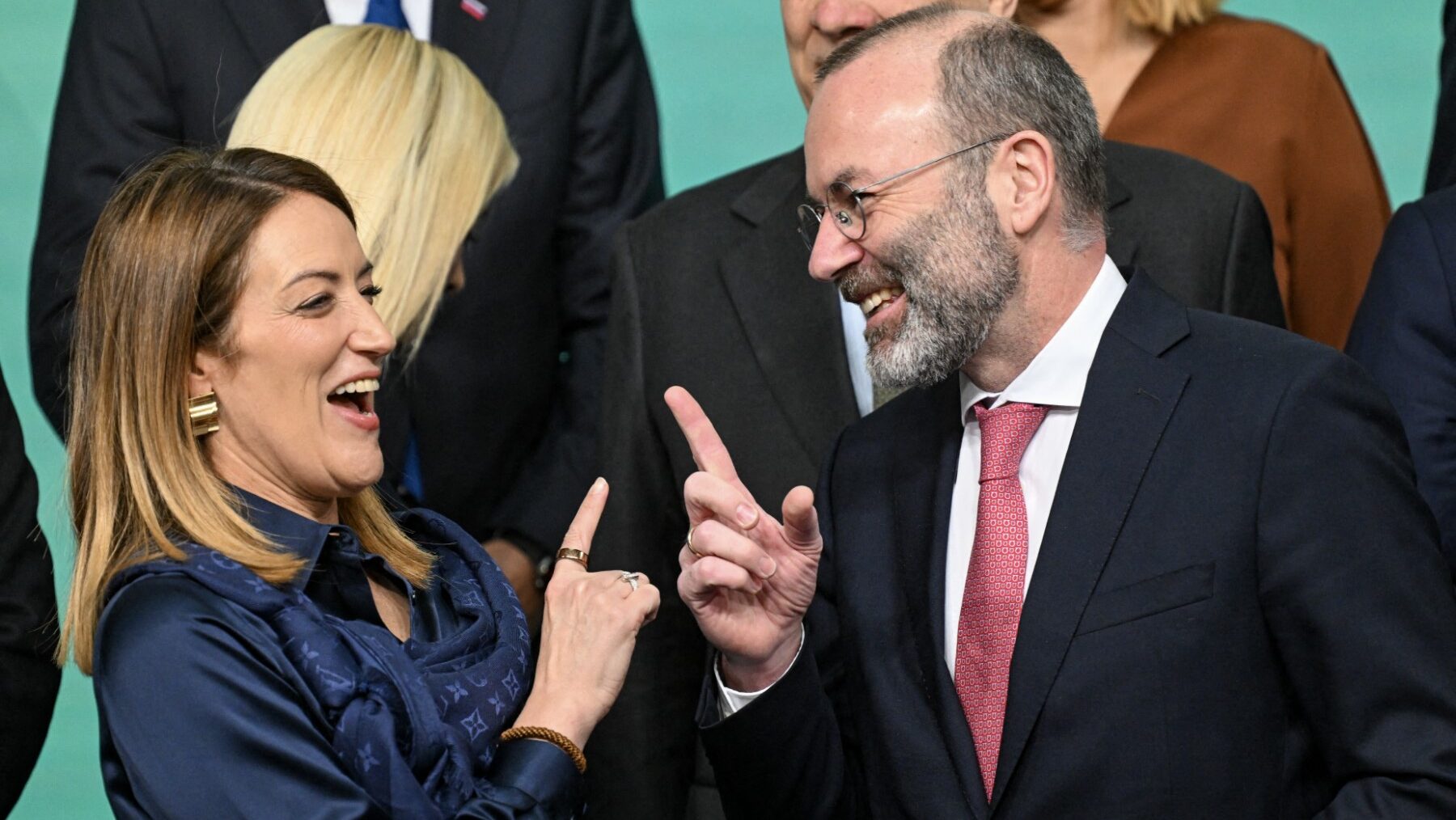
European Parliament President Roberta Metsola (L)and EPP President Manfred Weber share a laugh as they arrive for a photo during a meeting of the European People’s Party (EPP) in Berlin on January 18, 2025.
RALF HIRSCHBERGER / AFP
The president of the European People’s Party, Manfred Weber, has chosen to say out loud what had until now been quietly assumed in Brussels: the European “center,” he argues, must shift to the right. Not as the result of an ideological conversion or a deep reassessment of the European Union’s political course, but for a far more basic reason—polls and election results show that Europe is changing, and the EPP risks being left behind.
Presented as a sober reading of the new political climate, the message is in reality an exercise in electoral opportunism that is hard to disguise. Weber is not proposing a change rooted in principles nor a genuine self-criticism of the model his group has managed for decades. What he offers instead is a tactical, defensive adjustment designed to preserve power in an environment increasingly hostile to the traditional centrist left-leaning consensus.
The turn advocated by Weber does not question the pillars that have driven growing public alienation from the European Union. It does not revisit regulatory overreach, the erosion of national sovereignty, or the imposition of ideological agendas in social, climate, or cultural policy. Nor does it acknowledge that the rise of the Right is largely a reaction to the cumulative failure of those policies.
His proposal is far more limited: that social democrats and liberals accept a shift to the right on sensitive issues—immigration, industry, the environment—so that the EPP does not have to strike deals with forces outside Brussels’ old perimeter. In other words, to move the framework just enough to preserve the internal balance without altering the substance of the project. Change everything so that nothing really changes.
This logic reveals a profoundly instrumental view of the vote. The electorate is not a political subject to be listened to but a variable to be managed. If voters move, the rhetoric adjusts. If pressure mounts, concessions are made on the surface. Control, however, remains firmly in the same hands.
The clearest illustration of this strategy is Weber’s relationship with Giorgia Meloni. The EPP leader has shown an unprecedented willingness to cooperate with Italy’s prime minister and with Fratelli d’Italia, but from a markedly paternalistic position.
Meloni, according to Weber, is “behaving well.” She is “ready to compromise.” The choice of words is telling. He is not speaking of a political leader with a clear democratic mandate but of a figure assessed according to her degree of docility toward the system. Sovereigntist right-wing forces are acceptable only if they behave, only if they soften their positions, and only if they refrain from challenging Brussels’ fundamental balances.
This attitude is not merely humiliating for Italy; it exposes a hierarchical vision of European power in which the EPP appoints itself the continent’s moral and political arbiter. There is no genuine recognition of pluralism—only conditional integration.
Weber insists that his strategy is aimed at “stopping populism.” Yet the real fear underlying his discourse is the loss of the political monopoly that the EPP and its allies have exercised for years. The most recent European elections have not only altered parliamentary arithmetic; they have shattered the legitimizing narrative of the centrist consensus.
Invoking the cordon sanitaire or dismissing dissent as extremist or anti-European is no longer sufficient. Insecurity, uncontrolled immigration, industrial decline, and the erosion of the middle classes have generated a level of discontent that cannot be neutralized through rhetorical recalibration.
Faced with this reality, Weber seeks to appropriate the language of change without embracing its substance. He acknowledges the rightward shift—but strips it of any real political meaning. It is the strategy of someone who sees the end of a cycle approaching, yet still hopes to manage its final phase.