Recently, various news stories have surfaced around the world about Iranian demands that oil be traded in yuan. In return for a shift to the Chinese currency, Tehran would guarantee that the Hormuz Strait is open to oil shipping.
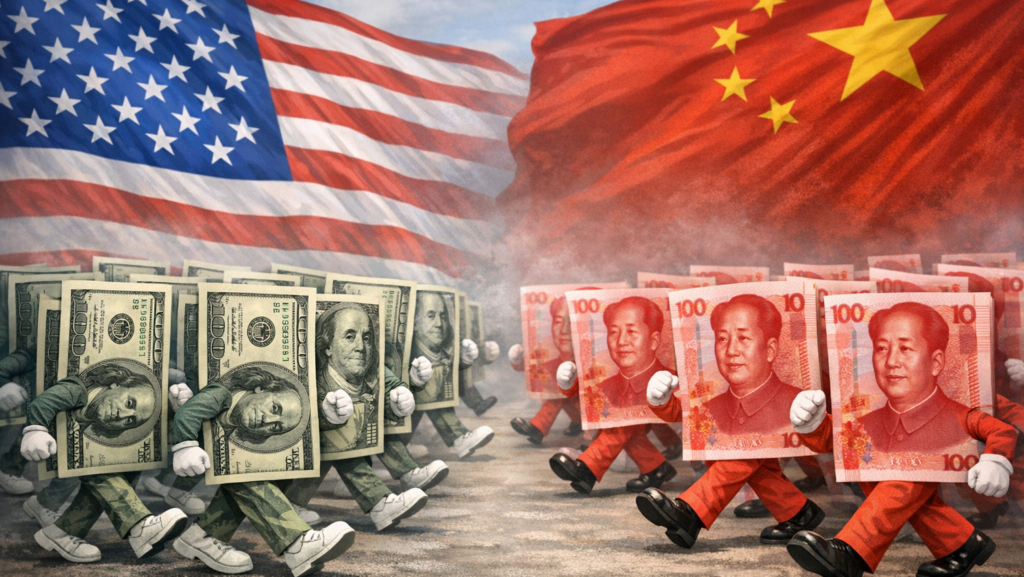
The tie between the yuan and the U.S. special military operation against Iran is sensational. In one fell swoop, it would shift the balance of power in the conflict, away from America’s military hegemony to a point where China could deal a near-fatal blow to the U.S. dollar as the world’s preeminent currency.
With such high stakes involved, Trump no longer ‘owns’ this conflict. He cannot back out of it without being absolutely sure that he does not sacrifice the dollar in the bargain.
As the story evolved through global media sources, it gained more substance.
An early, March 14th story appeared in a Russian publication over at Top War:
According to CNN, Iranian authorities are currently discussing a new mechanism for regulating shipping through the [Hormuz] strait. This would allow some vessels to pass through the strait, provided oil transactions are conducted in Chinese yuan. … As the American television channel notes, the condition Tehran is considering stems from China’s desire to expand the use of its currency in global energy markets.
While the CNN story referred to by TopWar appears to be a Facebook post, CNN did publish a long story on Iran’s oil-for-yuan bid on March 16th. Then on March 18th, established U.S. media outlet MSN reported:
Iran is negotiating with eight countries to allow passage through the Strait of Hormuz on the condition that oil is traded in Chinese yuan, CNN reported on the 17th. Following reports that these countries are considering a plan to permit ships from nations trading oil in yuan to pass through the strait, they are said to have contacted Iran to seek an agreement.
As this story has become conspicuously resilient, new details are being added. Here is The Chosun Daily, March 19th:
Earlier reports from major foreign media outlets indicated that Iran is reviewing a plan to permit ships carrying yuan-traded oil to pass through the Strait of Hormuz. Some countries appear to have responded to negotiations under the condition of yuan-based transactions … ships from countries like Pakistan and India have successfully passed through the Strait of Hormuz under Iranian government control.
On March 23rd, South Korea-based Financial News provided a significant amount of detail, lending more credibility to the scenario of Iran systematically discriminating between ships that are allowed through the Hormuz and those that are not.
At this juncture, it is logical to take a step back and review the consequences of what appears to be Iran coming out as a Chinese proxy gatekeeper in the Strait of Hormuz. On March 20 the Asia Times ran this story:
If recent reports are accurate that Iran is considering allowing limited tanker passage only if transactions are settled in Chinese yuan, then the issue at stake is no longer merely the movement of ships. It is the future of global energy finance.
This is a good point, especially since this story has evolved gradually through global media outlets, with new details emerging along the way. It is of such a quality at this point that it is worth considering as a prominent circumstance of the Iran conflict. Its gradual expansion, both in scope and in substance, is reminiscent of how a story would be growing if it originated with a major intelligence agency.
In this case, that agency would be Chinese. If there is one country that stands to gain significant geopolitical influence from pushing oil trade off the dollar, it is China. As I explained back in 2022 and in 2023, Beijing’s challenge to the dollar generally is both systematic and long-term in nature. Their efforts are most certainly focused on taking oil trade off the dollar, with approximately 20% of global oil trade already being denominated in other currencies.
I predicted on March 4th that the Iran conflict would be centered around the dollar-yuan tension. Part of the reason is the gradual expansion of the BRICS community and its commitment to trading and making financial transactions in non-dollar currencies.
Another, for America more ominous, reason is the increasingly precarious state of the U.S. government’s indebtedness. A reduction in the global demand for the dollar increases the stress on the U.S. economy to absorb dollars left idling globally. As I explained on March 4th, this is necessary to
avoid two bad things from happening concurrently: dollar depreciation and a return to inflation. Dollar depreciation erodes profits for foreigners who invest in U.S. Treasury securities as well as in stocks. If the depreciation is rapid enough, or if it is protracted but appears inevitable, then it can lead to a rapidly destabilizing sell-off of U.S. assets.
On the surface, the dollar appears to be stable, but a closer look at key statistics paints a different and worrisome picture. In the past year, the dollar has fallen 13% vs. the euro. While not unheard of in the normally volatile global currency market, it is also an unusually consistent trend that indicates weakening interest in the U.S. currency.
The stock market reached a peak in January, after which the leading S&P 500 index has slowly trended downwards. Many investors attribute this to AI-related disappointments—the promised land of endless profits continues to elude businesses that have made heavy investments in artificial intelligence. However, of greater and more acute concern are the worries that foreign stock market investors have. The combination of slower, even stagnant capital gains and a weaker currency means that foreign investors lose money simply by holding on to U.S. stocks in their portfolio.
Even the market for U.S. government debt is showing signs of investor concerns. Interest rates in the important secondary market, where the general public buys and sells U.S. Treasury securities, are consistently 20 interest points above the rates at auctions of new debt. While this sounds like a technical detail, it is an essential indicator of how much—or how little—domestic and foreign investors believe in the solvency of U.S. government debt.
The higher secondary market rates are vs. the auction rates, the more worried global investors are about the future of the dollar.
And, of course, of the future solvency of the federal government.
In so many words, the U.S. dollar is suffering from a structural weakness that would be radically reinforced if a large enough part of oil trade shifted to another currency.
Therefore, by convincing the Iranians to make the current military conflict a battle in defense of the dollar, China would have trapped President Trump in that very conflict, shifting the jurisdiction over the end of the war from Washington to Tehran (and Beijing). Iran could then engage the United States in a war of attrition—a kind of war that America has proven time and time again that it does not have the ability—or will—to fight.