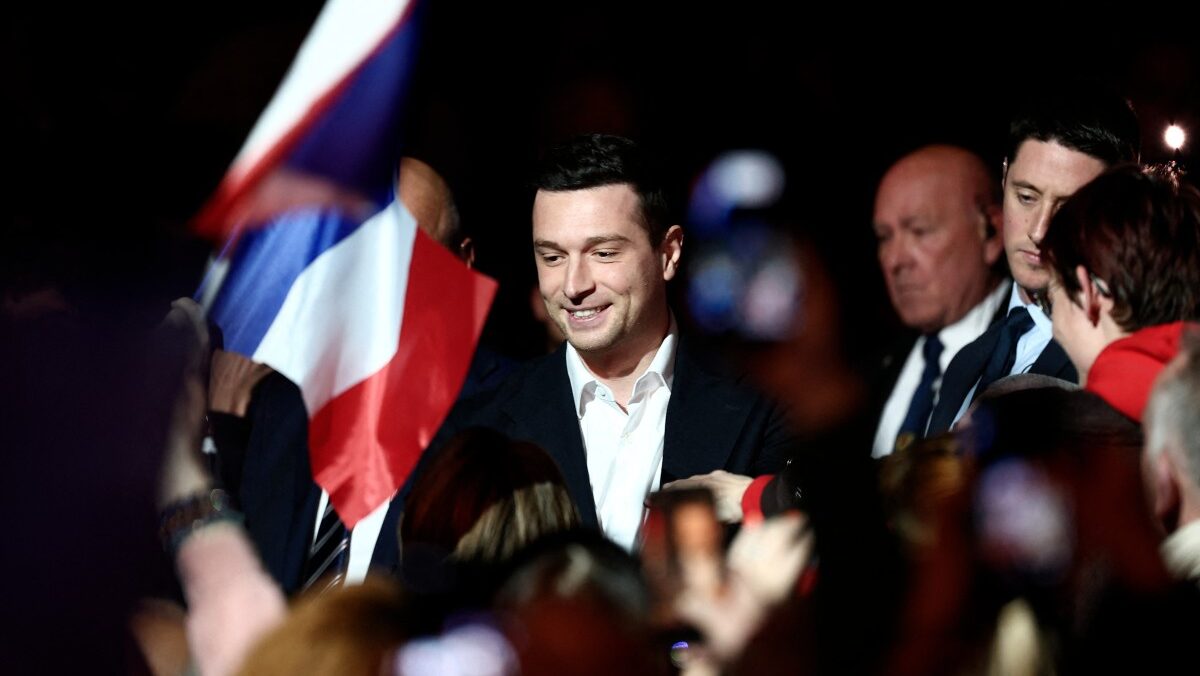
Rassemblement National RN party’s President Jordan Bardella greets supporters during a party rally following the results of the first round of France’s 2026 municipal elections, in Chalons-en-Champagne, on March 18, 2026.
SAMEER AL-DOUMY / AFP
The confirmation of the relationship between Jordan Bardella, leader of the Rassemblement National (RN), and Princess Maria-Carolina of Bourbon-Two Sicilies has sent shockwaves through newsrooms. Between media curiosity and more strategic interpretations, this revelation has captured the imagination and fuelled much speculation ahead of Bardella’s potential bid for the 2027 presidential election.
Rumours have been circulating since January, when the two young people were seen together at the bicentenary celebrations of Le Figaro. What was then merely a suspicion has become a reality, thanks to coverage in the popular magazine Paris Match.
For Jordan Bardella, bringing this relationship into the open significantly alters his public image. An established yet still young political figure—he is only thirty-one—he is adding a more personal dimension to his persona. On social media and in certain media commentaries, this announcement has been met with a mixture of surprise and goodwill, with some seeing it as a form of ‘normalisation.’ A man who is sometimes perceived as having a rigid political image—he has in the past been labelled with the disparaging nickname ‘cyborg’—is breaking down his defences and thus making himself more approachable.
The figure of Maria-Carolina of Bourbon-Two Sicilies adds a unique dimension. Both a model and a social media star, whilst hailing from the cream of European aristocracy, she possesses a very powerful media image, at the crossroads of aristocratic tradition and media modernity. She embodies a cosmopolitan profile—she speaks several languages and moves with the greatest ease amongst the international elite—which stands in stark contrast to the usual norms of the French political scene, and, above all, to the political personnel of the RN. Before her, another model played on this theme with some success: Carla Bruni, also Italian, and the conquest of President Nicolas Sarkozy.
On the political front, reactions remain measured but revealing. Some officials from the presidential majority have privately quipped about a “very European romance,” whilst opposition figures have preferred to avoid any direct criticism, in the name of respect for privacy. On the Left, however, a few voices have pointed to a certain disconnect between the RN’s political rhetoric and this closeness to high-society aristocratic circles. Conversely, within Bardella’s own party, this relationship is seen more as a godsend: the president is crafting a more ‘open’ and less divisive image, which can only serve him well should his presidential candidacy be confirmed. For experts in political communication, the signal sent is very clear: this is indeed a thunderous entry for the young man into the campaign. Displaying this relationship is a necessity for him: no one has ever reached the Élysée alone.
For the time being, in the media, coverage of the relationship oscillates between celebrity gossip and political analysis. The concrete political impact remains limited at this stage, but the image effect is real. This relationship helps soften the perception of Jordan Bardella among a wider audience, particularly internationally. It may also reinforce his generational positioning: that of a leader at ease with contemporary norms, capable of navigating between the political sphere and media exposure. One need only read the glowing comments from French internet users on media outlets’ forums. Beyond a few bitter and unpleasant remarks, the ‘charm’ factor sweeps all before it. Youth, beauty, the alliance of republican meritocracy—Jordan Bardella, the lad from the suburbs—and France’s monarchical past, ever-present, ever-dreamed-of—Maria-Carolina, the princess descended from Louis XIV—hits the mark.
It remains to be seen whether this relationship will stand the test of time or whether it will be as fleeting as an election campaign. For now, from this perspective, it undeniably presents itself as a serious asset for the RN candidate.