On May 9, Europe Day, the European Commission published a seemingly simple image on its official X account: an elderly white woman alongside a young black girl. With no explanatory text beyond the usual commemorative message. Hours later, the post had accumulated nearly 800,000 views and more than 1,000 comments.
The Schuman Declaration of 9 May 1950 laid the groundwork for the European Union that we know today.
— European Commission (@EU_Commission) May 9, 2026
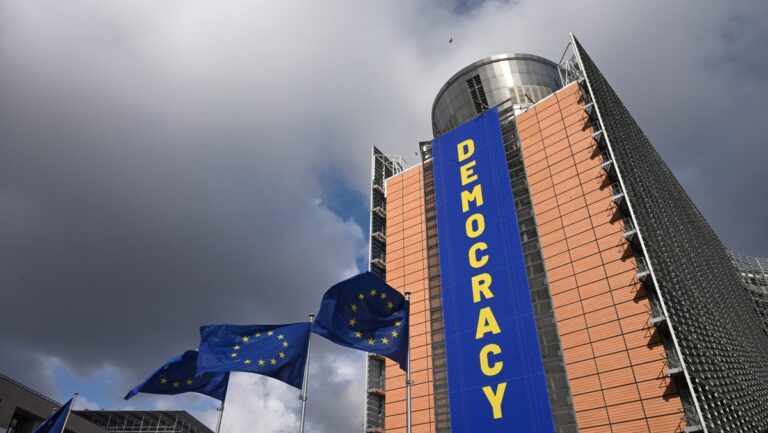
And if you are in Brussels or nearby, come celebrate and visit us, at our Berlaymont building.
More: https://t.co/q7hBNkzElg pic.twitter.com/E8EPfZCEIy
To understand why the image caused such a reaction, the broader context matters. Europe Day is not a neutral date in Brussels. It is the European Union’s main annual exercise in promoting the European project. EU institutions do not merely communicate policies; they attempt to shape a narrative about what Europe is and what it should become. Every image, slogan and visual choice forms part of that effort.
The Commission has not offered any explanation of the image or its intended meaning. Yet the reaction on social media revealed how a significant number of users interpreted the scene: the elderly woman representing an ageing Europe, and the girl symbolising the continent’s demographic future.
For many critics, the symbolism pointed toward a deeper political debate that has existed in Europe for years. Europe is ageing rapidly, with birth rates below replacement level across most member states, while immigration has become one of the main drivers of population growth.
Brussels presents this transformation through the language of diversity, inclusion and social cohesion. Critics, however, increasingly see it as something else: a demographic and cultural shift that risks weakening Europe’s historical identity and continuity. In that context, the image published on May 9 became far more than a simple commemorative post.
And in politics, images are rarely innocent.
Despite the controversy, the episode does not stand alone. It fits into a broader pattern in the way European identity is increasingly presented by Brussels institutions.
A recurring example is the House of European History, the museum funded by the European Parliament in the EU capital. Officially conceived as a space to promote a common European identity, it has faced criticism for exhibitions that place heavy emphasis on war, colonialism, and the traumas of the twentieth century as defining elements of European identity.
For critics, both cases reflect the same underlying logic: the reinterpretation of Europe not as a civilisation with historical continuity, but as a political space in permanent redefinition.
The European Commission usually presents its decisions in technical or administrative language. But episodes like this reveal what is increasingly at stake beneath those institutional terms: the battle over narrative, who defines Europe, what past is preserved, and what future is projected.