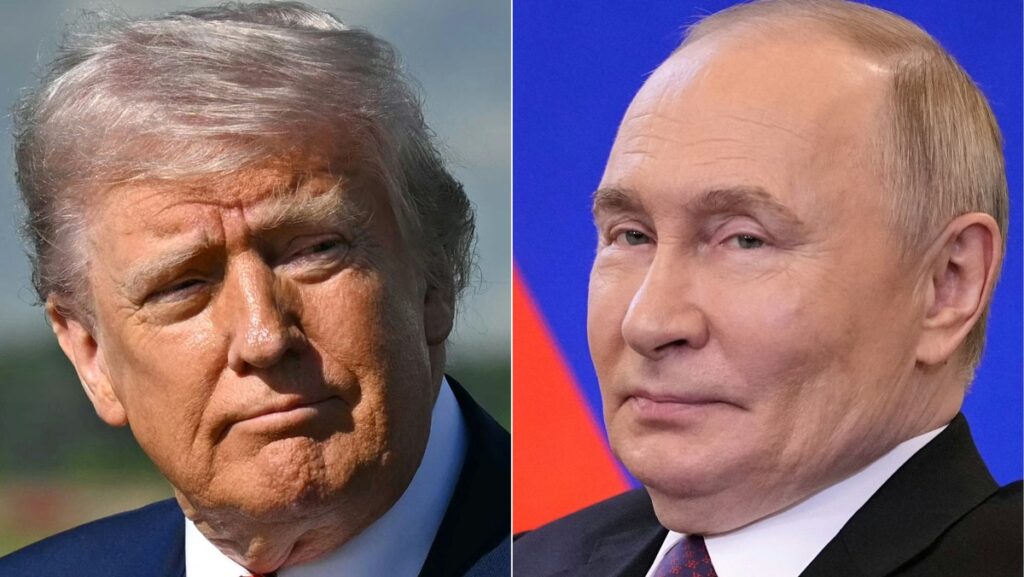
This combination of pictures created on June 4, 2025 shows U.S. President Donald Trump in Morristown, New Jersey, May 23, 2025, and Russian President Vladimir Putin at the Kremlin in Moscow on May 28, 2025.
Saul Loeb and Pavel Bednyakov / various sources / AFP
The upcoming meeting in Alaska will not be confined to the question of Ukraine. Its implications stretch far beyond the battlefield, carrying the potential to reshape the very architecture of the international order.
President Putin understands the stakes. He knows that he cannot risk not giving anything substantial to President Trump to take to his European allies and a beleaguered but yet stubborn Ukraine. Tactically and practically, he needs to keep the relatively good disposition of the American president towards Russia intact: this is the one asset that he cannot risk losing. President Trump has made it abundantly clear that his prospects are slim. On Monday, August 11th, he said that only after the first two minutes of the meeting will he know whether there will be concrete steps taken towards peace or not. Two minutes—a window both daunting and fateful.
As for the rest of us, let us pray that President Trump triumphs, because the current situation, as it goes, spells a sure disaster for Europe. Progressively, Ursula von der Leyen and friends have engineered a fateful path for Europe—that of total war and oblivion. Whatever President Trump can bring home will be a relief to a confused and disoriented Europe. In times as dire as these, relief is no small victory.
As for a comprehensive and long-lasting peace, no one imagines that the conflict between Russia and Ukraine can be settled any time soon. As Hungarian political theorist István Bibó would argue, to have a true peace settlement, each side will have to understand the root causes, fears, and experiences of the opposite side. That will take time and restraint from all parties involved. Most importantly, as Bibó would point out, a peace settlement would mean the organization of it on the ground. An enormous task and responsibility that most probably an outside power has to bear the burden for.
After the Second World War, the United States of America had the strong will and resources not only to bring the war to an end but also to impose a peace settlement. It had the resources, but what really made the difference was that, through a series of conferences starting from the Atlantic Conference in 1941 to the Yalta Conference in early 1945, the U.S. had persuasively built a coalition for peace. It is also true that, after these conferences, the United States had emerged as an undisputed global power, and global empires like France and Britain were nurtured into accepting this fact. And that process took a strenuous five years.
The situation today, however, is radically different. The United States today is not sure of the extent of its power, and increasingly, its closest allies are doubting what it can and cannot achieve. Unlike the situation during the Second World War, President Trump has a gigantic mission of forging a consensus for peace, making everyone move in the same direction. Today President Trump wants to achieve a cessation of hostilities very quickly, if possible on Friday, at the Alaska summit. But he cannot go to President Putin and ask him to negotiate a peace settlement, let alone sign it, if no one in his own camp is willing to accept it.
The risks to the power and prestige of the United States have been stacking up. So before anything else, the U.S. president had to gather strength and impose support from allies and partners. With tariff policies and tariff diplomacy, the Trump administration has created a coalition of obedient allies. The Turnberry Agreement was the last of the great victories on the road to Alaska. Finally, after going for all-out war, Europe has been ‘convinced’ to pull back in time to support the latest peace effort.
President Trump is also trying to boost his credibility as a genuine peacemaker. Building on his earlier success in bringing about a peace settlement to the conflict between Morocco and the separatists of Western Sahara, within a very short period, he has directly or indirectly forged peace in several regions, from the Congo to Cambodia. Nobody can accuse him of being a novice to peacemaking. While the Gaza and Ukraine conflicts remain the most difficult to manage, if there is one person on earth, realistically speaking, that can make a credible attempt, it is President Trump.
This said, the outcome of Friday’s summit in Alaska might not be solely dependent upon Donald Trump and his phenomenal effort over such a short period. President Putin is no newcomer to the art of war and peace. He, too, has gathered a powerful coalition of friends. But at the end of the day, what counts is how much each side is willing to give up. In this game, President Trump has nothing to lose, and he has all the right cards in his hand.
Ramachandra Byrappa earned his PhD in 20th-century history from Eötvös Loránd University (ELTE) in Budapest in 2014. He teaches contemporary Asian history and geopolitics at ELTE and is a Senior Research Fellow at the Hungarian Institute of International Affairs.