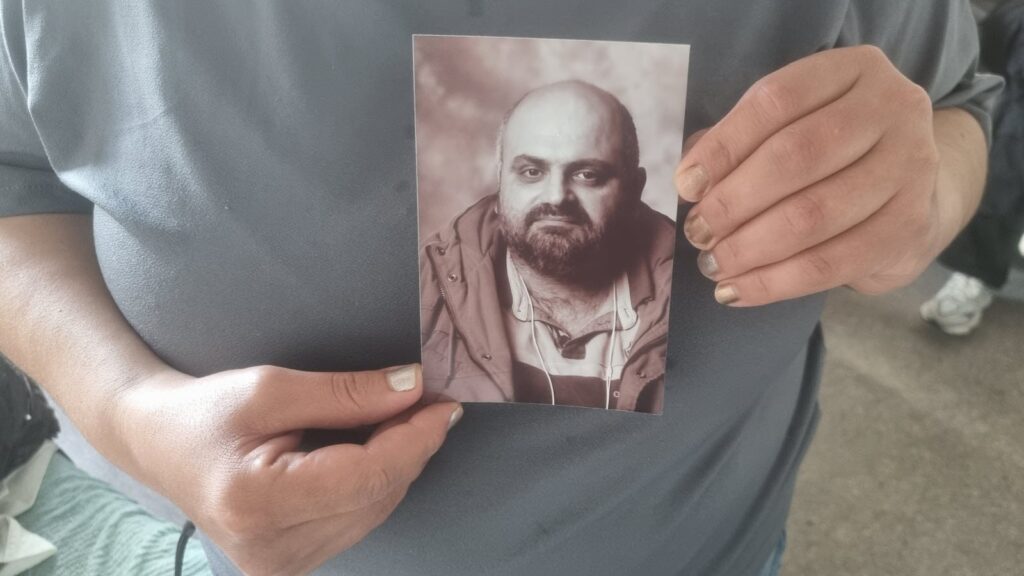
Photo of Ashur Sarnaya
@MaralSalmassi on X, 12 September 2025
Christians in Paris carried out a demonstration on September 28 against Christianophobia in response to the murder of an Iraqi Christian, who was stabbed to death on September 10 while livestreaming on TikTok about his faith outside his apartment in Lyon, France.
Ashur Sarnaya, a disabled Assyrian Christian who used a wheelchair, had fled persecution from the Islamic State (ISIS) terrorist group in Iraq and had reportedly stated that he received threats in online comments and anonymous phone calls. He was 45. Recordings of the live stream show blood pouring from Ashur’s throat as he struggles to breathe.
A witness filmed a young person’s back as he was leaving the scene. The hooded man was wearing dark clothing and is believed to be the murder’s perpetrator, the Assyria Post reported:
Originally from the town of Ankawa in Iraqi Assyria, Ashour was confined to a wheelchair and known for his live broadcasts on TikTok about Christianity and religion. Many now believe he was killed for comments he made about Islam. In one of his videos, still visible on TikTok, he said his content was regularly blocked and his accounts suspended—claims he attributed to reports by Muslim users. He received several threatening messages from Muslims online in the comments to his videos.
A member of France’s Assyrian Christian community told europeanconservative.com on the condition of anonymity:
Ashur obtained political asylum in France in 2015 after fleeing the ISIS genocide in Iraq. He criticized Islam and shared the Gospel with his viewers on YouTube and TikTok. His body has not yet been given to his family, so his funeral is not scheduled. The perpetrator has not been caught, but we think it was an Islamist and that Ashur was targeted for his criticism of Islam.
I’ve been living in France for over four decades now and I’m grateful to call France my new home. But our security has deteriorated a lot due to mass Muslim migration. Many radical Muslims have entered France in recent years. On our religious days and special occasions, our churches in Paris are now protected by the French military and police. This speaks volumes about how vulnerable our churches and Christian communities are in France.
Ashur is not the only victim of Islamic violence in the West. Christians who have fled the Middle East due to its Islamic violence are increasingly facing the same type of violence and other human rights violations at the hands of Islamists in Europe.
Assyrians are an indigenous people of Iraq, Iran, Turkey, and Syria. For 300 years (from 900 to 600 B.C.), Assyrian kings ruled the largest empire the world has ever known. The Assyrian Church of the East records that the Apostle Thomas himself converted the Assyrians to Christianity within a generation of Christ’s death. Christianity was ‘‘well established and organized’’ in Mesopotamia by the third century CE.
Today, there are around 3 million Assyrians worldwide who speak the Aramaic language, also known as Syriac, which is the language of Jesus Christ. Modern Assyrians are the descendants of the ancient Assyrians, one of the earliest civilizations to emerge in the Middle East. They have a history spanning over 6770 years. As the Assyrian American Cultural Organization of Arizona notes,
Although this flourishing empire ended its reign in 612 B.C.E, history is filled with recorded details of the continuous presence of the Assyrians till the present time. During the ancient periods, their civilization was centered at the city of Assur, the ruins of which are located in northern Iraq. Even after the horrors brought by ISIS, and destroying most of the Assyrian relics, you can still see the ruins of Nineveh and the Lamassu guarding the palace entrance.
The Assyrians contributed a great deal to helping usher the basis of civilizations, by inventing writing and literature, erecting the first organized library by King Ashurbanipal in Nineveh, developing paved roads, and creating the 360-degree circle, of which laid down the foundation of telling time. Establishing law and judicial systems with the Code of Hammurabi, helped facilitate many things such as instituting medicine, and pharmacology, and most importantly easing the spread of a universal language in the known world.”
Following the seventh-century Arabic and subsequent Ottoman Turkish invasions of the Middle East, the Assyrians (as well as other non-Muslims) were reduced to persecuted communities who lived at the mercy of their Islamic overlords. For centuries, Islamic supremacists have placed a target on indigenous peoples (including Assyrians) due to their religious beliefs. They turned Christians and Jews into “dhimmis”, second-class citizens who were obliged to pay a poll tax called jizya to be able to retain their Christian identities.
The Christian persecution in the Ottoman Empire culminated in the Assyrian, Armenian, and Greek genocides of 1913-23. As Joseph Yacoub, Emeritus Professor at the Catholic University of Lyon and the author of the book “Year of the Sword: The Assyrian Christian Genocide, A History,” writes:
The Armenian genocide of 1915 has been well documented. Much less known is the Turkish genocide of the Assyrian, Chaldean and Syriac peoples, which occurred simultaneously in their ancient homelands in and around ancient Mesopotamia—now Turkey, Iran and Iraq. The advent of the First World War gave the Young Turks and the Ottoman government the opportunity to exterminate the Assyrians in a series of massacres and atrocities inflicted on a people whose culture dates back millennia and whose language, Aramaic, was spoken by Jesus. Systematic killings, looting, rape, kidnapping and deportations destroyed countless communities and created a vast refugee diaspora. As many as 300,000 Assyro-Chaldean-Syriac people were murdered and a larger number forced into exile.
Other sources place the number of victims even higher, at up to 750,000. It is estimated that up to two-thirds of the Assyrian population in the Ottoman Empire were murdered during the genocide, which is also known by Assyrians as Seyfo, meaning “sword”.
The persecution against Assyrians never ended in Turkey, Syria, Iraq and Iran. Seyfo (the Assyrian Genocide) was followed by the 1924-25 massacres in Hakkari, Turkey; the 1933 Simele massacre in Iraq; the Islamic revolution of Iran that severely restricted freedoms for Christians; and the 2014 genocide committed by the Islamic State (ISIS) in Syria and Iraq. August 7 is observed annually by Assyrians as Assyrian Martyrs Day to honor the memory of all those Assyrians who have fallen victim to genocide, other mass atrocities, and persecution as a result of their distinct ethnic and religious identity.
According to a UK official report, Assyrians and other Christians throughout the Middle East continue to experience various forms of persecution and discrimination. This includes violence and harassment, expulsion, destruction of religious property and cultural heritage, larceny, lack of legal and constitutional protections, restrictions on and suppression of the practice of religion, arbitrary arrests and imprisonment, targeting of religious leaders, and educational exclusion, amongst others.
Before Islamic military conquests, massacres, and persecution started in the seventh century, most of the Middle East and North Africa (including lands which are today called Turkey, Syria, Jordan, Lebanon, Gaza, Iraq, Morocco, Algeria, and Egypt, amongst others) were predominantly Christian. They were part of the Eastern Roman/Greek Byzantine Empire. There were large Jewish and other non-Muslim communities throughout. People spoke Greek, Aramaic/Syriac, Armenian, Hebrew, Coptic (an ancient Egyptian language), and other languages. This was all before Arabic or Turkish largely erased and replaced those languages—a process that occurred simultaneously with Islamization.
Islam is now targeting Europe, violating the rights and freedoms of Christians in the Old Continent. Ashur survived ISIS, only to be murdered in Europe for his faith. His murder raises urgent questions about the religious freedom and safety of Christians in the West.