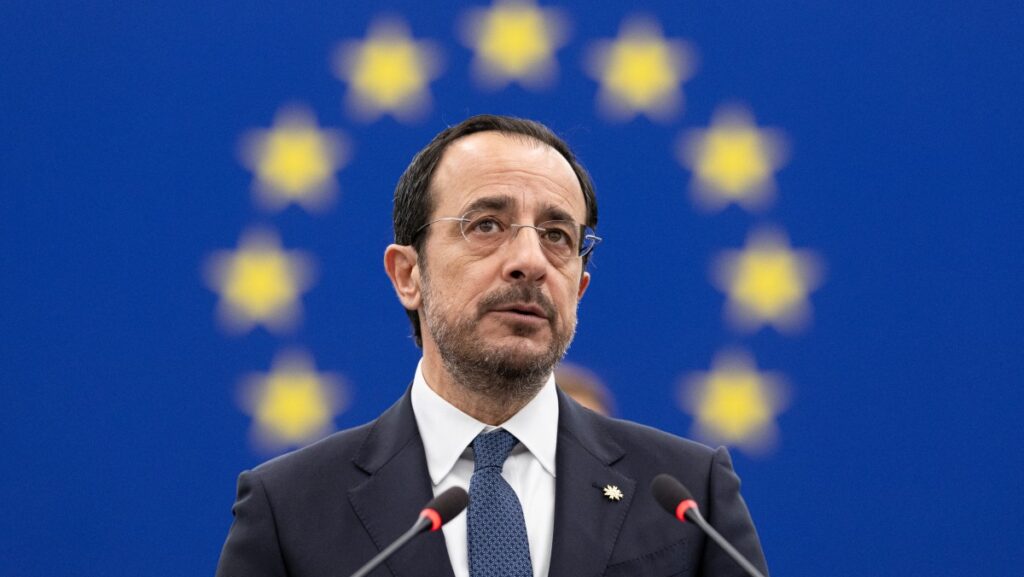
Cyprus’ President Nikos Christodoulides delivers a speech during the presentation of the programme of the Cypriot presidency of the Council of the European Union during a plenary session at the European Parliament in Strasbourg, eastern France on January 20, 2026.
ROMEO BOETZLE / AFP
When a smaller member state assumes the rotating presidency of the Council of the European Union, it is often treated as a procedural moment rather than a strategic one. Yet Cyprus’ six-month turn at the helm, which started on January 1, comes at a time when Europe faces mounting geopolitical pressures from its southern neighbourhood. Conflict in the Middle East, energy security concerns, and regional instability all place the EU’s southeastern frontier at the centre of European foreign policy. In this context, Cyprus’ presidency highlights how smaller states, particularly those located on geopolitical fault lines, can influence Europe’s external engagement in ways disproportionate to their size.
The presidency itself confers no executive authority, but it shapes agendas, moderates negotiations, and influences political tone. Smaller states frequently excel in this role precisely because they are not perceived as hegemonic actors. Cyprus, with longstanding diplomatic ties across the eastern Mediterranean and the Middle East, occupies a position that allows it to act as facilitator rather than protagonist, a role often conducive to building consensus within the Union.
Geography explains much of this potential. Cyprus sits at the intersection of Europe, the Levant, and North Africa. Developments in Lebanon, Israel, Gaza, Syria, or Egypt are therefore not distant foreign policy abstractions for Nicosia; they are immediate strategic realities. Migration routes, maritime security concerns, energy exploration, humanitarian crises, and regional diplomacy converge here in ways that few other EU member states experience so directly.
Recent initiatives illustrate how Cyprus has already leveraged this position. The Amalthea humanitarian maritime corridor during the Gaza crisis demonstrated the island’s logistical importance as a gateway between Europe and the Middle East. The Hestia evacuation framework showed Cyprus’ capacity to coordinate complex civilian evacuation operations during regional crises. Cooperation with the EU on Lebanon-related stability initiatives further underscores how Cyprus can translate regional proximity into European diplomatic engagement. Taken together, these efforts suggest a consistent strategic role: Cyprus functioning as a pragmatic bridge between the European Union and the Middle East, combining humanitarian facilitation, logistical capability, and political mediation.
Nicosia can also contribute to making the European Union a more consequential actor in Middle Eastern affairs. Its geographic proximity, longstanding regional ties, and operational experience allow it to translate local realities into European policymaking in ways larger member states sometimes struggle to do. By serving as a logistical hub for humanitarian operations, facilitating diplomatic engagement with regional partners, and highlighting the security, energy, and migration interconnections between Europe and the Middle East, Cyprus can help the EU move from reactive crisis management toward a more coherent and sustained regional presence. The value of a small frontier state lies not in geopolitical weight alone, but in its ability to anchor European policy in practical regional understanding.
Cyprus has also sought to broaden its diplomatic footprint beyond the immediate Middle East, strengthening ties with African partners, Gulf states, and Central Asian countries such as Kazakhstan. These relationships, often rooted in trade, energy cooperation, and regional dialogue, can provide the European Union with additional channels of engagement in regions where geopolitical competition is intensifying. For a small member state, such outreach does not replace EU foreign policy, but it can complement it by offering practical diplomatic access points and reinforcing Europe’s broader global presence.
Political messaging from Nicosia reinforces this broader strategic ambition. President Nikos Christodoulides has framed the presidency around three interconnected priorities: bringing European citizens closer to the Union, strengthening European strategic autonomy not only in defence but also in economic competitiveness and cohesion, and deepening engagement with the Middle East, a region geographically and politically proximate to Cyprus.
The emphasis on public connection reflects notably strong support for EU membership among Cypriot citizens, while the focus on autonomy and regional outreach underscores Cyprus’ aspiration to act as an honest broker between Europe and its southern neighbourhood. For a small state without hegemonic ambitions, this positioning can enhance credibility in regional diplomacy, particularly at a time when Europe seeks a more coherent role in Middle Eastern stability.
This geopolitical orientation is also reflected in the presidency’s broader political framing. Cyprus has articulated priorities centred on strategic autonomy, regional engagement, competitiveness, democratic resilience, and sustainable financial capacity. The emphasis on an autonomous Union open to the world suggests a vision of European strategic autonomy not as isolation, but as the ability to engage confidently with volatile neighbouring regions, particularly the Middle East. For a frontline state, autonomy is inseparable from stability in its immediate neighbourhood.
Migration policy illustrates this linkage particularly clearly. Mediterranean frontline states have long argued that migration cannot be addressed purely administratively, as it requires geopolitical engagement with origin and transit countries. Cyprus, once among the EU member states facing some of the highest per capita asylum pressures, is increasingly viewed in Brussels as a relative success story in managing flows through strengthened border management, diplomatic engagement with neighbouring countries, and administrative reforms. While challenges remain, this experience may allow the Cypriot presidency to push for a more balanced European approach, one combining humanitarian responsibility with security realism and sustained regional cooperation.
Energy security adds another layer. Eastern Mediterranean gas reserves, maritime boundaries, and regional alliances intersect directly with European energy diversification efforts. Cyprus’ growing energy cooperation with Israel and its exposure to regional instability place it at the centre of Eastern Mediterranean energy geopolitics, developments that increasingly influence Europe’s strategic autonomy.
Relations with Turkey inevitably remain part of this equation. Cyprus’ unresolved occupation problem and Ankara’s assertive regional posture give Nicosia a particularly acute understanding of how EU–Turkey relations affect stability across the Eastern Mediterranean. While the presidency cannot transform these dynamics, it can ensure that regional security concerns remain visible in EU discussions.
The presidency also coincides with renewed EU attention to enlargement and neighbourhood policy. Instability in the Middle East increasingly intersects with European security, migration, and economic policy. Cyprus’ diplomatic experience and geographic position may therefore help sustain a more integrated EU approach that treats southern neighbourhood engagement not as peripheral but as central to European stability.
Smaller member states like Cyprus can also contribute in less visible but equally important ways. Their diplomatic networks often extend into regions where larger European powers carry historical baggage or strategic rivalries, allowing them to act as credible interlocutors. They can host humanitarian and logistical hubs, facilitate informal dialogue channels, and provide early warning on regional developments thanks to geographic proximity. Their experience managing migration flows, maritime security challenges, and energy interdependence can inform more realistic EU policymaking. Perhaps most importantly, smaller states frequently act as pragmatic consensus builders within EU institutions, helping bridge divides between larger member states whose competing interests can sometimes slow collective action.
Beyond policy specifics, Cyprus’ presidency carries symbolic significance. It demonstrates that the EU’s geopolitical awareness is shaped not only in Berlin, Paris, or Brussels, but also on its periphery. Smaller states often perceive emerging risks earlier precisely because they experience them directly, and their perspectives can therefore enrich European strategic thinking.
Ultimately, Cyprus will not redefine Europe’s Middle East policy singlehandedly. But it can sharpen Europe’s awareness of regional interdependence. Stability in the Middle East is not a distant concern for the EU; it directly affects migration, energy, security, and economic resilience. By foregrounding these linkages, Cyprus can help the Union approach its southern neighbourhood with greater coherence and realism.
If the presidency succeeds in reinforcing this perspective, its contribution will extend beyond procedural stewardship, as it will illustrate how a small state, drawing on geography, diplomatic credibility, and regional familiarity, can enhance Europe’s capacity to act strategically in one of the world’s most complex geopolitical theatres.