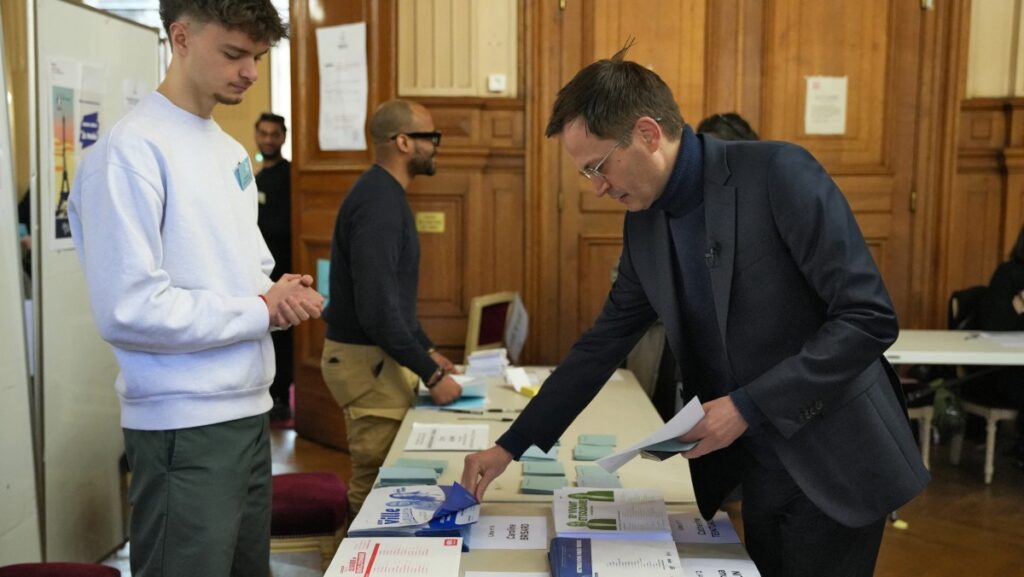
The first round of the local elections on March 15th, 2026, which serves as a test run ahead of the 2027 presidential election, provides many indicators of the shifts currently taking place within French politics. Several trends are emerging, notably the resolute rise of the Rassemblement National (RN), the resilience of the far left, and the centre-right’s laborious attempt to reposition itself.
Voter turnout, estimated at around 56%, is up compared to the 2020 municipal elections but remains lower than in 2014. The year 2020 was marked by a significant drop in turnout due to the COVID-19 pandemic; that chapter is closed, though there has been no return to normality—a sign of relative interest in the election but also of a certain persistent political disengagement. The slight rise in turnout should not obscure the climate of political mistrust prevailing in the country at a time when the majority of French people want Emmanuel Macron to step down.
Polling organisations appear to have significantly underestimated certain results, whether in terms of turnout or election results. Several candidates thus performed far better than predicted.
The first lesson from the election concerns the strength of the RN’s positions in the medium-sized towns it won in the last election. In Perpignan, Louis Aliot, the party’s vice president, was re-elected in the first round with 51.4% of the vote, significantly improving on his 2020 result. This sends a strong signal for the party, confirming its ability to establish a firm local foothold and to remain undeterred by legal scandals: Louis Aliot was indeed convicted in the European parliamentary assistants case, yet this did not dent his local popularity. Another major town retained by the RN is Fréjus, with its mayor David Rachline. These re-elections contradict the criticism levelled by certain politicians regarding the “chaotic management” of RN-run municipalities, an argument notably put forward by La France Insoumise spokesman Manuel Bompard.
In other towns, further results reinforce the progress of Marine Le Pen and Jordan Bardella’s party. In Toulon, the RN’s incumbent candidate, Laure Lavalette, secured 42% of the vote—roughly double the figure from six years ago. However, the outcome of the second round remains uncertain, since her opponents’ lists may merge to prevent any victory for the RN in such a big city.
RN President Jordan Bardella spoke from Beaucaire, where the outgoing mayor was also re-elected in the first round with nearly 60% of the vote. In his speech, he called for the RN lists to remain in the second round wherever they have qualified and reached out to “independent or genuinely right-wing lists” in order to counter the threat from the far left or what he describes as “dilution into Macronism.” Bardella also adopted the cordon sanitaire argument, this time applying it to the La France Insoumise party.
In Nice, the contest between Éric Ciotti, president of the Union of the Right for the Republic allied with the RN, and the incumbent mayor Christian Estrosi is being closely watched. Ciotti is leading with almost 42% against 31% for Estrosi. In France’s fifth-largest city, a victory for Ciotti could accelerate internal realignments within the right, where defections from Les Républicains (LR) to the RN-UDR alliance continue to multiply.
The LR party is also claiming several significant results. According to Bruno Retailleau, an LR candidate or an affiliated candidate was leading in more than half of the municipalities with over 9,000 inhabitants, allowing him to assert that his party remains “France’s leading party” in terms of local presence—a way of convincing himself, even as no significant victory is emerging in France’s largest cities.
On the Left, Jean-Luc Mélenchon’s La France Insoumise (LFI) on election night enthusiastically announced the exceptional progress made by his party. These loud declarations should be put into perspective. It is true that in certain major cities, the far-left party has achieved significant results, even though public opinion had seemed for several months to be rather hostile to the party’s antisemitic excesses or its open use of violence. Certain symbolic victories have left a lasting impression, such as that of Bally Bagayoko, elected in the first round in Saint-Denis—the largest city in the Île-de-France region after Paris, home to the basilica which for centuries served as the burial place of the kings of France—who celebrated his victory in clear terms: “Saint-Denis was the city of kings. Today it is also the city of Black people.” But overall, the party has seen a decline since the 2024 European elections. In Paris, LFI lost 5 percentage points; in Marseille, around 10 points; in Lyon, almost 7 points. Many voters who voted for LFI in 2024 did not wish to repeat the experience. Indeed, LFI appears more than ever to be the party of the suburbs and Islamised towns. There, its antisemitic excesses have even had a mobilising effect on the electorate.
In the major cities, the race looks set to be particularly close ahead of the second round.
In Marseille, the outgoing Socialist mayor Benoît Payan (36.6%) and the RN candidate Franck Allisio (35%) are neck and neck. As the Socialist mayor has refused any negotiations with the far left, which has also qualified for the second round, a victory for the RN in France’s second-largest city is conceivable but is likely to fail if the centre-right refuses to lend its votes in support of the RN candidate.
In Paris, the Socialist candidate Emmanuel Grégoire is in the lead with almost 38%, well ahead of the former minister for culture Rachida Dati (25.4%). The LFI candidate Sophia Chikirou has secured 13%. The presence of other qualified lists, notably that of Pierre-Yves Bournazel (11.8%) and that of Sarah Knafo, slightly above 10%, makes the situation highly uncertain and opens up the possibility of a four-way race, or even a more fragmented scenario with five candidates. The city appears more than ever to be sharply divided between the left-leaning east and the right-leaning west—a social, political and symbolic divide that now seems insurmountable.
Beyond municipal issues, these elections already appear to be a test for national political realignments. Several political figures, notably within the RN, have emphasised that “change begins as early as next Sunday,” without waiting for the 2027 presidential election.
On Sunday, March 22nd, the second round—for which candidate lists must be submitted by 6 p.m. on Tuesday—will be decisive in gauging the scale of these dynamics. On the Left, the question of alliances remains central. The first secretary of the Socialist Party, Olivier Faure, has ruled out any national agreement with LFI but has not closed the door on local arrangements to block the RN: in the major cities, we will see whether the ‘Republican front’ reflex still has a bright future ahead of it among left-wing voters—regardless of party directives—to prevent the inevitable rise of the national Right.