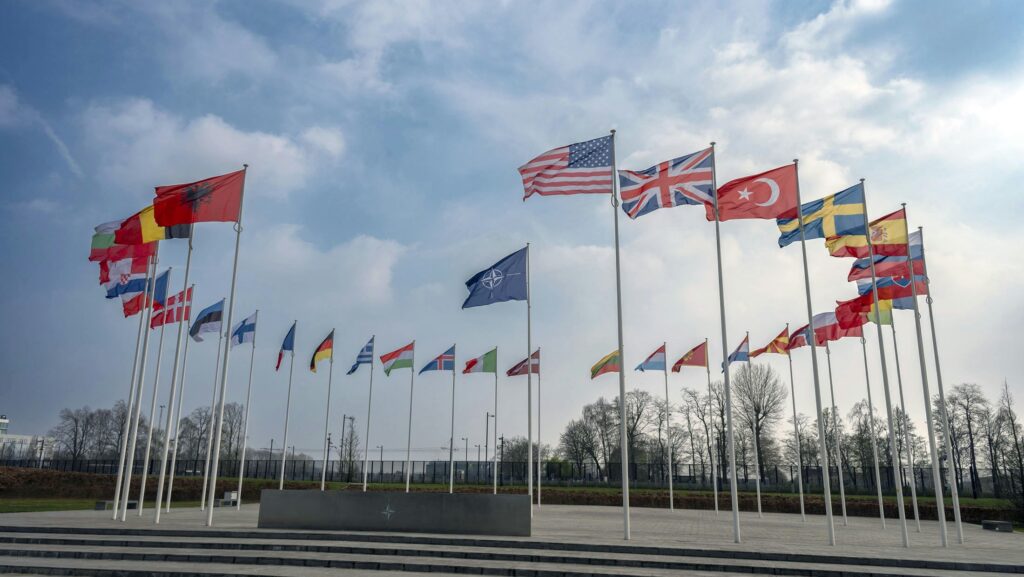
NATO headquarters in Brussels with 32 flags
NATO
Alliances are often described in moral language. They are portrayed as communities of shared values, mutual loyalty, and common destiny. Political leaders invoke solidarity; commentators speak of unity. Yet the historical record suggests a more sober reality. Alliances are rarely governed by sentiment. They are governed by interest.
This simple observation has been made evident by statements by the U.S. president Donald Trump and his cabinet since his comeback to the White House. He has been very clear about the priority of U.S. national interest in a way that has gone beyond rhetoric into action. On trade wars, on Venezuela, on Greenland—and now on Iran. Trump today demands European support—whether in the form of allowing U.S. planes to use military bases on European soil or with the reopening of the Strait of Hormuz—and even threatens Europe to leave Europe alone defence-wise, to exit NATO, to do nothing regarding the energy crisis that the joint U.S.-Israeli attack has produced, etc. In light of these circumstances, and delving into the overall refusal of European leaders to be drawn into this war, it is worth noting that the U.S. itself has repeatedly declined to support its allies in conflicts that fell outside the narrow framework of collective defence. A point that also opens the door to a deeper reflection about how alliances actually function—and who benefits from them.
For nearly eighty years, the United States has stood at the centre of the Western alliance system. Washington’s military might, economic weight, and global reach made it the organising power of the international order that emerged after the Second World War. From NATO to the Bretton Woods institutions, the architecture of the post-war world reflected American leadership.
Yet hegemony produces a curious paradox. The hegemon often sees itself as the power carrying the greatest burden within the alliance. It is the country that deploys the most troops, spends the most on defence, and assumes responsibility for maintaining stability. In American political discourse, this perception has become almost axiomatic: the United States is frequently described as the guarantor of global order, the reluctant sheriff of the international system.
And in many respects, this is true. But another reality exists alongside it. The hegemon is also the country that benefits the most from the system it leads. The security architecture; the economic arrangements—the U.S. dollar monopoly as the world’s reserve currency; and the political norms that define the international order are all shaped in ways that reflect its interests. The burdens of leadership are real—but so are the advantages.
In other words, both things can be true at the same time. The hegemon carries the system, but it also profits from it. Understanding this dual reality is essential for interpreting the history of Western alliances.
Throughout the Cold War and the decades that followed, many American allies supported Washington’s strategic objectives even when their own immediate interests pointed in a different direction. They did so not out of blind loyalty but because maintaining good relations with the hegemon was a long-term strategic investment. The stability of the alliance system, the credibility of security guarantees, and the economic benefits of integration all depended on preserving that relationship.
Yet the same history also reveals that alliances rarely override national interest. States cooperate when their interests converge and diverge when they do not. The Western alliance system has never been an exception.
Consider the case of France’s war in Algeria. Between 1954 and 1962, France fought a brutal counter-insurgency campaign against the National Liberation Front in Algeria. At the height of the conflict, nearly half a million French troops were deployed to a territory that Paris regarded not as a colony but as an integral part of the French Republic.
Yet the United States offered only limited support to its ally. President Dwight D. Eisenhower, and, later, John F. Kennedy increasingly viewed decolonisation as inevitable and believed that colonial wars risked pushing newly independent states toward the Soviet Union. Kennedy himself had criticised French policy as early as 1957 in a speech in the U.S. Senate, arguing that Western credibility in the Cold War depended on recognising the legitimacy of nationalist movements.
A similar pattern could be observed in the Turkish invasion of Cyprus in 1974. On July 20th of that year, Turkey launched a large-scale military intervention on the island of Cyprus following a coup backed by the Greek military junta. The operation—known as Operation Attila—resulted in the occupation of roughly a third of the island and the creation of the Turkish Republic of Northern Cyprus, a political entity recognised only by Ankara.
Despite Turkey’s status as a NATO ally, the United States did not intervene militarily. Washington instead pursued diplomatic mediation and later, in 1975, imposed an arms embargo on Turkey. The episode demonstrated that alliance ties did not automatically translate into military solidarity. American policymakers were primarily concerned with preserving stability within NATO and preventing escalation between two member states.
In both cases, alliance solidarity yielded to broader strategic calculations. As it did with Spanish Sahara in 1975, as it did recently with U.S. support of Morocco’s interests in Western Sahara over Spain’s. As it did again in 2022.
The most dramatic example of this dynamic, however, occurred during the Suez Crisis. On July 26, 1956, Egyptian president Gamal Abdel Nasser announced the nationalisation of the Suez Canal, a waterway that had long been controlled by British and French interests. The decision threatened not only economic stakes but also the strategic prestige of two European powers that had dominated the region for decades.
In response, Britain and France secretly coordinated with Israel to retake the canal. Israeli forces invaded the Sinai Peninsula on 29 October 1956, and British and French forces began bombing Egyptian targets on 31 October.
Yet the decisive actor in the crisis was not London or Paris—it was Washington. President Eisenhower strongly opposed the intervention. Concerned that it would destabilise the Middle East and drive Arab states toward the Soviet Union, the United States applied intense diplomatic and financial pressure on its allies. Washington even threatened to destabilise the British currency by selling U.S. holdings of sterling. Faced with the prospect of economic collapse, Britain accepted a ceasefire on November 6.
The crisis revealed a geopolitical truth that could no longer be ignored: Britain and France could not act independently of American power. As many historians have noted, Suez marked the moment when the centre of gravity within the Western world shifted decisively across the Atlantic.
The United States had become the hegemon of the alliance system. Later episodes reinforced the same lesson. During the Malvines or Falklands War, which began when Argentina claimed sovereignty over them on 2 April 1982. Washington initially attempted to mediate between Buenos Aires and the United Kingdom. Secretary of State Alexander Haig undertook an intense diplomatic mission to prevent the war.
Only after these efforts failed did the United States provide logistical and intelligence support to Britain, and even then, it stopped short of direct military involvement. Today, paradoxically, the U.S. may prove instrumental in pushing for Argentina’s dominance over the archipelago over Britain’s.
Two decades later, the Iraq War of 2003 revealed the inverse dynamic, for the interested party in this case was the hegemon. When the United States launched its invasion of Iraq on 20 March 2003, several European allies opposed the intervention—France and Germany in particular refused to participate. Yet despite these disagreements, the alliance endured, and United They Stood. Many NATO members allowed the United States to use bases on European territory to support the war effort. And over 1,100 European soldiers died in support of their U.S. ally in Afghanistan and Iraq.
In most cases it has not been the United States that subordinated its interests to those of its allies, but the other way around. European countries have repeatedly supported American strategic initiatives—even when their own immediate national interests might have suggested a different course of action. That is, of course, if one discounts a fundamental feature of hegemonic systems—i.e., unipolar world orders. Namely that maintaining good relations with the dominant power is itself a strategic investment. For decades, European governments accepted short-term costs or policy divergences because alignment with the sole hegemon of the international system promised stability, security guarantees, and economic benefits over the medium and long term.
For decades, this logic reinforced American leadership. But the strategic environment in which that leadership operates is now changing. The war with Iran and the growing tensions surrounding the Strait of Hormuz may illustrate just how much.
The strait is one of the most important maritime chokepoints in the world. Or it was, until last month. Roughly one-fifth of global oil shipments passed through its narrow waters. Today, disruption to navigation is having—and will have long-term—immediate and significant consequences for the global economy.
Yet the significance of Hormuz may extend beyond energy markets. If the current confrontation escalates—or even carries on in its current shape—the crisis may become a geopolitical moment comparable to Suez. Not because the situations are identical, but because both involve strategic chokepoints that reveal deeper transformations in the structure of power.
In 1956, the Suez crisis demonstrated that Britain and France were no longer the dominant actors in global politics. Their ability to shape events had become dependent on American approval.
Today, the international system is again undergoing a transition. The United States remains the most powerful country in the world. Its military capabilities, technological advantages, and network of alliances are unmatched. But it now operates in a world where other major powers—particularly China—possess growing economic and geopolitical influence. Regional actors pursue increasingly autonomous strategies, and global politics has become more fragmented.
In such a context, a crisis in Hormuz could illuminate an emerging reality: the United States is still a hegemonic power, but it is no longer the uncontested hegemon of a unipolar world.
It is a hegemon operating within an increasingly multipolar system. The implications are profound. Just as Suez forced Britain to recognise the limits of its imperial power, Hormuz may force the international community to recognise the limits of American primacy. The alliance system will not disappear overnight, but it may gradually evolve as other powers adjust their strategies to a more complex distribution of power. Especially if the U.S. (and Israel) are the countries that shut Hormuz down and it is European or Chinese soft power that reopens it—an invitation that, surprisingly, Trump has himself extended.
Alliances will continue to exist. National interests will continue to shape them. But the era in which a single country could define the strategic horizon of the entire Western world may be drawing to a close.
And if that moment comes, historians may one day look at the Strait of Hormuz much as they now look at the Suez Canal—not merely as a strategic waterway but as a symbol of a changing world order.