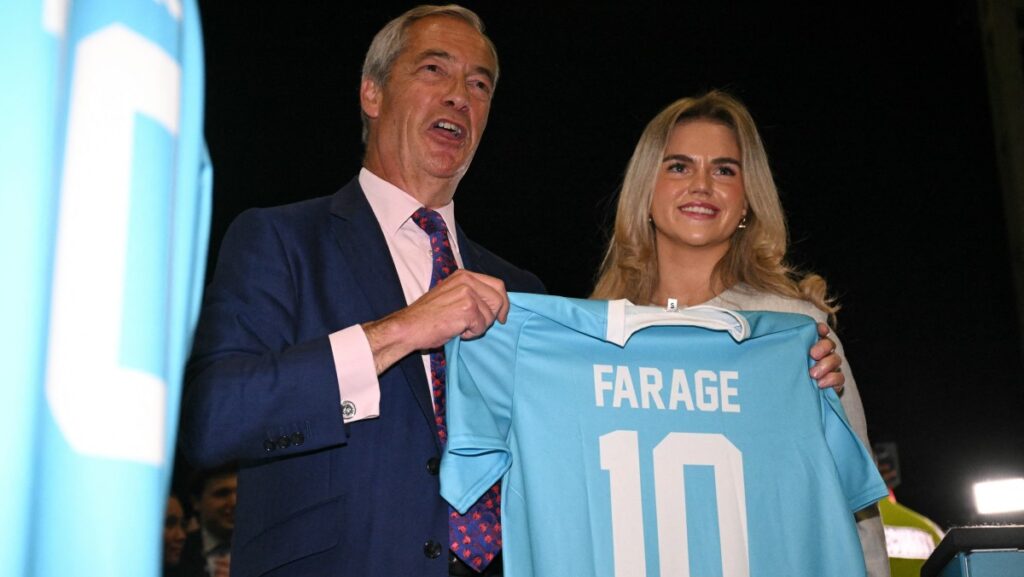
Reform UK Leader Nigel Farage poses with a football shirt with his name on during the second and final day of the party conference at the NEC Birmingham, central England, on September 6, 2025.
Oli Scarff / AFP
British politics has experienced a turbulent few weeks: an anti-migration mass protest mobilised an unexpected crowd of 150,000 people in London; two symbolic Conservative politicians defected to Reform UK; and Scottish First Minister John Swinney announced that he would seek a new independence referendum for Scotland. In addition, the two traditionally governing parties, Labour and the Conservatives, are now polling at 20% and 16%, respectively, while Reform UK has 31% support across the country.
These are all signs of a major transformation in the British political landscape—which may never return to the way we once knew it.
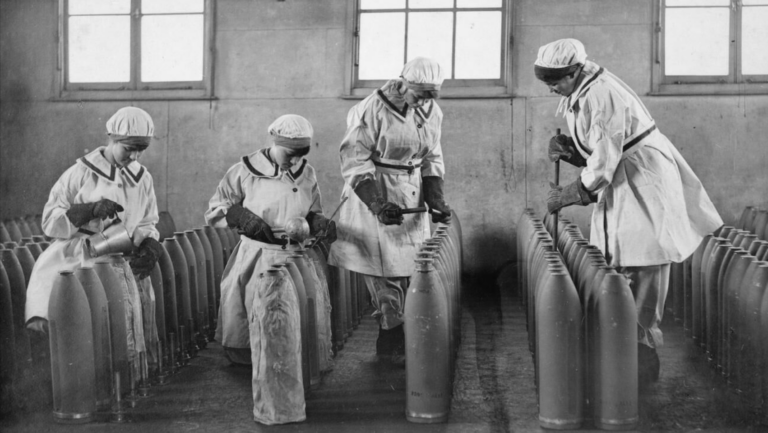
As much as it is unexpected, overtaking the two legacy parties is not unprecedented in British history. Something similar happened a century ago. Between the establishment of the constitutional monarchy in the 1600s and the First World War, politics was mostly defined by the alternation of Whig (Liberal) and Tory (Conservative) governments. Then, over a short period of time, the Liberals lost ground, and the Labour Party, a new political force not part of the political elites and establishment, took its place. Ever since, for over a century, Labour and Conservative governments have alternated. We are now, however, likely witnessing a historical transformation of the UK political system, with Reform UK potentially replacing the Conservatives.
Unemployment, the shadow of war, inflation—major problems that spark social discontent today in the UK, exactly as they did 100 years ago. Nigel Farage’s Reform UK appeals to the middle class and fuels the narrative of representing people who feel unheard. He labels his movement anti-establishment, challenging the elites of Westminster and Brussels. Similarly, at the time of their initial rise, Labour gained substantial support from middle-class workers who, enfranchised during WWI, were then eager to back the anti-elite new actor in politics.
The main reasons for such disillusionment were and are not only inefficiency in managing crises and challenges (e.g., war then and migration now), but symbolic scandals (e.g., the 1922 Cash-for-Patronage scandal of Liberal leader David Lloyd George, or recently the 2022 sexual harassment scandal of Chris Pincher, the Conservative deputy chief whip, or Partygate, when Tory leaders held gatherings at Downing Street despite COVID restrictions). Though less politically significant, these cases remain vivid in public memory and emblematic for disillusioned voters.
A few days ago, MP Danny Kruger declared that the Conservative Party is over and the real conservatives of Britain, who want to save the country, have to join Reform. Kruger—former speechwriter of David Cameron, political secretary of Boris Johnson, and a campaign veteran—had been regarded as an intellectual mastermind of the Tories with a philosophical-moral knowledge of what conservatism is, as well as a political ‘operator.’ Just one day after Kruger’s departure, former minister Maria Caulfield announced her decision to leave the Conservatives and join Reform, saying, “If you are Conservative right-minded, then the future is Reform.”
This defection wave is different from previous business-as-usual moves, as this time, well-known figures with crucial political networks are joining Farage. In comparison, in the 1910s, the Liberals faced similar challenges over internal divisions—the most remarkable of which was the split between supporters of H. H. Asquith and David Lloyd George. Internal divisions are normal in times of crisis; nevertheless, when they are visible to voters, citizens tend to punish disunity.
Reform UK, formerly the Brexit Party, started out as a single-issue protest party but managed to escape this label and become a popular front even post-Brexit by expanding its advocacy to all major policy areas. Likewise, a century ago, Labour was viewed as a class-based party exclusively for the blue-collar working class, but it quickly consolidated its role as the party for all leftist voters.
The transition from a single-issue movement to a nationwide party is gradual. A century ago, Labour gained local councils before forming a government, building strength in industrial towns and municipalities. Reform did not achieve good results in the last parliamentary elections, in 2024, but performed much better in the local elections in spring 2025, gaining 677 council seats (compared to 319 and 98 for Conservatives and Labour, respectively). Rapid growth of party membership is also a common point: in their time, Labour managed to gather a great number of members mostly through trade unions, while now, Reform’s membership (240,000) overtook that of the Conservatives (123,000). Such local success and rising party membership are usually strong indicators of a potential national breakthrough in the upcoming parliamentary elections.
In order to beat traditionally established, socially embedded, centuries-old, and financially stable parties, a new political movement needs a face—a charismatic figure that people can remember and follow. Reform UK has Nigel Farage for that role—an often provocative but by no means boring character, who first made Brexit his flagship policy and then formulated a clear vision of solving the migration issues of the country. Once known for his half-joking videos recorded in the corridors of the European Parliament, he has now made it all the way to the Oval Office to meet Trump.
Labour also had a charismatic leader when it rose: Ramsay MacDonald, who was the leader of the party and then the prime minister of the first Labour government. Just like Farage styles himself as an ‘outsider’ in politics, MacDonald came from a poor working-class family—he was an illegitimate son of a farm labourer. MacDonald was distrusted and labelled as ‘radical’ by the mainstream at the time, similarly to Farage nowadays—and not accidentally, as the very essence of their success was and is that they both promote(d) ‘radical’ views of their times.
It seems inevitable that British politics will be fundamentally transformed before our eyes. One possibility is that the well-known two-party system ceases to exist. After the local elections in May 2025, Nigel Farage himself declared that the result “marks the end of two-party politics.” In this scenario, Reform gets stronger, but Conservatives manage to keep some centre-right voters (predominantly in the countryside). On the Left, it is unclear whether Labour can keep leftist voters (mostly in urban areas) or if they also lose some of their electorate to, for example, Jeremy Corbyn’s new left-wing “Your Party.” This multi-party option can only become reality if parties’ voters are geographically concentrated, rather than being generally popular across the UK. Even in this case, after a period of political disintegration, it might gradually return to a system dominated by two major political forces over time.
Another scenario is that Reform attracts the most right-wing voters, and the Conservatives gradually shrink to being a small party due to internal divisions, value crises, and electoral dissatisfaction. Labour Prime Minister Keir Starmer already said that Reform was their “real opposition.” The British have a First-Past-the-Post (FPTP) electoral system, which means that in each constituency, whoever wins the relative majority gets the mandate. The FPTP system tends to result in two-party systems, as voters might strategically vote for the big parties with a chance to win so that their votes are not ‘wasted’; and even if they don’t, FPTP results do not reflect the popular support of small parties unless their support is concentrated in specific districts. To put it simply: a party could finish second in every constituency, losing by just 1%, and still win no seats in Parliament.
Consequently, on the one hand, it is difficult for an outsider party, like Reform, to enter the race of the two large parties; on the other hand, if Reform gets large enough to become one of the two dominant parties, the system is likely to keep it in a dominant position. In short: if Reform wins the hearts and minds of right-wing voters and secures a breakthrough victory in the next elections, it has a great chance of replacing the Conservatives for good—and, with that, making history.