Greek Minister of Migration and Asylum Thanos Plevris initiated a crackdown in February 2026 to identify and shut down unlicensed or illegal places of worship, focusing heavily on the approximately 60 informal mosques in Athens and the wider Attica basin and promising to deport those responsible for operating them.
Authorities have linked the initiative to national security, citing concerns over extremist ideologies and past security challenges. Unlike in much of Europe, muftis and imams in Greece are appointed by the state, and funding from foreign governments is forbidden. It is partly for this reason that Greece does not experience Islamic terror attacks like much of Western Europe, despite there being over 300 mosques in the Western Thrace region on the border with Turkey and the Dodecanese Islands, where over 150,000 Muslims have resided since the time of Ottoman rule.
While Athens was once the only European Union capital without a mosque, the official Votanikos Mosque opened in 2020, without minarets or loudspeakers. Being able to accommodate only around 300 to 350 people, the Votanikos Mosque evidently cannot serve the 200,000 to 300,000 Muslims residing in Athens, contributing to why illegal mosques in basements, apartments, and warehouses popped up outside the control of the state.
Operating an unauthorized religious site is now a criminal offense under Law 5224/25, which can lead to prison sentences of 2–6 months and substantial administrative fines, while foreign nationals caught running such sites will have their residence permits revoked and face automatic deportation.
This legal framework is part of a wider campaign to crack down on illegal immigration, a major point of criticism against the ruling center-right New Democracy party, which has been in power since 2019 but has not taken serious action on this issue until Plevris became minister in June 2025.
However, according to Konstantinos Floros, an independent Member of Parliament, there is “no new policy of closing mosques,” and rather, there has been a legal framework since 2014 that requires every place of worship to be licensed and to operate under specific conditions.
He told europeanconservative.com that the current actions of Plevris “are essentially the implementation of that law. In other words, when spaces operate without a license, the state intervenes, inspects them, and, if found illegal, shuts them down”:
This is not about religion. It is about legality. It is also about the need for basic registration and oversight, because in these informal spaces, there is often no control whatsoever. Beyond that, it’s clear that this is linked to the broader management of irregular migration. But the core point remains: a law already exists and is being enforced.”
For his part, Dr. Ioannis Kolovos, author of several books on Greece’s immigration policy, sarcastically told europeanconservative.com that there has been an “epiphany” of some sort and highlighted that in “stark contrast” with the immigration policy it has followed for years, “New Democracy has appointed a hardliner as minister who resorts to harsh rhetoric and has introduced tougher legislation on failed asylum seekers.”
According to the Ph.D. in Political Science,
this sudden U-turn contrasts the pro-multiculturalism rhetoric of Prime Minister Kyriakos Mitsotakis, the generous granting of asylum to six out of ten applicants, the ex post facto legalizations of illegal immigrants, and the decreasing number of deportations, which have characterized all previous years. Plevris’ recent declaration that he will close down all illegal mosques is part of this recent hardening of the government’s stance.
The election forecast in November 2025 predicted New Democracy at 28.5% and on a downward trajectory, having lost the trust of the right wing by lagging on the migration issue. Yet, in the latest survey, the ruling party polled at 31.1%, with some voters recognizing that Plevris has taken the migration ministry in a different direction from his predecessors.
Nonetheless, skepticism remains, with Dr. Kolovos saying that “the fact that, for six whole years, the government did nothing on the issue should make us quite cautious”:
Moreover, the government has done nothing to change the essence of its immigration and asylum policy. The granting of asylum remains high, thereby rewarding those who enter Greece illegally. No annual limit has been set on the number of asylum applications Greece can handle, and the number of illegal immigrants entering the country remains many times higher than the number of those deported or repatriated. Thus, as far as immigration policy is concerned, the situation in Greece is still getting worse—maybe at a somewhat slower pace than in the past—but it is worsening nevertheless.
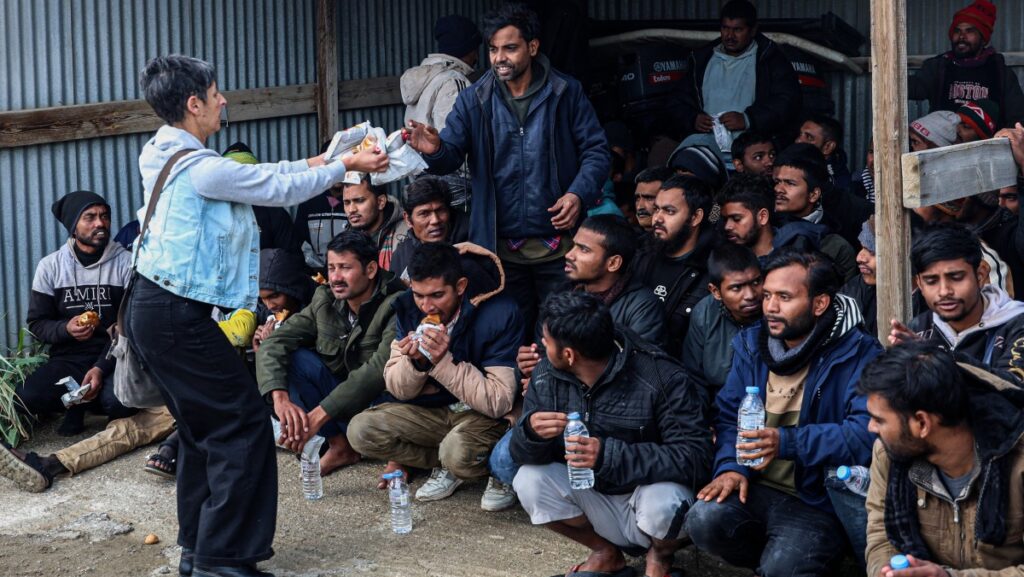
In 2025, Greece recorded approximately 48,298 illegal arrivals by sea and land, marking a 21% decrease compared to the 60,886 arrivals reported in 2024. However, the Hellenic Police carried out only 5,300 to 6,000 total returns and deportations throughout the year, indicating that Greece still faces a major imbalance between illegal migration and deportation.
For Dr. Kolovos, ahead of next year’s election and “in the absence of serious tangible improvement, the government resorts to token gestures like the closure of illegal mosques in an effort to stop hemorrhaging voters to right-wing anti-immigrant parties.”
“Most illegal mosques are mainly found in the Attica region, where most of the immigrant Muslim population lives. So far, the government has only closed down four from an estimated 60 to 80. I expect they will close a few more, just to keep the issue alive until the elections,” he continued.
Plevris announced on March 28 that a fourth mosque had been shut down, and the Bangladeshi migrant responsible for its operation was in the process of having his visa revoked and being deported. Although the closure of illegal mosques is widely supported, it is unlikely to satisfy lost right-wing voters, who are demanding that deportations increase and borders be more strictly sealed.
Floros explained that New Democracy is making “consistent efforts” to reconnect with parts of the right-wing electorate it has lost, mainly through its foreign and defense policy. He points to “tangible results” achieved by the ruling party, particularly in reducing tensions in the Aegean “without making concessions on sovereignty or sovereign rights, reinforcing alliances with key partners such as the United States, France, and Israel, and in implementing a substantial defense procurement program.”
However, the MP believes this is not sufficient to win back all right-wing voters:
The reality is that the right-wing space in Greece is currently fragmented and, in some ways, still expanding. That makes any full political reabsorption particularly difficult. At the same time, New Democracy does not appear to be pursuing an aggressive strategy to reclaim that space. Its approach seems more focused on containing political leakage to the right and keeping that space as divided as possible—which, to a certain extent, it has managed so far.
Dr. Kolovos, in the same vein as Floros, also does not believe that much of the lost right-wing vote will swing back to New Democracy, saying that there are “very low expectations.”
“This is due to the fact that New Democracy has already failed twice in keeping its election promises on immigration. In fact, they did the exact opposite of what they had promised. Thus, it would be unwise to expect much more than lip service from them,” he said, adding: “The majority of Greek voters appear to be able to see through the government’s window dressing.”
The academic concluded by pointing to a recent poll showing that two out of three Greeks favored an even stricter immigration policy, with that figure rising to more than seven out of ten among New Democracy voters.
New Democracy has data showing that the overwhelming majority of Greeks support stricter immigration policy, including voters of the left-wing main opposition party PASOK, the left-wing Course of Freedom, and the Communist Party of Greece. Although the closure of four illegal mosques and the intended deportation of those operating the sites are proving to be immensely popular, ultimately, New Democracy will only have a chance of regaining lost voters when all such places of worship are shut across the country and deportations outnumber illegal arrivals—something that appears unlikely ahead of next year’s election.