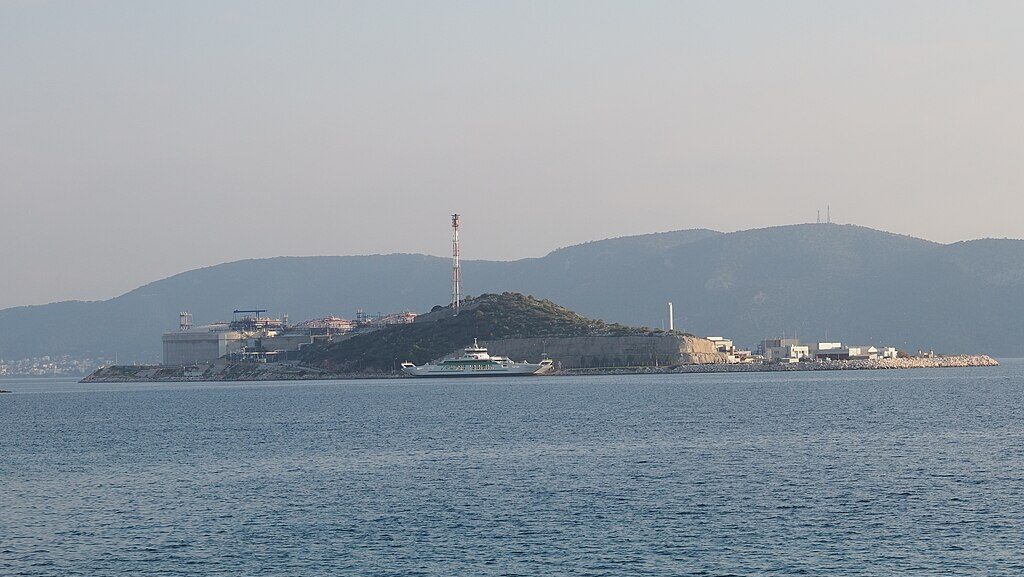
Revithoussa, once an unremarkable LNG terminal, has become one of Europe’s busiest entry points for non-Russian LNG.
C messier, CC BY-SA 3.0, via Wikimedia Commons
Europe’s rush to free itself from Russian natural gas has set off one of the most significant geopolitical shifts in decades. What began as a hurried response to a wartime emergency has become a far-reaching reconsideration of the continent’s energy foundations: where Europe gets its energy, how it travels, and which countries can be counted on when it matters most.
Amid this upheaval, Greece has stepped into a role few saw coming. Long viewed as a country on Europe’s margins, it now sits at the center of the continent’s new energy geography. This rise is not a stroke of luck. It reflects a blend of qualities that Europe needs more than ever: a strategic crossroads between continents, a stable political environment, respect for international law, and years of investment in infrastructure that is suddenly indispensable.
Together, these strengths give Europe something it has lacked for far too long: a dependable anchor on its southern flank. And Greece’s emergence is now reshaping not only Europe’s energy map but also the wider strategic balance across the Eastern Mediterranean.
Russia’s invasion of Ukraine did more than disrupt supply lines. It shattered the illusion that Europe could rely on a single, increasingly aggressive supplier without consequences. The belief that trade would soften Moscow’s behavior evaporated overnight, leaving European leaders to rethink the entire structure of their energy system.
In the search for alternatives, one lesson became clear: securing new suppliers is not enough. Europe also needs trustworthy transit states, countries that provide stability instead of risk, predictability instead of sudden political storms.
This realization pushed the Eastern Mediterranean back onto Europe’s strategic radar. A region often known for disputes and competing interests suddenly became crucial to the continent’s long-term energy security. And within that region, Greece stood out, not just for its location but for its reliability at a time when unpredictability had become the norm.
Athens, once overlooked, was now an asset Europe could not afford to ignore.
Greece’s growing roster of high-profile partnerships is among the clearest signs of its evolving role—none more symbolic than the agreement with ExxonMobil to explore offshore hydrocarbon fields in the Ionian Sea and south of Crete.
The commercial outcome remains to be seen, but the geopolitical message is unmistakable.
A major American energy giant operating in Greek waters demonstrates Washington’s confidence in Athens at a moment when the United States is prioritizing stable, rule-abiding partners in sensitive regions. This partnership strengthens Greece’s ties with Israel and Cyprus, reinforces its maritime rights under international law, and elevates the country from a simple transit corridor to a potential energy producer.
In essence, the ExxonMobil deal marks a moment where Greek national strategy and Europe’s long-term energy needs converge.
Diplomacy sets the stage, but infrastructure decides the outcome. Greece has spent the past decade quietly building the physical network that now allows Europe to redirect its energy flows with unprecedented flexibility.
Revithoussa, once an unremarkable LNG terminal, has become one of Europe’s busiest entry points for non-Russian LNG. Its expanded capacity allows Greece to bring in large volumes from the United States, Qatar, and other global suppliers, precisely when Europe needs alternatives the most.
Further north, the Alexandroupoli Floating Storage and Regasification Unit (FSRU) has emerged as a lifeline for the Balkans. It channels LNG directly into the networks of Bulgaria, Serbia, and North Macedonia, giving these countries a credible escape from their historical dependence on Russian pipelines.
For southeastern Europe, this represents one of the most important energy shifts in a generation.
Greece’s LNG capacity is just one part of the story. The Trans Adriatic Pipeline (TAP), crossing northern Greece, brings Azeri gas into Europe—another essential source of diversification. The Interconnector Greece–Bulgaria deepens this impact, giving smaller states new leverage and independence.
Taken together, these projects do more than diversify supply. They elevate Greece from a passive participant in Europe’s energy system to a central player shaping its future.
Greece’s infrastructure success is intertwined with a broader diplomatic transformation. What began as a handful of bilateral partnerships has become a coherent regional framework linking Greece, Cyprus, Egypt, and Israel.
These countries share more than geography. They share an interest in stability, maritime law, and resisting destabilizing behavior in a challenging neighborhood. Together, they form a dependable corridor that connects North Africa and the Levant directly to Europe.
Egypt already sends LNG to Europe through Greek waters, but cooperation is deepening. The GREGY interconnector—which will bring Egyptian renewable energy straight to Greece—could make Athens Europe’s gateway for North Africa’s emerging green power exports.
The Great Sea Interconnector is set to link the electricity grids of Israel, Cyprus, and Greece to the broader European system. This project ends Cyprus’s decades-long energy isolation and reinforces Greece’s position as the region’s main energy conduit.
Israel’s gas reserves give it remarkable export potential. Greece provides the safest and most reliable path into Europe. Their cooperation—already strong in defense and technology—now forms a strategic backbone for the wider region.
Through these partnerships, Greece has become a central force for cohesion in an area long defined by fragmentation.
The Eastern Mediterranean is a region where alliances shift quickly, waters are contested, and geopolitical rivalry is constant. In this environment, Greece has emerged as a steadying presence. Its stability is not just an asset; it is a necessity for Europe.
Energy security requires predictability, and that predictability depends on states that respect the rules, honor agreements, and maintain steady governance. Greece’s blend of institutional maturity, credibility, and strategic location provides Europe with exactly that foundation.
This has allowed Europe to anchor its southern frontier in ways that were unimaginable only a decade ago.