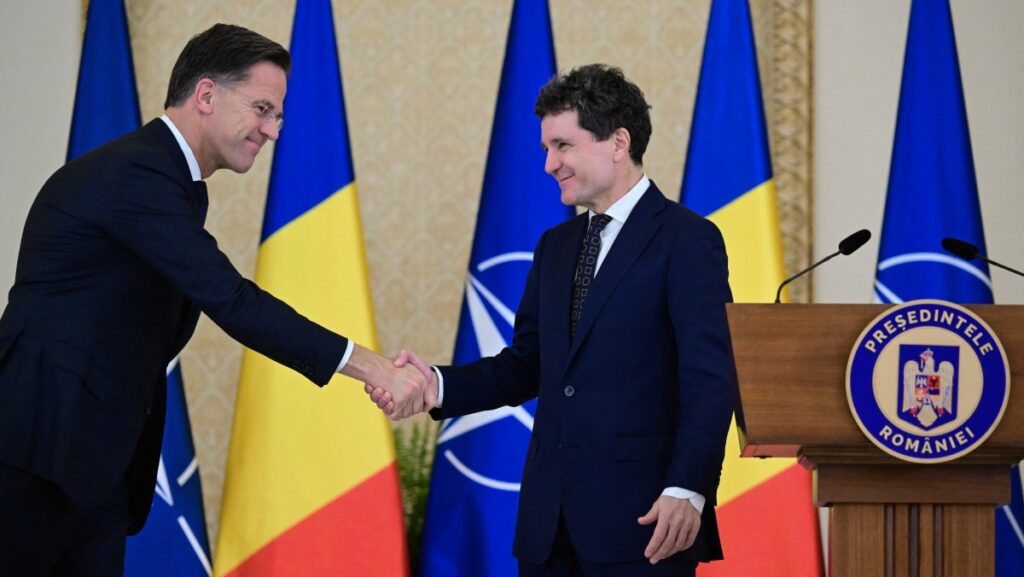
NATO Secretary General Mark Rutte and Romanian President Nicusor Dan (R) shake hands following a press conference at the presidential Cotroceni Palace in Bucharest, Romania, on November 5, 2025.
Daniel MIHAILESCU / AFP
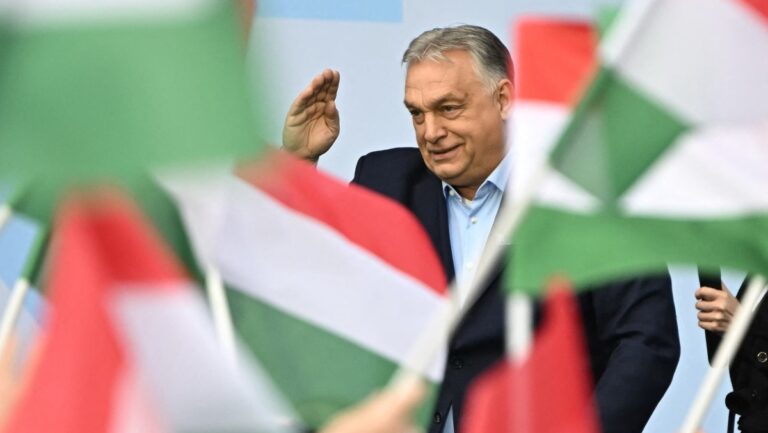
Viktor Orbán’s recent visit to the United States offered far more than diplomatic choreography. It reaffirmed a reality that has become increasingly visible: Hungary has developed a coherent foreign policy doctrine, one that gives Budapest more influence. Whether applauded or criticized, Hungary’s message is clear, and at a time when European politics is marked by hesitation, clarity has become a form of power.
What continues to distinguish Orbán from many European leaders is his willingness to speak openly what others only hint at. From the early weeks of the war in Ukraine, Orbán insisted that Europe needed a realistic peace strategy. Long before terms like ‘strategic patience’ or ‘negotiated outcome’ entered European debate, Orbán warned that a ‘permanent war’ mindset risked eroding Europe’s long-term stability. At the time, he was criticized; now, many of the arguments he raised are quietly gaining traction in European policy circles.
Orbán’s position on peace is not improvisation. It is rooted in Hungary’s geopolitical identity. For him, national interest is not a slogan but a practice. Hungary’s security depends on clear borders, cultural continuity, and energy autonomy—objectives that cannot be secured if the region remains locked in an open-ended conflict. The resulting foreign policy merges realism with conviction, standing out in a European environment where many leaders speak in cautious, bureaucratic language.
This clarity has earned Orbán a distinct audience in Washington. American conservatives increasingly view Hungary as an example of unapologetic sovereignty. They recognized something rare in contemporary politics: a leader who operates from a doctrine rather than reacting to events. His early skepticism of an indefinite war strategy in Ukraine and his insistence that Europe must think in terms of geography, not ideology, now resonate in think tanks and behind closed doors among diplomats who quietly acknowledge that ‘victory maximalism’ was never fully credible.
If Hungary offers strategic clarity, Romania sits at the other end of the regional spectrum. By size, geography, and strategic relevance, Romania should be one of the defining voices of Europe’s Eastern flank. Yet its foreign policy remains remarkably restrained. Bucharest is meticulous, dependable, and almost entirely silent. It aligns with allies but rarely influences the decision. It participates in every forum but seldom proposes anything new. It supports initiatives but hesitates to lead them.
Despite internal challenges, other countries articulate clearer strategic identities. Poland continues to speak firmly on defense and deterrence. The Czech Republic projects a stable pro-Western stance. Slovakia produces distinct ideas on Ukraine, energy, and EU reform. Romania, by contrast, remains the only major state whose strategic profile is defined more by absence than assertion.
This reluctance is becoming costly. The war in Ukraine has repositioned Europe’s strategic center of gravity. The stability of the Black Sea, Moldova’s trajectory, NATO’s posture, and future reconstruction efforts all hinge on Romania’s geography. And yet, the political class in Bucharest treats foreign policy as a matter of administration rather than strategy, technical management rather than long-term thinking. Romania lacks the narrative and confidence to turn those assets into influence and relevance.
While Romania is obedient, Hungary fills the regional vacuum not because it is the most powerful state, but because it has the confidence to speak when others hesitate. Whether one agrees with Orbán’s positions or not, they exist clearly and consistently. Romania’s positions, when visible at all, tend to resemble commentary on decisions made elsewhere. The problem is not capability but reluctance: a hesitation to turn structural strengths into diplomatic weight.
In this context, Orbán’s assertiveness is remarkable not only for its content but for its rarity. He understands that influence in Europe belongs to those who articulate ideas, not those who wait for consensus.
The next decade will be decisive for Central and Eastern Europe. Those who define the language of security, peace, and sovereignty will shape the political architecture of the region. And it is obvious that Viktor Orbán has already chosen to be one of the architects.