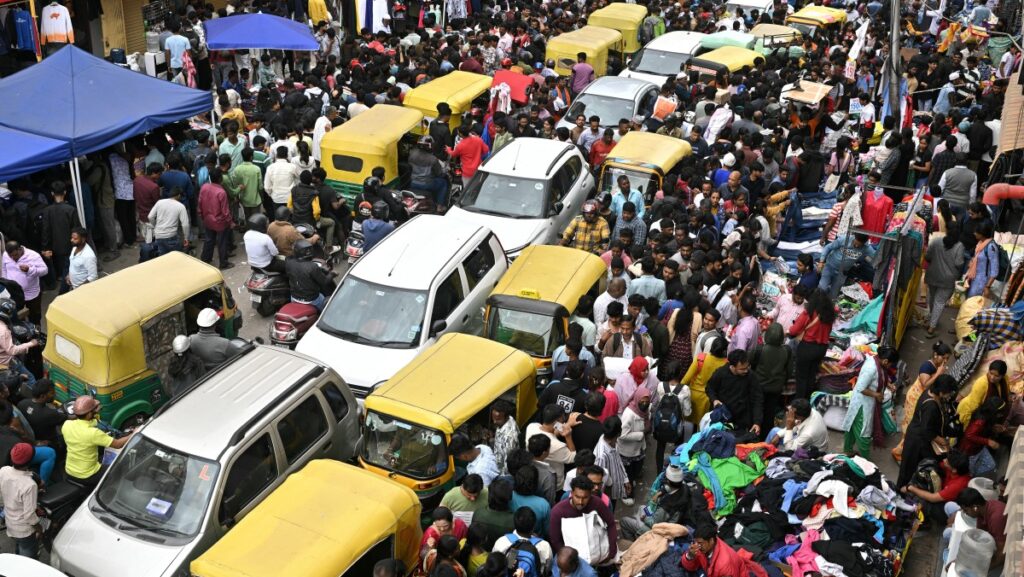
People gather to shop amidst traffic at Chickpet market in Bengaluru on January 11, 2026.
Idrees MOHAMMED / AFP
Back in 1991, when the United States led Operation Desert Storm against Iraq, the Iraqi leader declared that the conflict was the ‘Mother of all Wars.’ A joke was quickly coined by American TV comedians, showing a door opening to Saddam Hussein’s war room and a pizza delivery driver asking, ‘Now, who ordered the mother of all pizzas?’
Since then, the ‘mother of all’ moniker has been used to aggrandize everything from sports challenges to business sales. Now it is being applied to economic affairs. European Commission President Ursula von der Leyen calls the new trade agreement between the EU and India “the mother of all deals.”
European Council President Antonio Costa reinforced the spectacular image of the deal, emphasizing that it has “created a free trade zone of two billion people, with both sides set to benefit.”
Free trade is always good, especially when it takes place on a level playing field where one side does not take advantage of the other. I have no doubt that both India and the EU have gone into this ‘mother of all deals’ with the best of intentions; as far as India is concerned, we have good reasons to believe they will honor their side of the agreement. A country with a rich cultural history, India has a growing, evolving economy and a political system that is often characterized as the world’s largest democracy.
I would be more concerned about the EU end of this trade deal; it might be a good idea for Costa to temper his expectations. The European Union is at its best when it declares major deals, agreements, and institutional expansions, but its history since the Maastricht Treaty in 1992 is littered with grand, imploded ambitions.
Originally, the EU was supposed to collect all transnational competencies from the European Communities under one hat and pave the way for four freedoms to flourish in Europe: of goods, services, labor, and capital. Then they built the current bureaucratic superstructure that cranks out regulations and twists member states’ arms to discourage member state vetoes.
Brussels even seems to want its own military, something that was unthinkable back in the 1990s, when the EU was born.
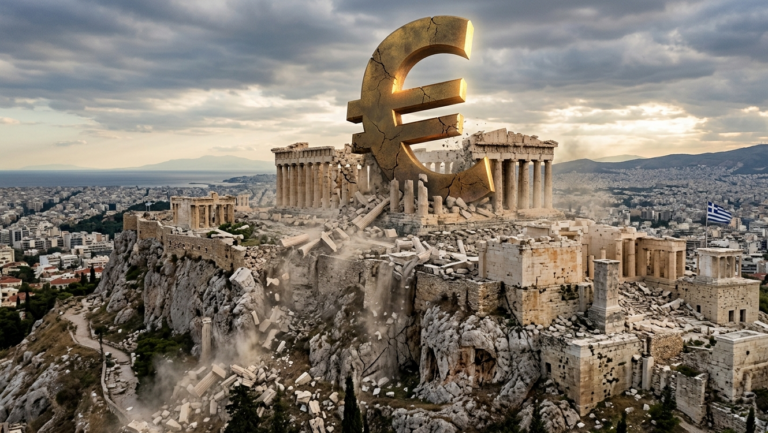
On the economic front, the Stability and Growth Pact (SGP)—enshrined in the EU Charter—was rendered meaningless the first time it was confronted with an excessive member state budget deficit, the very situation the SGP was created to prevent. The euro was minted as an anvil-solid, reliable reserve currency alternative to the dollar. Within a decade, the EU had destroyed the reserve currency argument by spearheading the reckless fiscal assault on Greece.
To get the Mercosur deal done, the Eurocracy has tried with increasing fervor to circumvent what limited democracy there is in the structure of EU governance.
In short, India is well advised to be vigilant and on the lookout for signs that the EU might be trying to modify its commitments to this deal.
With that said, there is little doubt that the Indians are the real winners here. The official story from Brussels is, of course, a bit different; EU Business reports:
While the EU and India already trade over €180 billion worth of goods and services per year, supporting close to 800,000 EU jobs, the trade deal is expected to double EU goods exports to India by 2032 by eliminating or reducing tariffs in value of 96.6% of EU goods exports to India. Overall, the tariff reductions will save around €4 billion per year in duties on European products, says the Commission.
Currently, the EU-India trade is worth €114bn per year. This deal will most certainly secure current trade, and it will very likely lead to some expansion. However, that expansion will not be to the benefit of the EU.
India has a GDP per capita that is 5-6% of what it is in Germany and France, Europe’s two largest economies. This is an enormous difference in purchasing power; even though India’s total population is closing in on 1.5 billion, the markets for European products are strictly limited. To compete on a broad scale with domestic producers, European goods manufacturers would have to water down their products to such an extent that it would effectively mean developing a new line of product.
To take the car industry as an example—it is one thing to sell Audi, Mercedes, and BMW to the small niche of the Indian auto market where the nation’s wealthy bring their money. It is quite another thing to compete in the mass market, where the best-selling model sells for a price around €9,000. For comparison, a Renault Twingo, which is smaller and simpler than the Mahindra FRONX that leads the Indian market, sells for about €17,500 in France.
If we put this price comparison in the context of India’s annual GDP per capita, which according to TradingEconomics.com currently stands at approximately €2,600, we get a price-to-income ratio that gives no room in average Indian household budgets for cars produced at European manufacturing costs. This restricts not only the market that Europe’s car manufacturers can compete on but the market for most of Europe’s goods industries.
But how does this conclusion compute with the fact that Europe already trades with India?
As far as manufacturing is concerned, Europe has likely already reached its top on the Indian market. Reduction or even removal of tariffs will push sales volumes somewhat, but due to the astronomical difference in production costs, that push will, generally speaking, never be more than marginal.
Things may look different when it comes to trade in services. According to the World Trade Organization, in 2024, services accounted for 37% of India’s total imports, equal to $268 billion. In 2024, exporters in the European Union sold services to India to the value of $30.5 billion; this 11.4% share has a greater potential for growth than goods trade.
There are two reasons for this, the first of which has to do with the nature of services production. It is associated with much lower fixed costs than production of goods. Since it is easier for a business to change its flexible costs in an adaptation to new markets, there is simply greater potential for market-specific cost adjustments.
Second, Europe has a relatively high level of competence in the production of professional services. Although statistics from the World Trade Organization do not specify exactly the professional categories of most of the EU’s current services exports to India, it is reasonable to assume that engineering consultancy will win some more export revenue in coming years.
With the dramatic differences in production costs and purchasing power between India and the EU, economic logic dictates that India stands to gain most from this deal. They will be able to flood Europe with cheap cars, industrial equipment, agricultural vehicles, and pharmaceutical products. The European domestic industry is in for a rough ride; ironically, perhaps the greatest competition to Indian products on European markets will come not from domestic producers, but from Chinese exporters.