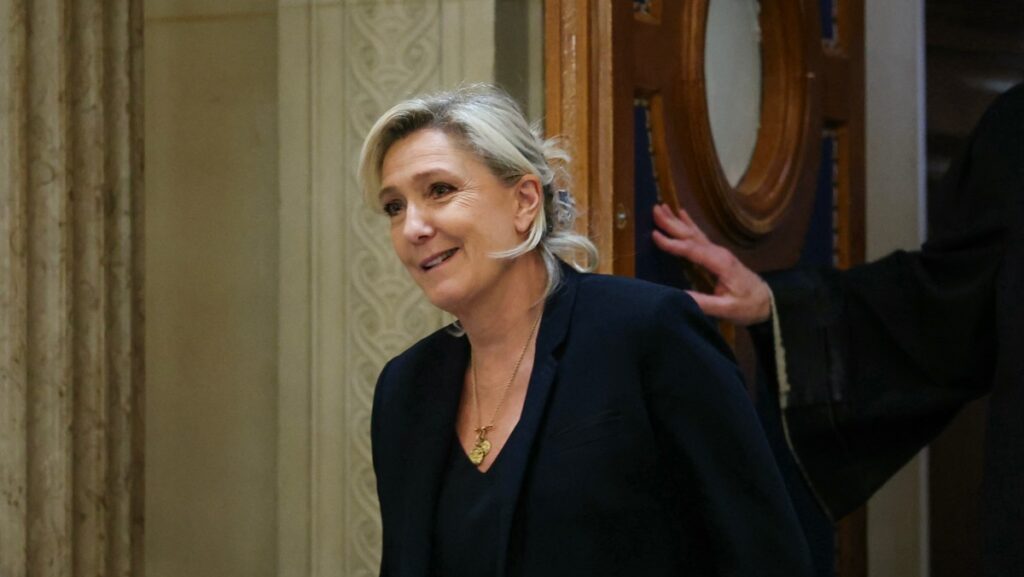
President of Rassemblement National (RN) parliamentary group Marine Le Pen leaves during a break in the defense’s closing argument in the appeal trial at the Palais de Justice in Paris on February 4, 2026.
ALAIN JOCARD / AFP
After a long afternoon of closing arguments in Marine Le Pen’s appeal trial over the European parliamentary assistants’ case, the advocates general ruled in favour of upholding the sentence handed down in the first instance a year ago against the leader of the Rassemblement National (RN) MPs—albeit with some nuances. The final verdict will not be known for several months, but Marine Le Pen’s chances of being able to stand in the 2027 presidential election are steadily dwindling.
At the end of the three-week appeal trial, the prosecution sought a four-year prison sentence for Le Pen, including one year without parole, which could be served with an electronic tag, and five years of ineligibility. However, unlike the first-instance conviction, no provisional enforcement was requested.
The issue of provisional enforcement was at the heart of the RN’s challenges to the first judgement, which saw the first-instance verdict as a deliberate attempt to prevent Marine Le Pen from running in the 2027 presidential election. The absence of provisional enforcement in the indictment is therefore ‘good news’ for the RN, according to RN spokesman Laurent Jacobelli, who appeared on the parliamentary channel Public Sénat on Wednesday, February 4th. “It proves that everything we said during the first stage of the trial was realistic,” said the MP. “It is clear that this line of defence was the right one.”
The party is making the most of every opportunity, but there is little cause for celebration. We must wait for the verdict—with “confidence, serenity and impatience,” in Jacobelli’s words—which is due this summer, but acquittal now seems highly unlikely. On the evening of February 3rd, Marine Le Pen acknowledged that she would not be a candidate in the presidential election if the prosecution’s recommendations were followed.
Apart from an acquittal, several scenarios are possible, as the indictment is only a recommendation and in no way a final judgement.
For Le Pen to be able to campaign, two conditions must be met. The first is that Le Pen be sentenced to a short period of ineligibility: two years instead of five. In that case, since she was first convicted in March 2025 with immediate enforcement, she would no longer be subject to this conviction at the time of the presidential election, as two years will have elapsed, and she would therefore be able to campaign. The second is that she does not receive a prison sentence, even one under electronic tag: it would be impossible to campaign, given the restrictions it entails—not to mention the disastrous image of a candidate in handcuffs, which the media would not hesitate to exploit against her.
If the conviction is upheld, Marine Le Pen and her party would still have one recourse: an appeal to the Court of Cassation to challenge the appeal court’s ruling. For the moment, the suspensive effect of the appeal to the Court of Cassation has not been clearly established. But it is difficult to see how someone facing a conviction of ineligibility, even if suspended, could launch a presidential campaign without damaging her or her party. This is particularly true given that the timetable in this scenario remains highly uncertain: if the Court of Cassation were to uphold her conviction on appeal a few weeks before the presidential election, when Le Pen would already be engaged in the campaign, the RN would risk finding itself without a candidate. It is for this reason that Le Pen has had to resign herself to acknowledging that, if the conviction is upheld, she will withdraw from the race—without, however, giving up her rights in the medium term.
The best summary of the situation was provided by Le Pen herself: “I am a believer, and I still believe in miracles.” But every believer knows that miracles are few and far between in the economy of Providence. At this stage, the scenario of Le Pen running for president is therefore almost certainly fading into the distance.
For the French Right, the shock is severe—though predictable. From a long-term perspective, it is dismaying to see how badly the electoral machine is jammed, ensuring that the Right never comes to power, ever since the cabal against conservative candidate François Fillon, who was conveniently embroiled in a legal scandal ahead of the 2017 presidential election.
For Le Pen personally, the blow is particularly hard—she who has been doing a long and thankless job, accumulating contempt, spittle, and opprobrium with uncommon endurance for more than thirty years, and now sees her efforts ruined at the very moment when attaining power appeared more within reach than ever before.
Faced with this situation, the only way to avoid sinking into nihilism and defeatism is, as the Le Pens have always done, to bounce back by seeking opportunities without ever admitting defeat. Not having the Le Pen name on the presidential ballot is also an opportunity, as it still carries with it apprehensions and myths. The alliance of the Right may be easier to achieve without the symbolic pressure of the Le Pen name. Finally, the political offensive to bring down Le Pen provides an extraordinarily powerful argument against the corruption of the system and its desire to prevent the Right from coming to power in France. The challenge now is to transform these opportunities, which are real but still theoretical, into concrete victories.